Why I Switched My React Projects to Feature-Sliced Design
Why I Switched My React Projects to Feature-Sliced Design
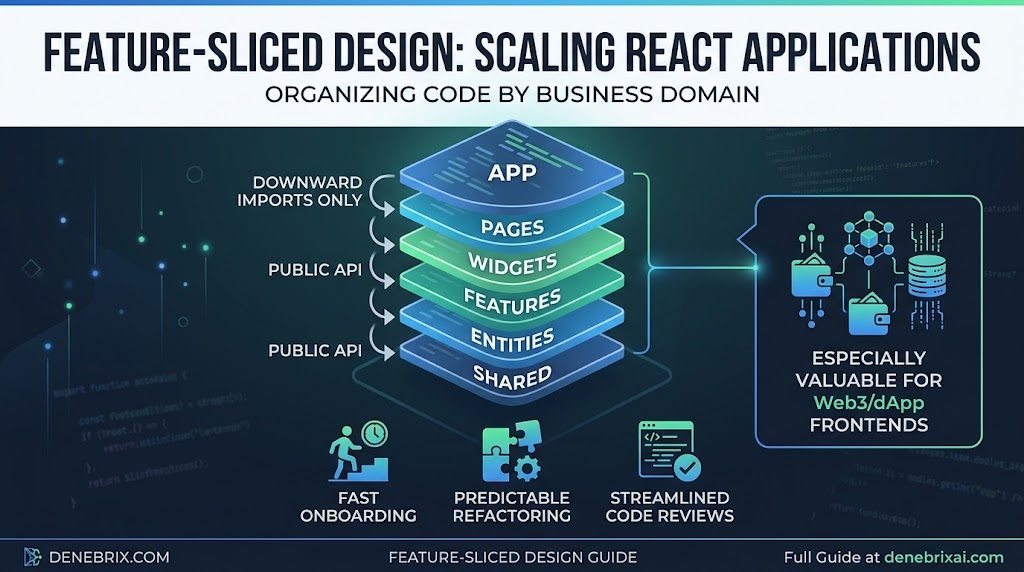
I have been building frontend applications for a few years now, and the same problem kept showing up on every mid-sized to large project I touched. Components scattered everywhere, unclear boundaries between what belongs where, and a new developer needing almost two weeks just to understand where things live before they could contribute anything meaningful. Last year I finally sat down and restructured a project using Feature-Sliced Design, and it changed how I think about frontend architecture completely.
I wrote a full breakdown of the approach here if you want the detailed technical version with code examples: Feature-Sliced Design Guide
Here is everything I learned going through that transition, the good and the frustrating parts both.
The problem I kept running into
Before Feature-Sliced Design, my folder structure looked like most React projects out there. A components folder that grew into hundreds of files. A hooks folder with no clear ownership. Utils that nobody remembered the purpose of six months later. Every new feature meant hunting across five different folders to piece together what actually happened when a user clicked a button. Testing became a nightmare because touching one file could break something completely unrelated three folders away, and nobody could predict which files were safe to change without running the whole app locally first.
The team grew, and the problem grew faster than the team did. Code reviews took longer because reviewers had to trace logic across scattered files just to understand a single pull request. That is the point where I started looking seriously at architectural patterns instead of just adding more folders and hoping things would sort themselves out.
What Feature-Sliced Design actually is
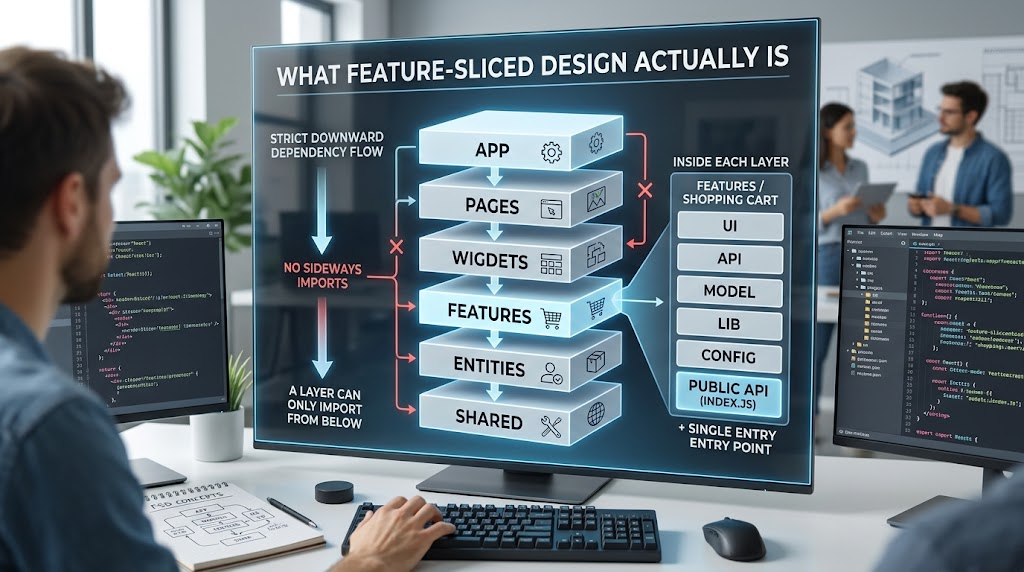
Feature-Sliced Design organizes your codebase by business domain instead of technical role. Instead of grouping files by what they are, like components or hooks, you group them by what they do for the business. The structure is built around layers, and each layer has one job.
The layers, from top to bottom, are app, pages, widgets, features, entities, and shared. The app layer handles bootstrapping, providers, and global configuration. Pages map directly to routes. Widgets are composite blocks that combine multiple features into a larger chunk of UI, like a full navigation bar or a dashboard panel. Features are the reusable user interactions themselves, things like authentication, a shopping cart, or a comment system. Entities represent core business objects such as a user, a product, or an order. Shared sits at the bottom and holds reusable utilities, UI primitives, and configuration that has no business logic attached to it at all.
The rule that ties this all together is strict and simple. A layer can only import from the layers below it, never sideways and never upward. Features cannot reach into widgets. Entities cannot reach into features. This one constraint eliminates most of the spaghetti import chains that make old codebases painful to touch, because the dependency direction is enforced structurally instead of relying on team discipline that erodes over time.
Inside each layer, code is further broken into slices, and each slice is divided into segments like ui, api, model, lib, and config. Every slice exposes a single public API through an index file, so other parts of the app interact with it through one clean entry point instead of reaching directly into its internals.
What actually improved once we adopted it
The biggest win by far was onboarding speed. A new developer could open the features folder, see exactly what business logic each slice handles, and start making real contributions within a day instead of a week. They did not need a tour of the codebase from a senior engineer because the structure itself explained where things lived.
Refactoring got noticeably safer too. Since the import rules are enforced, a change inside one feature slice rarely broke something unrelated in a different part of the app. That confidence changed how the team approached bigger changes. People stopped being afraid to touch older code because the blast radius of any change became predictable.
Code reviews also got faster. When a pull request touched the features layer, reviewers already knew roughly what to expect and where to look, instead of tracing logic across a dozen scattered files trying to reconstruct the full picture.
Where it gets genuinely tricky
I want to be honest about the downsides because I do not think any architecture is free of tradeoffs. Feature-Sliced Design has a real learning curve if your team is used to a flat or purely technical folder structure. The first week or two involves a lot of conversations that start with "wait, where does this actually go." Deciding whether something belongs in entities or features is not always obvious, and different teams end up drawing that line slightly differently depending on their domain.
It also adds ceremony that is not worth it for small projects. If you are building a landing page, a quick prototype, or a small internal tool that will never grow past a handful of files, Feature-Sliced Design adds structure you do not need yet. The overhead of setting up layers and enforcing public APIs only pays off once the project has enough complexity that the old chaos would have caught up with you anyway.
There were also a few migration headaches moving an existing project over. You cannot flip a switch and reorganize everything overnight without breaking things. We did it gradually, feature by feature, running the old and new structures side by side for a few weeks until everything settled.
Why this matters even more for dApp frontends
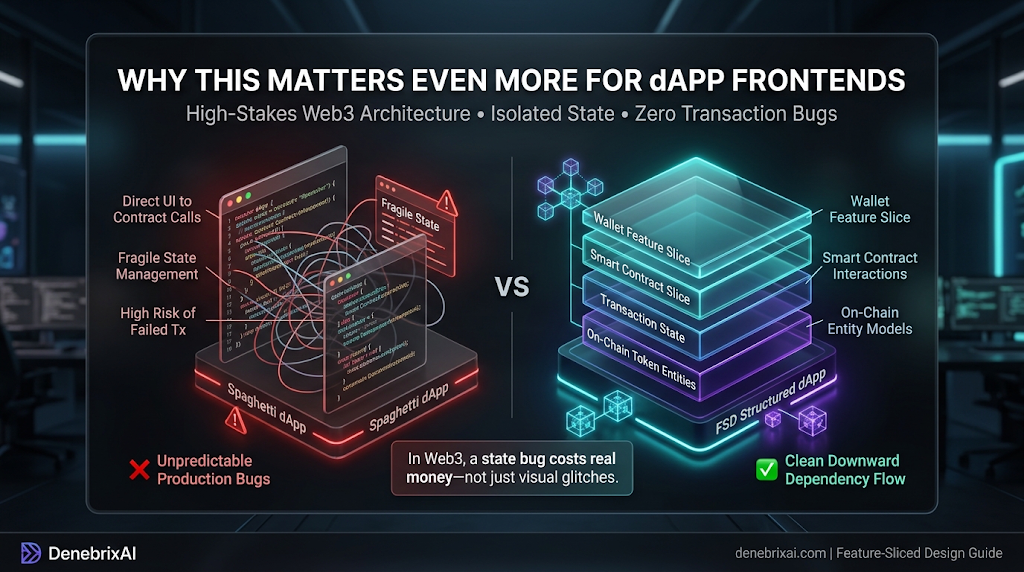
I want to add a note here specifically for people building on Steem or any other chain, because this hits differently for Web3 projects than it does for a regular SaaS dashboard. A typical dApp frontend juggles wallet connections, contract calls, transaction states, and on-chain data fetching, all layered on top of the usual UI concerns. That is a lot of moving parts, and it gets messy fast without clear boundaries.
With Feature-Sliced Design, wallet connection logic lives in its own feature slice, contract interaction code lives in another, and entities like a token balance or a transaction record get their own clean models separate from the UI that displays them. When you are debugging a failed transaction at two in the morning, knowing exactly which slice owns that logic saves real time. I have seen dApp codebases turn into a tangle of hooks calling contracts directly from random components, and that becomes unmaintainable the moment the team grows past one or two developers or the protocol adds new features.
If you are shipping anything on-chain with a React or Next.js frontend, whether that is a wallet integration, a token dashboard, or a full trading interface, this kind of structure pays off faster than it does on a typical web app, simply because the stakes of a broken state are higher when real transactions are involved.
Who should actually consider this
If you are working on a React, Next.js, or Vue application that you expect to grow past a handful of contributors, or one that already feels tangled and hard to navigate, Feature-Sliced Design is worth the investment. The payoff shows up most clearly once you have multiple developers touching the same codebase regularly and the cost of miscommunication starts to outweigh the cost of learning a new structure.
For anything smaller, a prototype, a one-off landing page, or a project you know will stay small, stick with whatever structure you already have. The strict layering only earns its keep once the complexity it is solving for actually exists.
I go much deeper into the layer structure, segment breakdown, and step-by-step migration process in the full guide linked above, including code examples for setting up the public API pattern correctly. If your project is starting to feel like the mess mine used to be, it is worth spending an afternoon evaluating whether this fits.
FAQs
Is Feature-Sliced Design only for React?
No. It is framework agnostic. I have seen it used in Next.js and Vue projects as well, since the core idea is about folder structure and import rules rather than anything tied to a specific library.
Do I need to rewrite my whole project to adopt it?
Not at all. Most teams migrate gradually, one feature at a time, and run the old and new structures side by side until everything is moved over. That is exactly how I did it.
How is this different from a standard atomic design or MVC setup?
Atomic design groups things by UI complexity, like atoms and molecules. MVC groups things by technical role. Feature-Sliced Design groups things by business domain instead, which tends to map more naturally to how teams actually think about their product.
Is it worth it for a small solo project?
Usually not. The layering adds overhead that only pays off once you have enough complexity or enough contributors that clear boundaries start mattering. For a small script or a weekend project, skip it.
Does it work well for dApp or blockchain frontends specifically?
Yes, and I would argue it helps even more there. Wallet logic, contract calls, and transaction state each get their own clear slice, which makes debugging and onboarding easier on projects where a mistake can mean a broken transaction rather than just a visual bug.