What Was the Cat Doing at the Window
My father is not the type to make things up. I want to say that first because everything that follows is going to sound like something a person makes up, and I've spent a long time sitting with this story trying to find the seam where the story starts to crack. I haven't found it yet.
(image is AI generated)
He works for an NGO. The kind of work that takes him to places most people only know as names on a map. Remote barangays, mountain communities, and areas where the road ends and you keep going anyway. He's been doing it for years and part of the job means staying in those places for stretches at a time. AirBnb is not a concept that reaches everywhere, and back then it wasn't even a concept at all. The usual arrangement was that the barangay would coordinate with a local family willing to take in visitors. You stay in their home, eat at their table, live alongside them for however long the work requires.
This particular stay was in the mountains of Capiz.
If you know anything about Philippine folklore, you already know what that means. Capiz has a reputation that precedes it by centuries. You don't have to believe in any of it to know the stories, and you don't have to believe in the stories to feel the weight of them when you're actually there, in the mountains, far from any city, sleeping in someone else's house.
The family he stayed with was small. A mother and her son, who was nine years old. My father doesn't remember their names, or if he does, he's never said them out loud to me.
One night, the boy got sick.
It wasn't dramatic at first. He was lying down, whimpering, clearly uncomfortable like any other sick child. He was restless, unable to find a position that helped, crying softly without being able to say exactly where it hurt.
The mother was in the kitchen preparing arroz caldo, the rice porridge that every Filipino mother defaults to when her child is unwell, because it is warm and soft and it is the closest thing to doing something when there is nothing else to do.
My father was in the main room, close enough to see the boy.
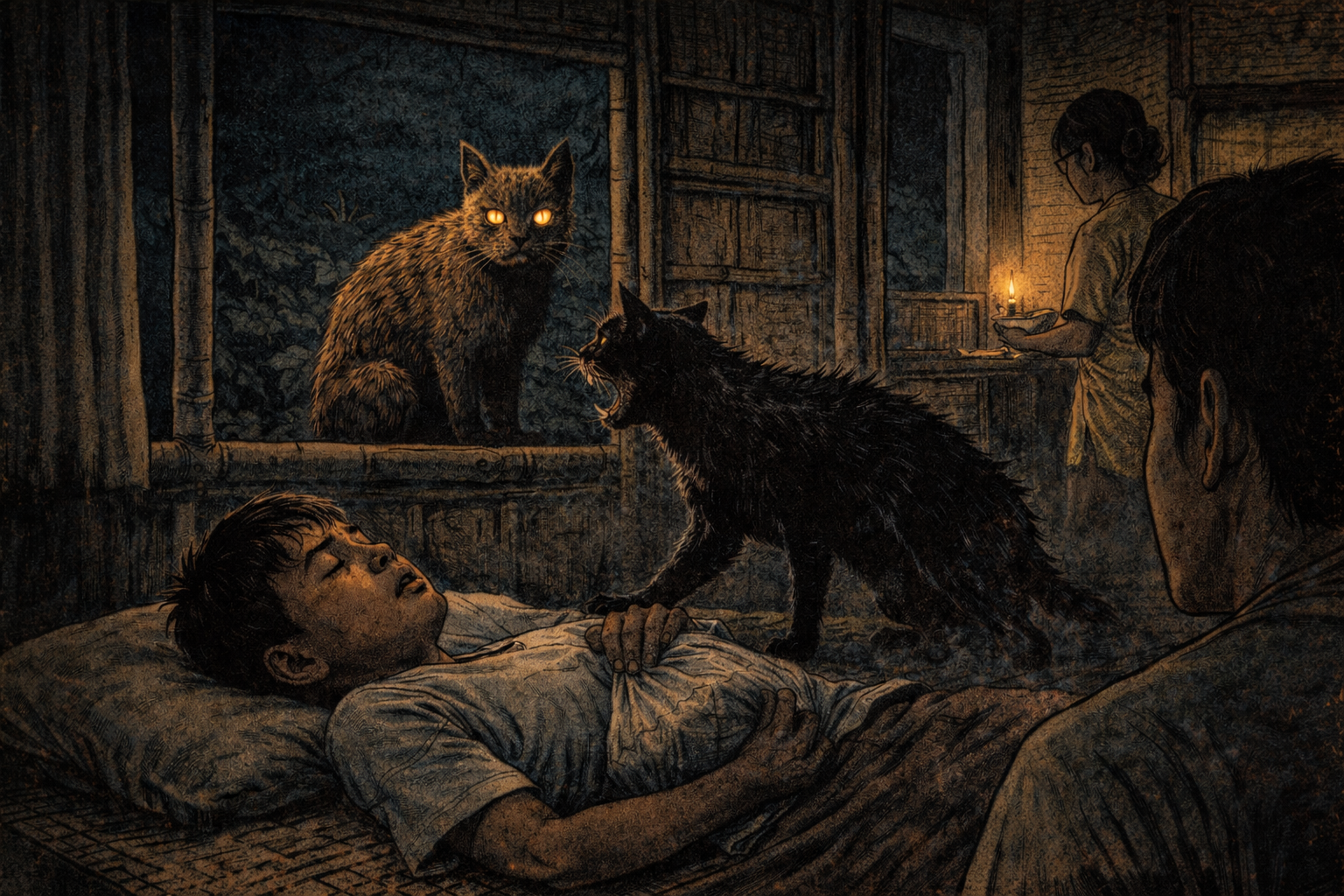
That was when he noticed the cat at the window.
It was crouched on the sill, watching the child. Still and focused. Locked-in with intent. the posture of something that has found what it came for.
The household had their own cat. And their cat was losing its mind.
It was growling low and constant, positioning itself between the strange cat and the boy, fur raised, doing the full display. My father had seen cats fight before but this felt different. The household cat wasn't posturing for territory. It seemed to be guarding the boy on the mat.
My father doesn't fully believe in aswang. Or so he says. He is an educated man, practical, the kind of person who needs a reason for things. But he has also spent enough time in enough remote places to know that what local people know about their own land is worth paying attention to. And he knew what Capiz was known for. He knew enough about the stories to know one of the specific things they said. Like how the aswang doesn't always come as itself. It comes wearing something else. An animal. A neighbor's dog. A cat that looks ordinary.
The local term is "salipdanan" or "panalipdanan". From "salipod", meaning cover, a shell, something worn over the real thing. It's been described to me as similar to the western idea of possession, but that's not quite right. Possession implies a passenger. This is more like a costume, except the costume is alive and the thing wearing it has gone all the way in.
My father told the mother about the cat.
She came into the room and something happened when she did.
The household cat launched itself at the strange cat the moment she crossed toward her son. A full fight, sudden and vicious, the two animals tangling at the window while the mother knelt beside the boy. And the boy, my father watching this, visibly got better. His breathing evened out. The crying stopped. He seemed to settle, the way a person settles when pain lifts without warning.
The mother tried to chase the strange cat away, throwing whatever was nearby. But she kept hitting her own cat instead. Every time. The strange one sat untouched on the sill while the household cat took the thrown slippers and the rolled newspaper. My father watched this happen more than once and could not explain the geometry of it.
Eventually the strange cat left. The boy told his mother, that the cat had been eating him.
The mother must have heard this differently than my father did. Because she went back to the kitchen.
The cat came back almost immediately after she left.
Same window. Same stillness. Same fixed attention on the boy.
The boy got worse. Started crying again, the soft helpless kind, and the household cat was going frantic again at the sill.
This cycle happened three times. Mother comes in, boy improves, cat retreats or gets driven off by the household cat. Mother leaves, boy worsens, strange cat returns to the window.
My father was watching all of this from across the room. He told me he didn't know what to do with what he was seeing. There was a rational explanation available at every individual step. A stray cat, a sick child, an anxious house cat reacting to an intruder, coincidental timing. But the whole of it, laid out together, did not feel like coincidence. It felt like a sequence.
The third time the mother left, the boy went quiet.
Similar kind of quiet to finally falling asleep. But it was the wrong quiet. And by the time the mother came back with the arroz caldo, bowl warm in her hands, ready to finally feed her son.
The boy was gone.
She screamed for the neighbors. Someone arranged transport to the hospital, a long ride down a mountain road in the dark, but there was nothing to be done by then. The child had been dead for several minutes before she found him.
My father overheard the conversation the next day, pieces of it, the way you overhear things in small communities where news travels through walls.
The autopsy found damage to the liver. Not a wound, no cut, no puncture, nothing on the surface of the body to explain it. Just sections of the liver that were no longer there. Chunks of tissue, absent. The body was closed and intact and something had eaten part of what was inside it.
I don't know what to do with that detail. I've tried to find a medical explanation that fits and I haven't found one that satisfies me, which doesn't mean one doesn't exist. I am not a doctor. I don't know what a liver can do or fail to do during certain kinds of illness, what necrosis looks like, what an overworked provincial autopsy might miss or misread.
But I know my father. I know he goes away for work for days at a time, has been doing it my whole life, has slept in more strangers' homes than I can count. He is not a man who reaches for supernatural explanations. He is not trying to scare anyone when he tells this story.
The boy told his mother the cat was eating him.
He said it plainly before she went back to the kitchen.
She went back to the kitchen.
I don't blame her. I don't know what I would have done either. You can only act on what you understand, and some things are designed to stay just outside of that.