Budgeting vs Forecasting in FP&A: Key Differences and Tips
Budgeting and forecasting are two of the most important activities within financial planning and analysis (FP&A). Both help finance teams understand financial performance, plan for the future, and support better business decisions. However, they serve different purposes.
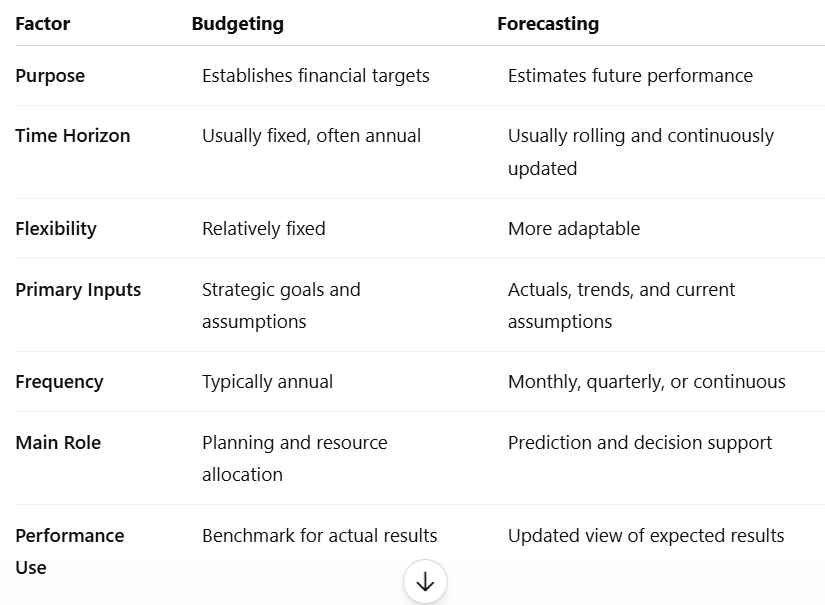
A budget sets financial targets and expectations, while a forecast provides an updated estimate of what the business is likely to achieve based on current data and changing conditions.
Understanding the difference between budgeting and forecasting can help CFOs and finance teams build a more flexible and effective FP&A process.
What Is Budgeting in FP&A?
Budgeting is the process of creating a financial plan for a defined period, usually a fiscal year. It establishes expectations for revenue, expenses, investments, headcount, cash flow, and other financial metrics.
For example, a company may create an annual budget that projects $50 million in revenue and allocates spending across sales, marketing, operations, technology, and other departments.
The approved budget then becomes a benchmark against which actual performance can be measured.
Common Uses of Budgeting
Organizations typically use budgets to:
Establish financial targets
Allocate resources across departments
Control planned spending
Set performance benchmarks
Align teams with business objectives
Support strategic initiatives
The limitation is that an annual budget is based on assumptions made at a specific point in time. If market conditions, customer demand, costs, or business priorities change, the original budget may no longer accurately represent the current business outlook.
What Is Forecasting in FP&A?
Forecasting is the process of estimating future financial performance using historical results, current actuals, business drivers, and updated assumptions.
Unlike a budget, a forecast is generally more flexible and can be updated as new information becomes available.
For instance, if revenue is lower than expected during the first quarter, the finance team can update its forecast for the remaining quarters and evaluate the potential impact on profitability and cash flow.
Common Uses of Forecasting
Forecasting can help finance teams:
Predict future revenue and expenses
Monitor changing business conditions
Identify potential risks
Improve cash flow visibility
Update financial expectations
Support management decisions
This makes forecasting particularly valuable in businesses where market conditions and operating assumptions can change frequently.
Budgeting vs Forecasting: Key Differences
How Budgeting and Forecasting Work Together
Budgeting and forecasting should not be treated as competing processes. They complement each other.
Think of the budget as the destination and the forecast as the current route to that destination.
For example, a company may budget $20 million in annual revenue. After six months, actual sales performance and market conditions may indicate that the company is likely to generate $18 million.
The budget remains the original target, while the forecast provides management with an updated view of the expected outcome.
This allows finance teams to ask important questions:
Why are we behind the budget?
Are the underlying assumptions still valid?
What has changed in the business?
What actions can improve the outlook?
What will happen if current trends continue?
When Should You Use Budgeting?
Budgeting is particularly useful when an organization needs to establish financial targets and allocate resources.
Annual Financial Planning
Companies can define revenue, expense, hiring, investment, and cash flow targets for the upcoming fiscal year.
Resource Allocation
Budgets help management determine how much funding should be allocated to departments, projects, and strategic initiatives.
Performance Management
Actual results can be compared with budgeted figures to identify favorable and unfavorable variances.
Strategic Planning
Major initiatives such as geographic expansion, new products, acquisitions, or technology investments can be incorporated into the financial plan.
When Should You Use Forecasting?
Forecasting becomes particularly valuable when conditions change throughout the year.
Rolling Forecasts
Instead of relying exclusively on an annual forecast, finance teams can regularly update their outlook using the latest actual performance and business assumptions.
Scenario Planning
Finance teams can develop best-case, base-case, and worst-case scenarios to understand how different outcomes could affect the business.
Cash Flow Planning
Forecasting can help organizations anticipate future cash inflows and outflows and identify potential liquidity challenges.
Risk Management
Changes in sales, operating costs, customer demand, or other business drivers can be incorporated into forecasts to identify potential risks earlier.
The Role of FP&A Software
As budgeting and forecasting processes become more complex, many finance teams are moving away from managing everything through disconnected spreadsheets.
Modern FP&A software can bring budgeting, forecasting, reporting, financial analysis, and scenario planning into a centralized environment.
For example, Taxilla FP&A combines these capabilities to help finance teams manage budgeting and forecasting within a connected planning environment. Its functionality includes annual and rolling budgeting, rolling forecasts, driver-based planning, scenario planning, and reporting and analysis.
This type of approach can make it easier to connect the original budget with updated forecasts and actual financial results. Instead of maintaining separate spreadsheets for each planning cycle, finance teams can work with a more structured and centralized process.
The benefit isn't simply automation. A connected FP&A environment can also make it easier to track assumptions, analyze variances, compare different scenarios, and provide management with a more current view of financial performance.
Common Challenges With Traditional Budgeting and Forecasting
Despite their importance, budgeting and forecasting can become time-consuming when they depend heavily on spreadsheets and manual processes.
Some common challenges include:
Manual data collection
Multiple spreadsheet versions
Inconsistent assumptions
Difficult-to-maintain formulas
Limited real-time visibility
Time-consuming consolidation
Slow scenario analysis
Difficult collaboration between departments
These challenges can reduce the amount of time finance teams have available for analysis and strategic planning.
Tips for Better Budgeting and Forecasting
- Focus on Business Drivers
Instead of forecasting every financial line item independently, identify the operational drivers behind financial performance.
For example, revenue may depend on customer volume, average selling price, conversion rates, and retention.
- Update Forecasts Regularly
A forecast becomes less useful when it is based on outdated assumptions. Establish a regular forecasting cycle that incorporates the latest actual results.
- Compare Budget, Forecast, and Actuals
Looking at all three provides a more complete picture of performance.
Budget vs. actuals shows whether the organization is meeting its original targets.
Forecast vs. actuals shows whether the latest expectations are accurate.
Budget vs. forecast highlights how expectations have changed since the original plan.
- Build Multiple Scenarios
Scenario planning can help finance teams prepare for uncertainty. Consider modeling different assumptions around revenue growth, costs, hiring, pricing, or market conditions.
- Reduce Manual Data Management
Automating data collection and integration can reduce repetitive work and improve the consistency of financial information used in planning.
- Make FP&A a Continuous Process
Budgeting and forecasting shouldn't be limited to one annual exercise. A continuous planning approach allows finance teams to adjust assumptions and financial plans as the business evolves.
Final Thoughts
Budgeting and forecasting have different roles in FP&A, but both are essential for effective financial management.
Budgeting establishes where the organization wants to go, while forecasting provides an updated view of where it is likely to end up.
When these processes are connected, finance teams can better understand performance, identify emerging risks, allocate resources, and support strategic decisions.
As businesses increasingly adopt continuous planning, FP&A software can also play an important role in bringing budgeting, forecasting, reporting, and scenario analysis together. Solutions such as Taxilla FP&A demonstrate how organizations can move toward a more connected approach without making the planning process unnecessarily complicated.
Ultimately, the goal isn't to choose between budgeting and forecasting. It is to use both effectively—and continuously—to make better financial decisions.