Iran War Tensions
Trump’s Iran Dilemma: Negotiation, Escalation, and the Question of an Unwinnable Conflict
Former U.S. President Donald Trump stirred fresh speculation today after posting on social media:
“Iran took too long to negotiate an agreement and will now have to pay the price.”
Notably, Trump did not clarify what “the price” would entail. The statement immediately raised questions among analysts: Has the diplomatic track reached a point of no return? Has Washington effectively abandoned negotiations in favor of military pressure?
These questions come amid reports of escalating tensions across the Middle East. According to various regional sources, Iranian forces and U.S.-aligned assets have been engaged in a growing cycle of military action and retaliation. Reports of drone interceptions, missile strikes, and attacks on military infrastructure have further fueled concerns that the conflict could expand beyond its current scope.
Chinese geopolitical analyst Victor Gao recently questioned the consistency of Washington’s military assessments, arguing that previous claims regarding the destruction of Iranian military capabilities appear difficult to reconcile with subsequent reports of continued Iranian operations.
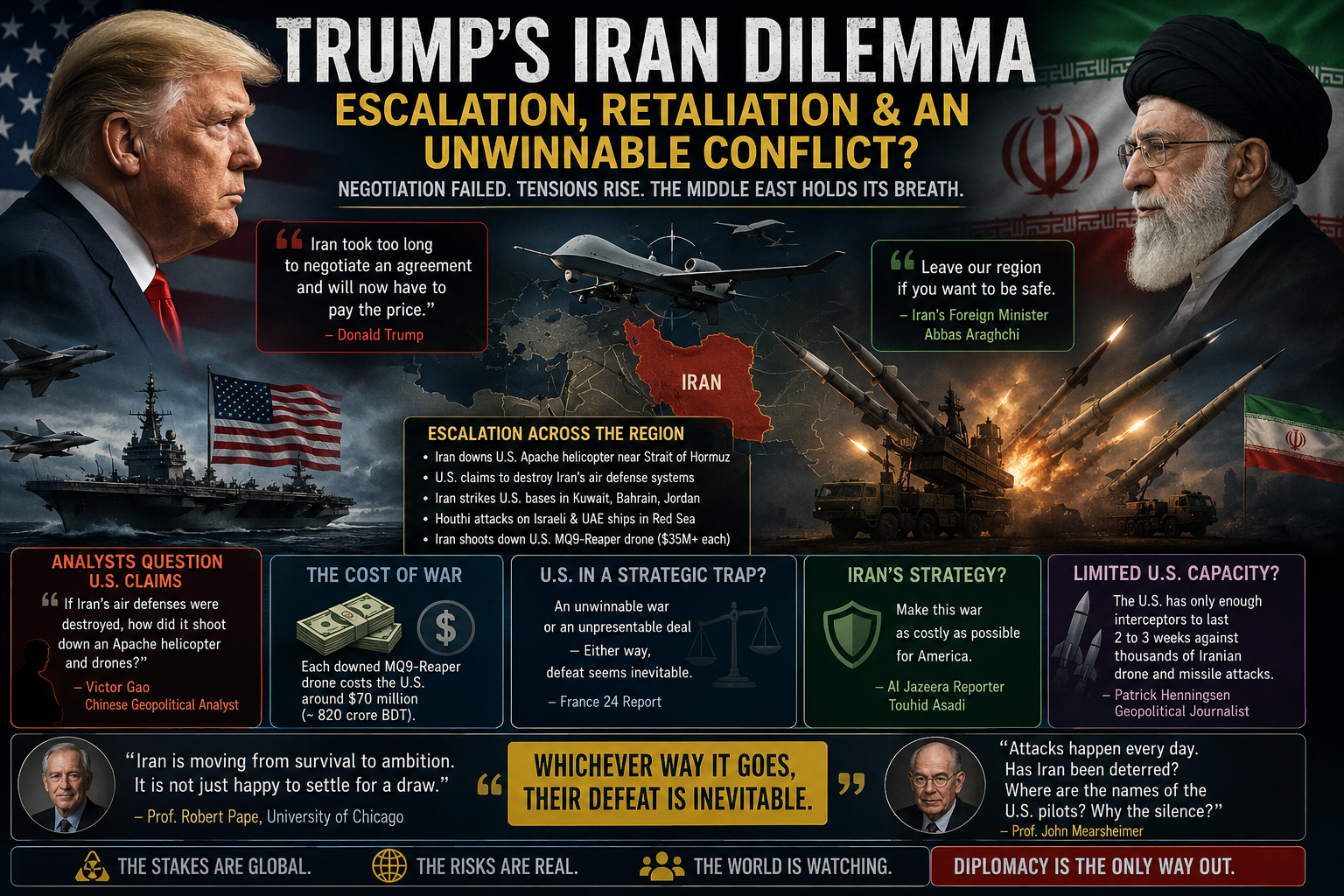
Such observations have prompted a broader debate: If Iran's military capabilities had been severely degraded, how has it continued to launch operations across multiple fronts?
Meanwhile, Iran has signaled that it intends to demonstrate that its strategic capabilities remain intact. Speaking to CGTN, several regional observers argued that Tehran is attempting to prove it can project power throughout the region despite ongoing military pressure.
Trump later intensified speculation by declaring that attacks on Iran would resume. Whether this reflects a genuine strategic decision or merely a negotiating tactic remains unclear.
Geopolitical commentator Patrick Henningsen offered a more cautious interpretation, suggesting that Trump's statements often evolve rapidly and should not automatically be interpreted as a definitive policy shift.
Yet the larger strategic questions remain unanswered:
- Why has the rhetoric shifted from negotiation to military action?
- Why are regional actors becoming increasingly involved?
- What does Iran hope to gain from continued escalation?
- Can the United States and its allies achieve their stated objectives through military means?
Several analysts argue that Iran's strategy is not necessarily to achieve outright military victory, but rather to increase the political, military, and economic costs of confrontation for Washington and its partners.
According to reports from regional media, attacks linked to Iranian allies have continued to disrupt maritime activity in key waterways, including the Red Sea. Such developments reinforce the perception that Tehran possesses multiple avenues through which it can apply pressure beyond its own borders.
University of Chicago political scientist Robert Pape reportedly summarized the situation with a striking observation:
“Iran is moving from survival to ambition.”
His argument suggests that Tehran may no longer be focused solely on defending itself but may instead be seeking to reshape the regional balance of power.
At the same time, critics within Israel and the broader region have questioned whether military operations have achieved their intended goals. Initial objectives reportedly included degrading Iran’s nuclear capabilities, reducing its missile threat, and weakening the Iranian government. The extent to which those goals have been accomplished remains a matter of intense debate.
This leaves Washington facing a difficult strategic dilemma.
On one side lies the prospect of deeper military involvement in a conflict that many analysts view as increasingly costly and unpredictable. On the other lies the possibility of a negotiated settlement that may prove politically difficult to defend domestically.
Some observers describe this as a classic strategic trap: an unwinnable war on one side and an unpopular compromise on the other.
Whether Trump ultimately chooses renewed escalation or renewed diplomacy remains uncertain. What is clear is that every additional military exchange increases the risk of a broader regional confrontation.
The coming days may prove decisive.
For now, residents across the Middle East are watching developments closely, hoping that diplomacy can still prevent a wider conflict.
History will ultimately determine who benefited, who suffered, and whether this confrontation marked the rise of a new regional power or merely another chapter in the region’s long cycle of conflict.
One thing, however, is beyond dispute: the stakes continue to rise, and the consequences of miscalculation could be felt far beyond the Middle East.