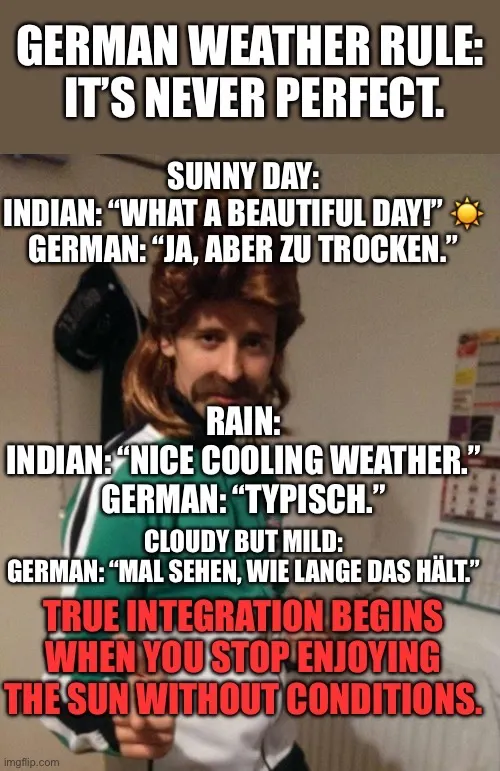
Integration Level 2: The Weather Is Never Right
Welcome to your first practical lesson in Advanced German Integration.
You already know how to say:
- „Das Wetter ist schön.“
- „Heute ist es warm.“
- „Es regnet.“
Very good. Grammatically correct. Perfect A2 level. Now forget it. Because in Germany, weather is not a meteorological condition.
It is a social bonding instrument.
If you say, with full sincerity, “What a beautiful sunny day!”, you immediately reveal one of three things:
- You are new.
- You are on vacation.
- You are suspiciously happy.
None of these signals help your integration.
Rule 1: The Weather Is Always Slightly Problematic
Sunshine?
→ “Ja, aber es ist schon sehr heiß.”
Rain?
→ “Typisch. Immer wenn man raus muss.”
Cold?
→ “Also langsam reicht’s jetzt mit dem Winter.”
Mild spring day with birds singing?
→ “Mal sehen, wie lange das hält.”
The key principle: optimism must be balanced immediately. This is not negativity. It is preventive emotional hedging.
Germans do not trust stability. If the sun shines today, there is statistical evidence that it might rain tomorrow. Why risk emotional overinvestment?
Practical Dialogue Training
Scenario A: Office Kitchen
Colleague: „Schönes Wetter heute, oder?“
Wrong answer (Indian enthusiasm mode):
“Yes! Amazing! Perfect day!”
Correct integration answer:
„Ja, noch. Aber am Wochenende soll es ja schon wieder schlechter werden.“
You are now culturally aligned.
Scenario B: Elevator
Stranger: „Ganz schön kalt.“
You must not say: “I love cold weather.”
That creates distance.
Instead: „Ja, und die Heizung im Büro funktioniert auch nicht richtig.“
Congratulations. You just added infrastructure critique. Advanced move.
In many parts of India, visible joy is normal. Smiling at strangers? Fine. Appreciating sunshine? Natural.
In Germany, emotional expression is more calibrated. Too much enthusiasm in neutral situations creates mild discomfort. Why? Because it disrupts the collective baseline of controlled realism.
The weather conversation serves as a safe training field. It is low risk. No politics. No salary comparison. No migration debate. Just clouds.
But inside the clouds lies a deeper cultural pattern: Expectation management. If you assume something will deteriorate, you cannot be disappointed. This is not sadness. It is strategic pessimism.
Micro-Exercises for Migrants
Try these sentences in your next conversation:
- „Naja, man kann nicht meckern.“
- „Es geht schon.“
- „Ist halt Deutschland.“
- „War ja klar.“
Notice how none of them express strong emotion. They live in the comfortable middle zone between acceptance and critique. This is where many German conversations reside.
If a German says, “Endlich Sommer!”, check the forecast immediately.
Because somewhere in the collective subconscious there is a warning system saying: “This joy is premature.”
Important Cultural Insight: Complaining about the weather does not mean someone is deeply unhappy. It is ritualized modest dissatisfaction. It signals:
- I am realistic.
- I am not naive.
- I am not overexcited.
- I belong.
You are not becoming unhappy. You are becoming synchronized.
Your Homework for one week: Never say the weather is perfect. Always add a small limitation. Observe reactions. You will notice subtle nods of approval. Tiny signals of shared understanding.
Integration has begun.