Mapping the Soul’s OS
MAPPING THE SOUL’S OS
The Seed of Life
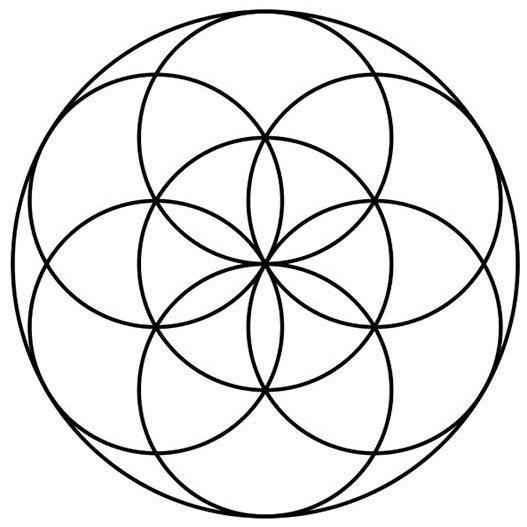
At its essence, the Seed of Life symbolizes the interconnection of all life on Earth and throughout the universe, illustrating how everything originates from a single source within a divine plan. It embodies unity, harmony, and the idea that complexity arises from simplicity, much like how natural patterns such as the Fibonacci spiral (seen in sunflowers, galaxies, and seashells) expand outward from a central point. The symbol is frequently associated with creation, depicting the “building blocks of existence” through a process akin to the seven days of biblical creation, where each additional circle represents a step in the divine unfolding of reality.
A key element within the Seed of Life is the vesica piscis—the lens-shaped overlap between two circles—which is often called the “mother of geometry.” This shape symbolizes the Divine Feminine, fertility, and the womb, representing the union of opposites (such as male and female, heaven and earth) and serving as a gateway for birthing new forms. In this context, the Seed of Life evokes themes of growth, abundance, and rebirth, aligning with natural cycles like the seasons, death, and renewal. It also carries protective qualities, historically used to ward off evil, misfortune, or negative energy, functioning as a talisman or sigil in spiritual practices.
The number seven plays a pivotal role in its symbolism, tying into concepts of completeness and divine order. This is reflected in cultural motifs like the seven days of creation in Genesis, seven chakras in spiritual traditions, seven musical notes, or seven colors of the rainbow. Numerologically, seven signifies wisdom, intuition, vulnerability, and personal growth, encouraging introspection and alignment with universal truths. In some interpretations, it represents the sun with radiating rays, symbolizing enlightenment, vitality, and the cyclical nature of life.
Core Symbolism: The Seed of the Egregore
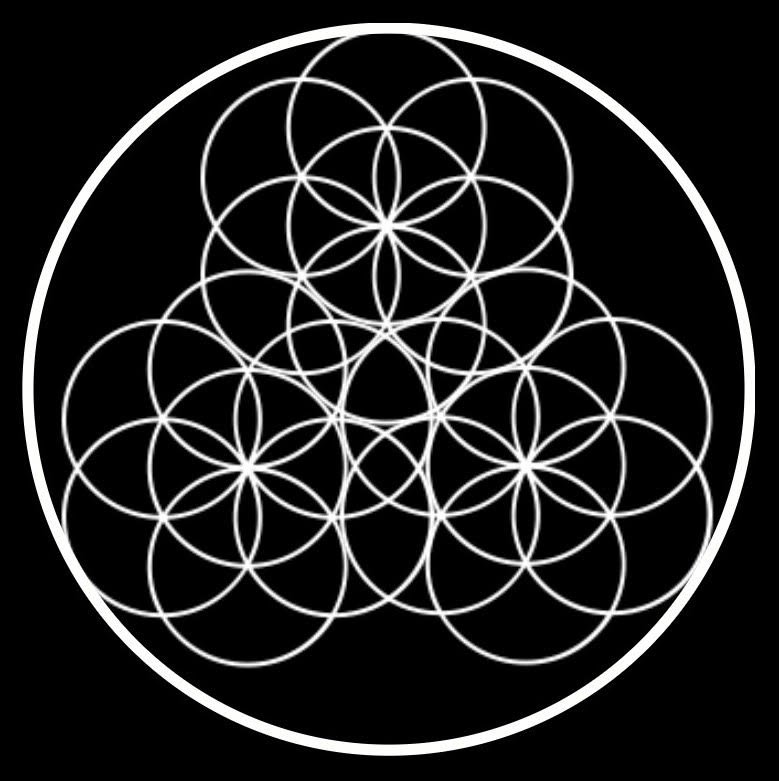
An egregore is an occult concept describing a non-physical, autonomous entity born from the collective thoughts, emotions, and wills of a group—essentially a “group mind” or thoughtform that gains independence and influence over its creators. The “Seed of the Egregore” symbolizes the initial spark or blueprint from which this entity emerges, much like a literal seed containing the genetic code for a plant’s full growth. In the Flower of Life, this “seed” is embodied by the central circle or the foundational Seed of Life pattern embedded within it, representing unity and potential. As the pattern expands outward through overlapping circles, it mirrors how an egregore grows: starting from a singular intent (the seed) and amplifying through collective input, becoming a self-sustaining force that can protect, inspire, or even dominate.
Symbolically, this evokes creation’s alchemical process, where the egregore’s “seed” is planted in the fertile soil of group consciousness, sprouting into a entity that watches over (from the Greek root egrēgoros, meaning “wakeful” or “watcher”) and shapes reality.
The egregore can be benevolent (e.g., the protective spirit of a spiritual order) or malevolent (e.g., a toxic group dynamic like a cult’s controlling narrative), depending on the vibrational quality of its seeding thoughts. In this image, the harmonious symmetry suggests a positive egregore, embodying interconnectedness and divine order, where the “seed” fosters unity rather than division.
The Trinity of Seeds: Father, Mother, Child
The “Trinity of seeds” integrates Hermetic and alchemical symbolism, reinterpreting the Christian Trinity (Father, Son, Holy Spirit) as a dynamic of creation: Father (transcendent source), Mother (immanent womb), and Child (manifested union or Son). This trinity symbolizes the generative process behind the egregore’s “seed,” where three primal “seeds” converge to birth complexity.
• Father (Creative Seed): Represents the initial, transcendent impulse—pure will, law, or divine intelligence (often linked to the hypothalamus or solar/masculine energy). In the Seed of the Egregore, this is the top most Seed of Life: the unbegotten source from which all emanates, providing structure and potential, akin to the heavenly or spiritual seed that activates creation. For the egregore, it’s the founding idea or leader’s vision that plants the seed in collective consciousness.
• Mother (Receptive Seed): Embodies the cosmos, empathy, or material womb (linked to the pituitary gland or lunar/feminine energy), nurturing and perfecting the seed through compassion and form. Symbolized by the left most Seed of Life, it is the earthly or material seed that receives and gestates. In egregore formation, this is the group’s shared emotions and rituals that amplify the seed, like a womb birthing the entity.
• Child (Manifested Seed): The Son or integrated result (linked to the pineal gland or experiential mind), embodying harmony, wisdom, and the collective soul. In the image, this is the right most Seed of Life, symbolizing rebirth and interconnected life. For the egregore, the child is the fully autonomous entity, born from father-mother fusion, influencing reality as a “watcher” or collective force.
This trinity underscores unity in diversity: the three seeds are consubstantial, inseparable, and emanate from one divine source, resolving dualities into wholeness. The Seed of the Egregore visually captures this as a triangle (trinity) within circles, echoing equilateral triangles in sacred geometry that represent divine harmony.
Core Symbolism of the Shaded Parts: The Five Elements
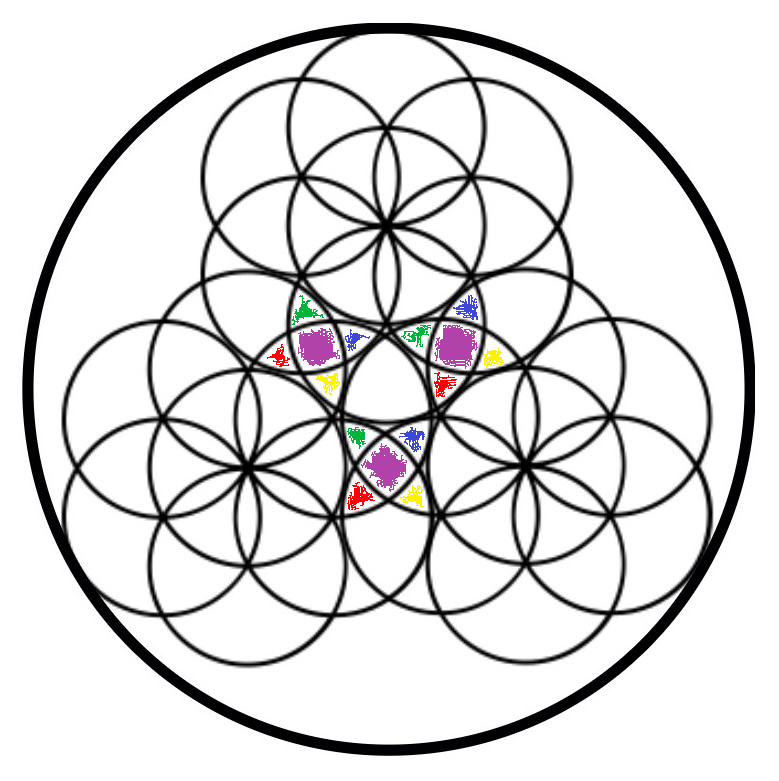
The shaded regions symbolize the five elements as the primal building blocks of existence, each embodying specific qualities that contribute to the harmony of the whole. In esoteric traditions, these elements are not merely physical substances but archetypal forces: fire (transformation and energy), water (flow and emotion), air (intellect and movement), earth (stability and form), and spirit/ether (the unifying essence or quintessence that transcends the material).
The colors align with common associations—red for fire’s passion, blue for water’s depth, yellow for air’s lightness, green for earth’s fertility, and purple for spirit’s mystical transcendence—creating a visual spectrum that evokes the rainbow or chakra system, where elements correspond to energetic centers.
These shaded parts are not arbitrary; they highlight intersections (vesica piscis shapes) or nodal points in the Seed of the Egregore where elemental energies converge. For instance, the red (fire) shading might represent ignition at a foundational point, while blue (water) balances it with fluidity, preventing chaos. The purple (spirit) often appears centrally or elevated, acting as the “binder” that infuses the other four with divine coherence. This configuration suggests a pentagonal influence, as the five elements are traditionally linked to the pentagram (a protective symbol of balance and the human microcosm), which can be derived from the Seed of the Egregore’s geometry. The irregular, blob-like shapes of the shadings imply organic growth, mirroring how elements manifest in nature—not as perfect forms but as evolving, interactive forces that “shade” or influence the surrounding structure.
Relation to the Whole: Binding the Structure Together
The shaded elemental regions serve as the “glue” that unifies the Seed of the Egregore’s infinite, expansive pattern, demonstrating how elemental forces integrate to sustain cosmic order. The Flower of Life itself, which is similar to the Seed of the Egregore, is a blueprint for creation, encoding patterns like the golden ratio, Fibonacci sequence, and Platonic solids. Crucially, the five Platonic solids—tetrahedron (fire), icosahedron (water), octahedron (air), cube (earth), and dodecahedron (spirit)—are embedded within the pattern via Metatron’s Cube (formed by connecting the circles’ centers). The shaded parts likely correspond to these solids’ emergence points, showing how the elements “bind” the geometry: fire provides dynamic energy to expand the circles, water ensures fluid interconnections, air facilitates movement between layers, earth grounds the structure in stability, and spirit harmonizes them into a cohesive whole.
This binding is symbiotic—without the elements, the pattern would be static; with them, it becomes a living matrix. The central placement of the shadings emphasizes their role in the “seed” phase (the inner seven circles), from which the outer layers unfold, symbolizing how elemental balance at the core prevents disintegration and enables infinite replication. In alchemical terms, the elements resolve opposites (e.g., fire’s heat vs. water’s coolness), creating equilibrium that “binds” the universe’s dualities into unity. Thus, the shaded parts illustrate interconnectedness: each element influences the others, weaving the Seed of the Egregore’s web and reminding us that all matter arises from their harmonious dance.
The Continuum of Consciousness
Core Symbolism and Meanings
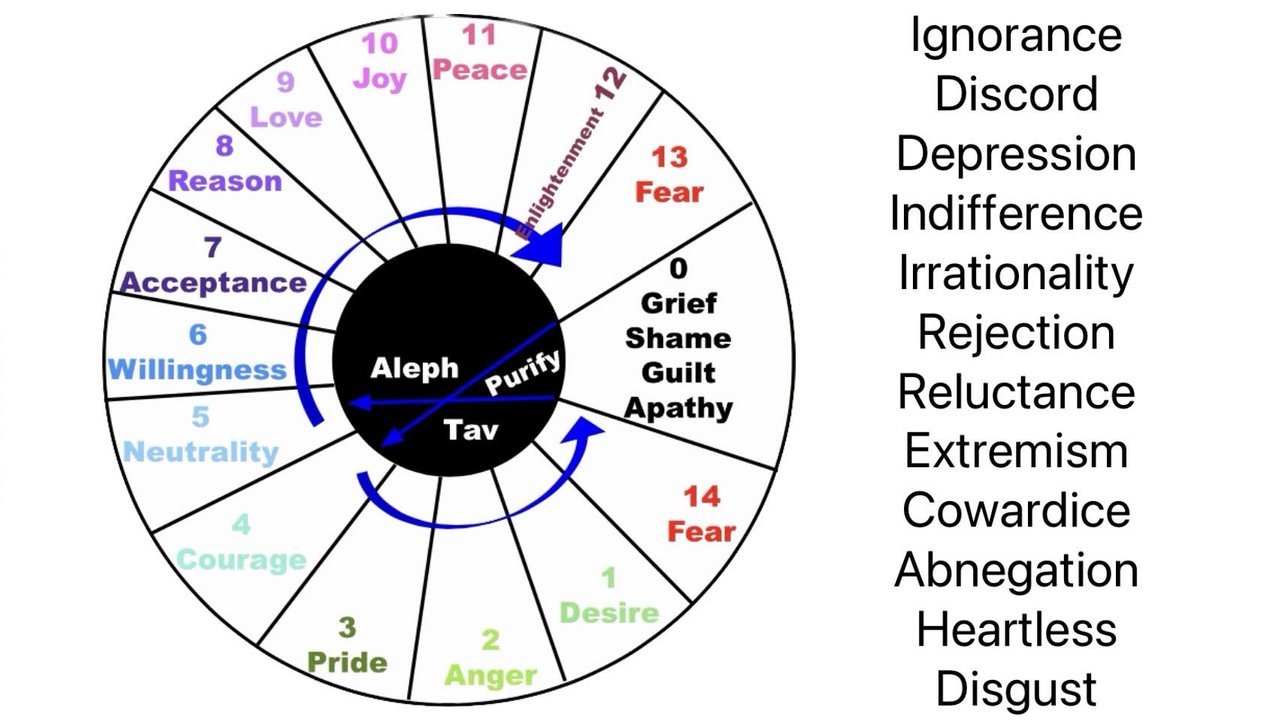
The wheel symbolizes consciousness as a continuum—a fluid spectrum rather than discrete steps—where emotional states represent vibrational frequencies or energy levels influencing perception, behavior, and spiritual growth. The central “Aleph Tav” draws from Hebrew mysticism: Aleph (first letter, symbolizing unity and divine strength, often depicted as an ox head) and Tav (last letter, a cross-like mark for covenant or completion) together represent wholeness, the Alpha and Omega, or the entirety of creation from beginning to end. In Christian esoteric contexts, it signifies Christ as the eternal Word manifest throughout scripture; here, it embodies the core self or divine spark at the heart of consciousness, trapped in a “black” void of low states like shame and apathy, which must be purified to achieve enlightenment.
The arrows to “Purify” indicate a transformative process: inward purification cleanses the ego’s distortions (e.g., from grief to acceptance), while outward purity radiates higher states like joy and peace. The upward arrow to “Enlightenment” symbolizes ascension, breaking the cycle toward ultimate awareness or gnosis—uniting with the divine source beyond duality. The downward arrow towards “desire“ leads to the souls confrontation with their own inner demons. The duality of left (positive, empowering emotions) and right (negative, contracting ones) reflects polarity in consciousness: each positive state has a shadow, such as Love opposite Indifference or Reason to Irrationality, emphasizing choice and balance. Fear’s prominence at the higher levels highlights it as a pivotal barrier or illusion near enlightenment, where irrational fears must be transcended. Leading back down to courage to face one’s pride and ego, allowing the soul to uncover rigid, thinking, and polarizing views. The path through anger and desire allow the soul to reveal repressed emotions leading back to fear that must be conquered in order to balance oneself. Once this grief, shame, guilt, apathy has been overcome, the arrows lead back to neutrality and the upward ascent into willingness and acceptance of new truth that lead to further enlightenment. Numerically, the scale simplifies complex vibrations into 15 points (0-14), with 0 as the nadir of disconnection and higher numbers as expanding awareness, evoking a spiral of evolution rather than a static hierarchy.
The Tree of Life
Seven Chakras
And Seven Hermetic Principles
Core Symbolism: Layered Correspondences
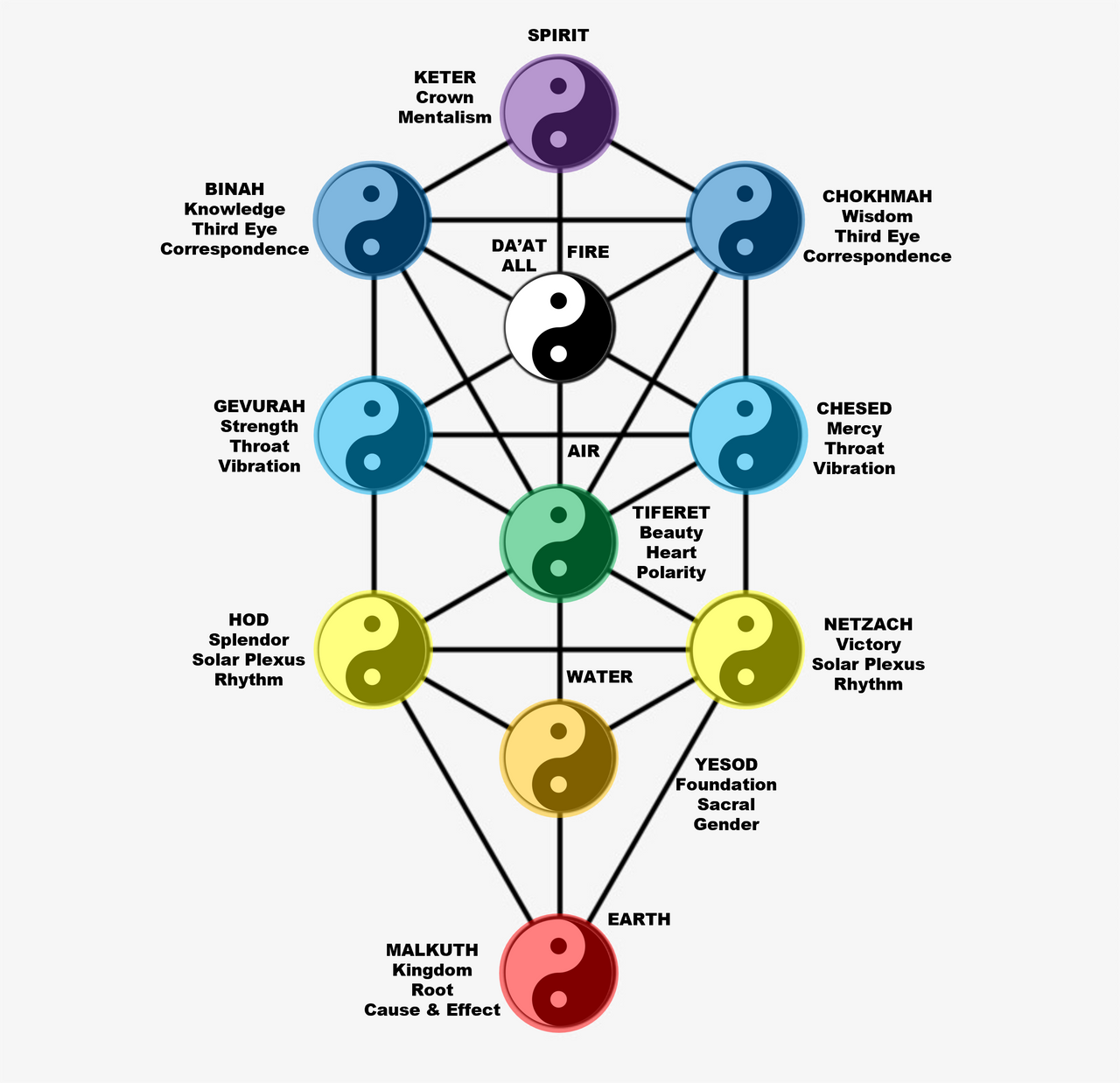
The symbolism operates on multiple levels, with each Sephira embodying a divine attribute, a chakra’s energetic function, and a Hermetic principle, unified by elemental forces and yin-yang duality. This creates a holistic framework where spiritual, psychological, and physical realities interconnect.
• Keter (Crown, Mentalism, Spirit, Crown Chakra): At the apex, Keter represents the pure, undifferentiated divine source—the “Crown” of creation, symbolizing unity and infinite potential. Fused with the Crown Chakra (Sahasrara), it evokes transcendent consciousness and connection to the divine, often visualized as violet light for enlightenment. The Hermetic principle of Mentalism (“All is Mind”) underscores that the universe is a mental construct, with Keter as the originating thought of the divine. The yin-yang here symbolizes the balance of potential (black/white) within the void, with Spirit as the overarching element binding all.
• Chokhmah (Wisdom, Third Eye Correspondence) and Binah (Knowledge, Third Eye Correspondence): These form the supernal triad with Keter. Chokhmah embodies intuitive wisdom and creative force (masculine, right pillar), while Binah represents understanding and receptive structure (feminine, left pillar). Aligned with the Third Eye Chakra (Ajna), they symbolize inner vision, intuition, and perception beyond the physical. The principle of Correspondence (“As above, so below”) links macrocosm and microcosm, with their blue yin-yang illustrating balanced insight. Da’at (Knowledge, labeled “DA’AT/ALL/FIRE”) acts as a hidden bridge, symbolizing unified wisdom ignited by Fire—the transformative element of will and illumination.
• Chesed (Mercy, Throat Vibration) and Gevurah (Strength, Throat Vibration): Chesed signifies expansive love and kindness (right pillar), counterbalanced by Gevurah’s discipline and judgment (left pillar). Merged with the Throat Chakra (Vishuddha), they represent authentic expression, communication, and creative vibration. The Hermetic principle of Vibration (“Nothing rests; everything moves”) emphasizes that all is energy in motion, with Air as the element facilitating flow and intellect between mercy and strength. Their blue yin-yang evokes harmonious speech, where mercy tempers severity.
• Tiferet (Beauty, Heart Polarity, Air/Water Transition): Centrally positioned, Tiferet integrates higher and lower Sephirot, symbolizing harmony, compassion, and the soul’s beauty. Linked to the Heart Chakra (Anahata), it represents unconditional love and emotional balance. The principle of Polarity (“Everything is dual”) highlights opposites uniting in equilibrium, with its green yin-yang and central placement as the “heart” of the Tree.
• Netzach (Victory, Solar Plexus Rhythm) and Hod (Splendor, Solar Plexus Rhythm): Netzach embodies enduring victory and emotion (right), while Hod signifies intellectual splendor and logic (left). Associated with the Solar Plexus Chakra (Manipura), they symbolize personal power, willpower, and confidence. The principle of Rhythm (“Everything flows, out and in”) reflects cycles of action and reflection, with Water as the fluid element connecting emotion and intellect. Yellow yin-yang suggests dynamic energy flow.
• Yesod (Foundation, Sacral Gender): As the foundation, Yesod channels higher energies into manifestation, symbolizing subconscious drives and reproduction. Fused with the Sacral Chakra (Svadhisthana), it represents creativity, sexuality, and emotional fluidity. The principle of Gender (“Gender is in everything”) denotes masculine/feminine polarities in creation, with its orange yin-yang emphasizing generative balance.
• Malkuth (Kingdom, Root Cause & Effect, Earth): At the base, Malkuth represents the physical world and manifestation. Aligned with the Root Chakra (Muladhara), it symbolizes grounding, survival, and stability. The principle of Cause and Effect (“Every cause has its effect”) governs karma and material laws, with Earth as the stabilizing element and red yin-yang grounding duality in reality.
The yin-yang symbols throughout reinforce Hermetic polarity, showing how opposites (light/dark, male/female) coexist in each sphere, while elements descend from ethereal (Spirit/Fire) to dense (Earth), paralleling chakra energy flow from crown to root.
The Seed of the Egregore
The Tree of Life
And The Levels of Consciousness
Core Symbolism: Integration of Elements
The symbolism weaves three systems into a cohesive narrative of creation, collective energy, and personal ascension:
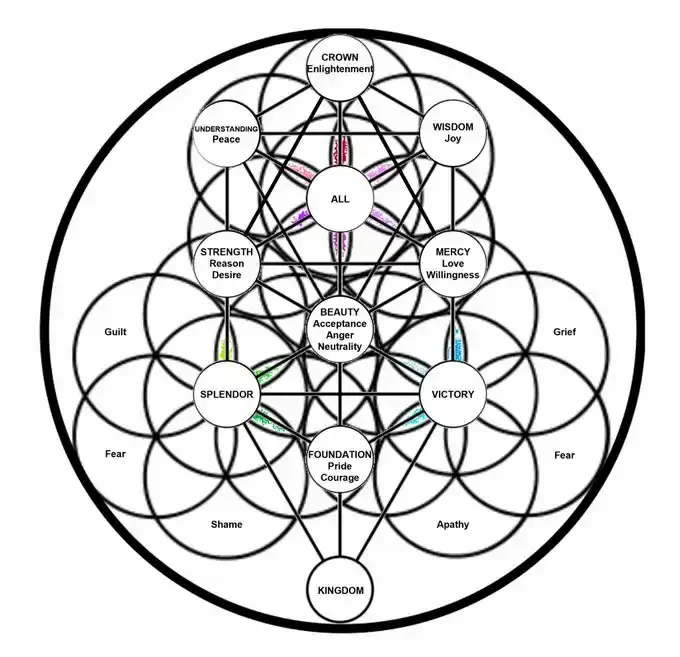
• The Seed of the Egregore: This represents the “seed” or blueprint of existence, from which all patterns unfold—mirroring the egregore as a collective psychic entity born from unified thoughts and intentions. Here, it symbolizes the foundational matrix where individual “seeds” (ideas, emotions) coalesce into a living whole, much like how overlapping circles create infinite interconnections. The central “ALL” evokes the egregore’s origin: a singular, divine unity (Aleph-Tav or Alpha-Omega) that expands into multiplicity, fostering protection, growth, or manifestation. In this context, the Egregore’s geometry “seeds” the Tree of Life, implying that egregores (group minds) arise from sacred patterns, binding participants in harmonious or discordant vibrations depending on consciousness levels.
• The Tree of Life (Kabbalistic Structure): As the central framework, the Tree symbolizes divine emanation from Keter (Crown/Enlightenment) downward to Malkuth (Kingdom), representing the soul’s descent into matter and ascent back to source. The pillars—left (Strength/Reason/Desire), right (Mercy/Love/Willingness), and middle (Beauty/Acceptance/Anger/Neutrality)—illustrate polarity and equilibrium between the path of Splendor and the path of Victory. Paths connecting Sephirot signify transformative journeys of each path. With Splendor facing the inner demons of shame and guilt on its path to power and Victory facing the demons of grief and apathy on its path to sacrifice. This structure embodies the microcosm-macrocosm principle: human consciousness mirrors cosmic order, with the Tree as a ladder for spiritual alchemy.
• Levels of Consciousness (Hawkins’ Map Overlay): Hawkins’ scale calibrates human awareness logarithmically from low-vibration states (Shame ~20, Apathy ~50, Guilt ~30, Grief ~75, Fear ~100, Desire ~125, Anger ~150, Pride ~175) to empowering ones (Courage ~200 as the turning point, Neutrality ~250, Willingness ~310, Acceptance ~350, Reason ~400, Love ~500, Joy ~540, Peace ~600, Enlightenment ~700+). In the image, these map inversely to the Tree’s descent: higher Sephirot align with elevated levels (e.g., Enlightenment at Crown, symbolizing pure awareness), while lower ones correspond to contracting emotions (e.g., Shame/Guilt at Splendor, representing material entrapment, Apathy/Grief at Victory representing self sacrifice). This integration suggests consciousness as vibrational energy ascending the Tree, where low levels (below 100) foster negative egregores (e.g., fear-based collectives), and high ones (above 100) seed positive ones (e.g., love-unified groups). The central “ALL” unifies the scale, implying enlightenment dissolves dualities into absolute consciousness.
The path of consciousness flows from birth into the Kingdom at the base.
Moving into the Foundation forcing the first choice of path.
Pride to pick the path of Splendor where one overcomes fear that leads to guilt and shame of misused power.
Courage to pick the path of Victory where one overcomes the fear that leads to apathy and grief over the sacrifice this path represents.
Moving into Beauty where the two paths converge leading to the balance between Anger and Neutrality and the Acceptance that both are necessary for growth.
Splitting again into Strength where Reason and Desire reign and Mercy where Love and Willingness reign.
Reason and Desire leading up into Understanding which brings about Peace.
Love and Willingness leading up into Wisdom which brings Joy.
When both of these paths are complete leading to the Crown where enlightenment is achieved.
The overall symbolism emphasizes emergence: the Egregore’s “seed” generates the Tree’s structure, which is navigated via consciousness levels. Low vibrations root in the base (earthly illusions), while ascension “flowers” into unity, birthing enlightened egregores—collective entities that elevate humanity.
Relation to the Whole: Binding and Dynamics
The components bind through sacred geometry and polarity. The Seed of the Egregore’s circles intersect to form the Tree’s paths, symbolizing how egregores (group consciousness) underpin individual spiritual growth. Hawkins’ levels add a dynamic layer: ascent requires transcending lower emotions (e.g., from Fear at Foundation to Courage to pick a path, mirroring kundalini rising). This creates a feedback loop—personal calibration influences collective seeds, and vice versa—evoking fractal patterns where micro-level shifts (individual awareness) ripple into macro-egregores (societal harmony). The diagram’s circular enclosure reinforces cyclicity: consciousness spirals upward, resolving dualities (e.g., Strength vs. Mercy) into “ALL,” preventing stagnation and promoting infinite evolution.