HEALING ORIGINAL SIN
HEALING ORIGINAL SIN
So many struggle with the story of Adam and Eve. On its surface an overbearing God threatens them with death if they eat of a certain fruit, while a sly serpent offers enlightenment and godhood. The serpent can appear the good guy and God the oppressive one. What if we pause and simply ask what is actually happening?
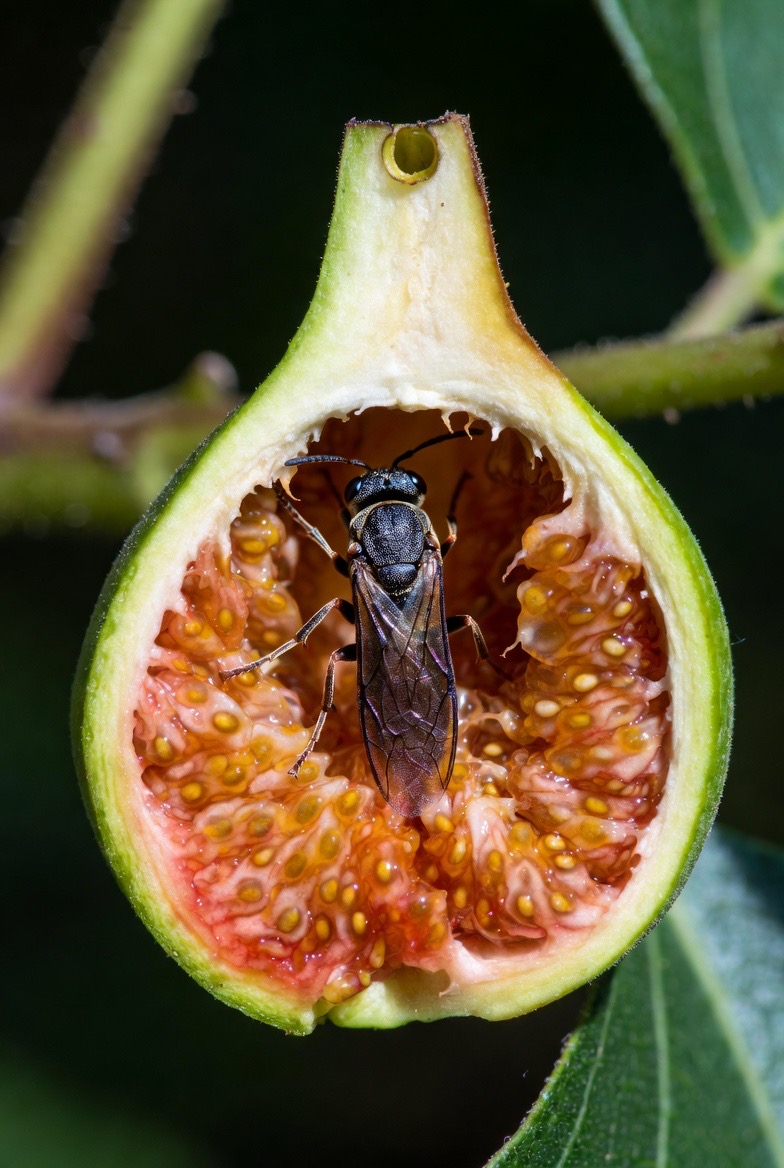
The fruit itself is never named. The text only records that after their eyes were opened they covered themselves with fig leaves. That detail alone invites investigation: might the choice of fig leaves open a window onto the natural life of the fig itself, and through it onto the cycle of creation, birth, and death?
In the wild a fig flowers inward. A female wasp, carrying pollen, must enter through a narrow opening; the passage often costs her wings and antennae, trapping her inside. She pollinates, lays her eggs, and dies; her body becomes nourishment. Males emerge first, mate, and die within the fruit; fertilized females collect pollen and leave to begin the cycle again. The fig becomes a seed-bearing fruit only through this sequence of death and new life. One might wonder whether this ordinary biological process stands as a quiet parallel to the warning “when you eat of it you will surely die,” and to the larger pattern that bringing forth life seems bound to the cost of death.
The serpent’s words—“You will not die; your eyes will be opened and you will be like God, knowing good and evil”—also invite examination. Eve ate and did not fall dead at once; her eyes were opened. Adam ate and the same followed. They became aware of their nakedness and covered it with the leaves of the very tree whose fruit-cycle involves such costly reproduction. Could the knowledge of good and evil they received be an awakening to the tension of creation and destruction that runs through the natural world—the same tension mirrored in human generation? The text leaves the question open.
The curses that follow can be read in the same light. Adam is told the ground will require toil; Eve is told childbirth will bring pain. Both statements sit beside the reality that new life exacts a price. The further word spoken to the woman—“you will desire to control your husband, but he will rule over you”—marks a shift in relation that the story itself records. Whether that shift is consequence, warning, or something else remains for the reader to weigh.
The serpent is cursed to crawl and to live in hostility with the woman’s offspring; one of those offspring will strike its head while it strikes the heel. Later Scripture sees in that word a foreshadowing of Christ’s victory. The same narrative also leaves the serpent’s role ambiguous: liberator of knowledge or deceiver who handed a burden the hearers were not yet ready to carry. The story does not settle the question for us.
One might even smile darkly at a passing thought: the serpent’s form has sometimes been compared to the male organ, and from that organ have come both the seed of new life and, in human history, the shapes of swords, guns, and cannons. How strange that the same capacity for generation has also been turned toward protection—and sometimes destruction. The irony is hard to miss, yet the text itself never presses the comparison; it remains only a wry aside.
All of this raises a practical question about timing and responsibility. Knowledge carries weight. Premature knowledge can wound. The burden of parenting is therefore real.
Both husband and wife carry the capacity for clarity of mind and perception of the heart. In the daily rhythm of marriage those gifts often find a complementary expression: the husband’s clarity of mind can offer steady direction and manifestation, while the wife’s perception of the heart can offer deep seeing and the power to birth that clarity into lived reality. Each is invited to receive the other’s gift without looking away—mind receiving heart, heart receiving mind—so that the two may integrate and align.
Fathers are called to protect their children’s innocence, to model that clear-minded stewardship, to teach sons how to step into humble confidence and daughters how to recognize integrity when they meet it.
Mothers are called to nurture, to offer the heart’s perception freely, to teach daughters how to step into presence and sons how to recognize faithful partnership. Both are invited to discern when a child is ready for harder truths, to let them sit with the consequences of their choices, and to remain present to help them see the lesson. Free will remains; not everything that is permissible is profitable.
The larger invitation is simply this: can one hold both the protective boundary and the catalytic disruption without forcing a final verdict? Can one forgive the apparent withholding and the apparent trick, and then look for the same tension inside one’s own growth?
The text itself ends with expulsion and the promise that death is not the last word; later pages speak of judgment after death and of a patience that desires none to perish. The story leaves the full integration of those strands open for patient, careful reading—and for parents who must decide, day by day, what knowledge to withhold and what knowledge to entrust
This is the necessity to be rooted in the totality of Christ. So you can be shrewd as a serpent, witness, don’t look away. Seek to understand, feel the totality of the fear and desire in your heart then release it to God. But innocent as a dove, trusting completely that what is good will return to you and what is not will not, so you can always return to virtue.
This is a message to all those out there consuming children. Forcing them into bondage and being used as instruments and objects of your lust. We see you. God wants that none should perish and all return to repentance and he is long suffering in his patience. There is a very narrow path to forgiveness. You have created a very deep ocean of emotion. Look inward. Tie the millstone around your own neck and dive in. Those who seek to save their life will lose it. But those who seek to lose their life for Christ’s sake will find it. Be shrewd as a serpent but release and return to innocence.
Once you have done this ask yourself what you truly desire?
What do you deserve based on that desire?
Then go and make amends.