Cat Tree for Multi-Cat Homes: How Many Do You Really Need?
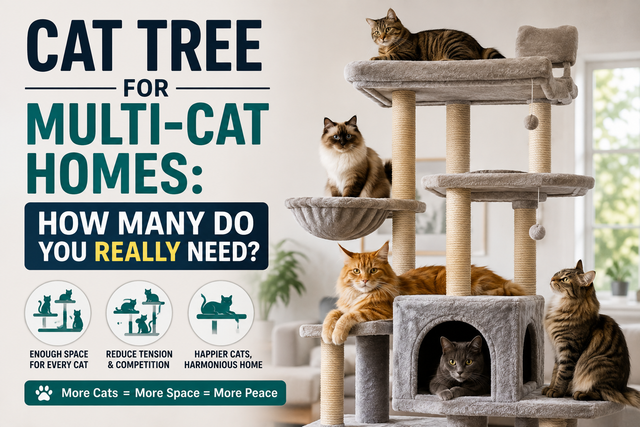
Three cats and one climbing tower usually ends with two cats fighting over the top platform while the third gives up and naps on the couch instead. Multi-cat households run into resource competition fast, and vertical space works exactly like food bowls and litter boxes in that sense — not enough of it creates tension that shows up in subtle ways long before an actual fight breaks out.
The One-Per-Cat-Plus-One Rule Applies to Climbing Space Too
Behaviorists commonly recommend one resource per cat plus one extra for things like litter boxes and feeding stations, and vertical territory follows a similar logic even if it's less rigid. This doesn't mean buying a separate tower for every cat in the house, but it does mean a single structure with only one appealing top perch will create competition in a two-or-more-cat home.
A Cat Tree with multiple platforms at varying heights solves part of this by giving each cat a distinct spot rather than forcing everyone to compete for the single best one. Look for structures with at least 3-4 separate resting platforms if you're buying for two or more cats, rather than a tall tower with just one or two total spots.
Multiple Platforms Beat Multiple Towers in Most Cases
Buying two or three separate towers sounds like the obvious solution, but it eats floor space fast and doesn't always solve the actual problem. A single larger structure with platforms spread across different heights — some low, some mid-level, one at the top — often works better than several smaller towers crammed into one room, since cats can spread out vertically rather than needing separate horizontal footprints.
Weight capacity becomes critical here. A structure meant for multiple cats climbing simultaneously needs a rating of at least 15-20kg total, since two average cats at 4-5kg each plus jumping force can easily exceed a lower-rated base. Check this number specifically rather than assuming a tall multi-platform tower automatically handles multiple cats safely.
Base Width Needs Extra Margin for Shared Use
The standard base-to-height ratio — roughly one-third — needs a bit more margin when multiple cats use the same structure regularly. Two cats jumping on and off at different angles creates more lateral stress than one cat using it alone, so add 10-15% to the standard base width calculation for any tower shared between cats.
Material matters just as much here. A hollow or lightweight base that might be fine for a single lighter cat often flexes noticeably under combined multi-cat use. Solid MDF or dense particleboard, ideally with some weighted ballast in the base, holds up far better when more than one cat is climbing and jumping regularly.
Spacing and Placement Prevent Territorial Standoffs
Where you put multiple pieces of climbing furniture matters as much as how many you buy. Placing two towers directly facing each other in a narrow space can create a standoff dynamic, where one cat claims a high perch and the other avoids approaching entirely. Spacing structures across different rooms, or at least different corners of a larger room, reduces this kind of tension considerably.
A Cat Tunnel connecting separate resting areas gives cats a path to move between spaces without a direct face-to-face confrontation over a single perch, which helps ease competition in tighter layouts. Checking a Cat Breeds List for your specific cats' temperaments also helps here — some breeds share space easily, while more territorial ones do better with clearly separated structures rather than one shared tower regardless of platform count.
Platform Sizing Still Needs to Match Individual Cat Weight
Buying for multiple cats doesn't mean sizing everything for an average — it means checking the largest cat in the household and sizing platforms accordingly. If one cat weighs 4kg and another weighs 7kg, platforms need to accommodate the heavier cat's size, roughly 40cm across, rather than the smaller cat's needs alone. Undersized platforms get avoided by larger cats even if smaller cats use them fine.
For households mixing breeds significantly in size, a Cat Tree for Large Cats with reinforced posts and wider platforms throughout often works better than a standard model, even if only one cat in the house is genuinely large. It's easier to size everything for the biggest cat than to buy separate structures for different size cats.
When Separate Structures Actually Make More Sense
Multiple platforms on one tower isn't always the right call, particularly in larger households with four or more cats, or homes with cats that show clear territorial conflict. In these cases, separate structures in different rooms — even a smaller Cat House for cats that prefer enclosed shelter over open climbing — reduces overall competition better than trying to consolidate everyone onto one large tower.
Outdoor access changes this calculation too. If cats have access to a garden or catio, an Outdoor Cat Tree or Outdoor Cat House effectively adds another resource without taking up indoor floor space, which can ease pressure on indoor structures considerably. A Cat Wheel as a separate activity option also redirects some energy away from climbing competition, since it gives cats an outlet that doesn't involve claiming a shared perch.
Building the Right Setup for Your Household
There's no fixed number that works for every multi-cat home — it depends on how many cats you have, their sizes, and how well they already get along. Watching for early signs of competition, like one cat consistently blocking another from a platform or hovering near a tower to guard it, tells you more than any general rule about whether your current setup needs adjusting.
Starting with one well-built Cat Tree offering multiple platforms, checking weight capacity against your combined cat weight, and adding a second structure or a Rhr Cat Tree style budget option in a separate room if tension shows up tends to work better than overbuying upfront. Adjust based on what your cats actually do rather than assuming more furniture automatically solves competition.
FAQ
How many platforms does a cat tree need for a two-cat household? At least 3-4 separate platforms spread across different heights gives each cat a distinct spot, reducing the chance both cats want the exact same perch at the same time. Fewer than that tends to create competition even with an otherwise well-built structure.
Is it better to buy one large multi-cat tower or several smaller ones? It depends on your cats' relationship and your available space. Cats that get along well often do fine sharing one larger structure with multiple platforms, while cats showing territorial behavior usually benefit more from separate structures in different rooms.
Does weight capacity really matter if my cats rarely climb at the same time? Yes, because cats sometimes do climb simultaneously even if it's not a daily occurrence, and a structure rated too low for combined weight risks failure during those moments. It's safer to size for combined weight capacity than to assume cats will always take turns.