My First Visit to the Doctor
The Appointment I'd Been Avoiding
Once I'd finally decided to see my GP, I discovered something rather irritating: making the appointment didn't immediately stop me worrying about it.
I'd spent months telling myself there was probably nothing wrong, yet the moment an actual doctor was going to have an opinion on the matter, my imagination became remarkably productive. Every trip to the loo suddenly seemed worthy of analysis. Was that slower than yesterday? Had I been up twice last night or three times? Was I drinking too much tea? Should I stop drinking tea altogether?
That last suggestion was obviously ridiculous, so I abandoned it immediately.
My wife, meanwhile, seemed quietly relieved that I'd finally booked the appointment. She didn't actually say "I told you so," but after many years of marriage you become quite capable of hearing your spouse say things without them having to bother moving their lips.
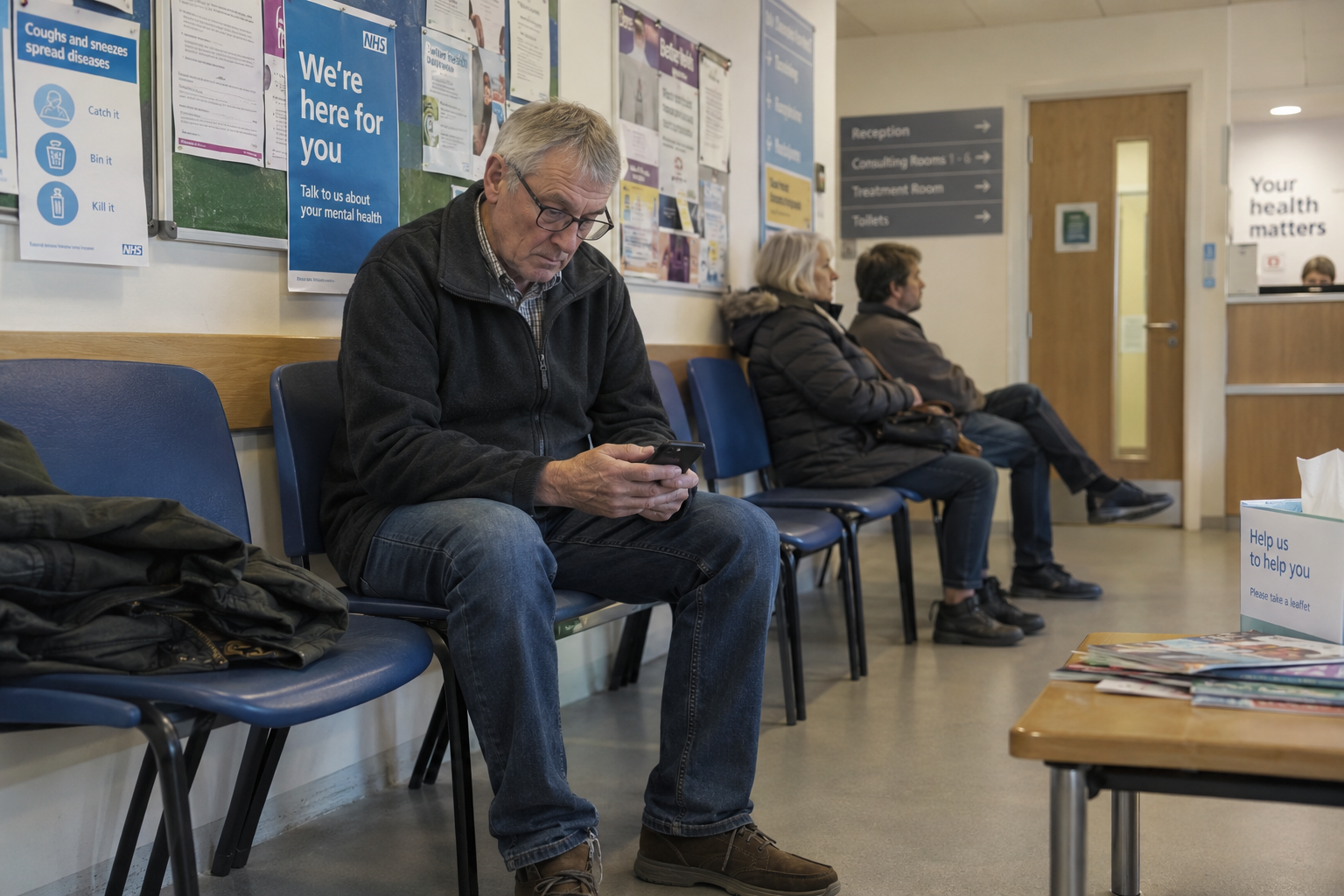
On the morning itself, I arrived at the surgery ten minutes early and joined the usual collection of people sitting on plastic chairs, surrounded by curling health leaflets and posters telling us about various bits of ourselves that might require attention.
Nobody spoke. Nobody made eye contact. It was a British GP waiting room, after all, not a cocktail party.
I tried reading a poster about flu vaccinations, followed by one about blood pressure. Then, in a moment of spectacularly poor judgement, I took out my phone and Googled urinary symptoms.
Don't do this.
Within about four minutes I'd mentally diagnosed myself with everything from a minor infection to conditions that probably hadn't been seen in Middle England since Queen Victoria was on the throne.
Then the little screen on the wall beeped and summoned me to Room 4.
After months of avoiding the conversation, there was no getting out of it now. I put my phone away, headed down the corridor and prepared to discuss my plumbing with a complete stranger.
Retirement really hadn't turned out quite as advertised.
Apparently, Doctors Ask Questions
My GP was a pleasant chap, probably somewhere in his forties, who greeted me as though discussing the intimate details of my bathroom habits was the most ordinary thing he'd do all morning.
For him, I suppose it probably was.
He asked what had brought me in, which gave me my first opportunity to discover just how difficult it is to describe something you've spent months pretending isn't happening.
"Well, I've been getting up a bit in the night."
How often?
"Two or three times, usually."
How long had that been happening?
"A while."
He wanted something slightly more medically useful than "a while", so I thought about it properly and realised we'd gone well beyond a few weeks. I couldn't give him an exact date, but it had been many months and things had gradually become more troublesome.
The questions continued. Was my stream weaker? Did I sometimes struggle to get started? Did I ever feel as though my bladder hadn't completely emptied? Any pain? Any blood? What about the urgency I'd been experiencing during the day?
I'd treated these things as separate little annoyances. Hearing myself reel them off in one conversation made the whole business sound rather less trivial.
The doctor didn't appear alarmed, which helped enormously. He explained that urinary problems become more common as men get older and that several things can cause them. One possibility was an enlarged prostate, but he wanted to investigate properly rather than jump to conclusions.
I nodded thoughtfully, as though the word prostate hadn't caused every health article I'd ever half-read to come charging into my head at once.
This is another peculiar male talent. We can know perfectly well that we possess a prostate for sixty years while maintaining only the vaguest idea of where it is or what the thing actually does.
Mine, apparently, had finally decided to introduce itself.
Then Came the Tests
The first part was straightforward enough. We discussed my general health and medications, and the doctor explained that I'd need to provide a urine sample and have some blood tests.
Fair enough. I'd had blood taken before.
Then he mentioned a physical examination.
There are certain phrases capable of instantly altering the atmosphere in a room, and "I'd like to examine your prostate" sits fairly high on the list.
He explained what he wanted to do and why. I'll spare you the detailed commentary because this is supposed to be a health blog, not revenge on my readers, but the examination itself was over remarkably quickly.
That was perhaps the daftest part of the whole business. I'd spent months building the prospect of a prostate examination into something enormous, only to discover it took less time than choosing a sandwich in Tesco.
My GP was completely matter-of-fact throughout. Afterwards, he explained that the prostate seemed enlarged, although that finding needed to be considered alongside my symptoms and the other tests rather than treated as the whole answer.
He also reassured me that an enlarged prostate is common as men age and doesn't automatically mean prostate cancer. That was certainly good to hear, although once your brain has opened that particular cupboard, it does have an irritating habit of wandering back for another look.
When I left the room, I felt unexpectedly lighter.
Nothing had been solved yet, but for the first time in months somebody who actually knew what he was doing was investigating it.
Professor Hart's home diagnostic service could finally take the afternoon off.
Me, Google and a Very Bad Idea
There were still the urine and blood tests to deal with. My GP explained that one of the blood tests could include a PSA test, which doctors can use alongside symptoms, examination findings and other information when assessing prostate problems.
Importantly, he told me PSA wasn't some magical yes-or-no answer. Levels can vary for different reasons and needed to be interpreted in context.
That was perfectly clear.
Naturally, I went home and Googled PSA levels.
Not excessively, you understand. Just enough to frighten myself, reassure myself, frighten myself again and finally conclude that the internet contains approximately seventeen different answers to every medical question ever asked.
My wife caught me reading yet another page on my phone.
"What are you looking at now?"
"Nothing. Just reading."
"You're Googling it, aren't you?"
I put the phone down.
There's very little point arguing with someone who's known you for decades. They have access to historical evidence.
Instead, I got on with things. I pottered about in the garden, found a couple of jobs in the shed and generally attempted to leave the medical interpretation to people who hadn't received their qualifications from a search engine.
When the surgery contacted me to discuss everything, I still felt that little knot in my stomach. The difference was that this time I was ready to hear what they had to say.
Finally, It Had a Name
Taking the symptoms, examination and test results together, my doctor explained that his assessment was that benign prostatic hyperplasia, usually shortened to BPH, was the likely cause of my problems.
In normal English: an enlarged prostate.
I'll admit that my attention initially became rather attached to the word benign.
He explained that the prostate commonly grows as men get older. Because of where it sits in relation to the urethra and bladder, that enlargement can cause the sort of symptoms I'd been experiencing: a weaker stream, difficulty getting started, urgency, the sensation that the bladder hasn't emptied properly and, of course, those increasingly tiresome nighttime expeditions to the bathroom.
Suddenly, all those apparently unrelated annoyances I'd been collecting began to fit together.
I felt relieved, although not in a right then, that's sorted, who's coming to the pub? sort of way. I still had symptoms that needed managing, and the doctor made it clear that urinary and prostate problems shouldn't simply be ignored because BPH happens to be common.
The big difference was that I finally had a sensible explanation.
I'd spent months blaming tea, beer, ageing, poor sleep and probably the weather at some point. Now somebody had actually joined the dots.
And there was an uncomfortable lesson hiding in there too. I'd devoted an extraordinary amount of energy to avoiding an answer that, once I had it, made me feel considerably better.
So, What Happens Now?
Once the relief settled, the engineer in me took over.
Right. We've identified the likely fault. What are we going to do about it?
My GP explained that BPH doesn't affect every man in the same way. Some people have relatively mild symptoms that can be managed with lifestyle changes and monitoring, while others benefit from medication. There are further treatment options when symptoms are more troublesome or complications arise.
We talked about some of the things I'd already tried, including drinking less before bedtime and being a bit more sensible with caffeine and alcohol. There were other practical suggestions too, although I was quietly disappointed to learn that none involved being prescribed a fortnight somewhere warm.
Then we got onto medication.
The doctor explained the type of medicine he thought might help, what it was intended to do and the possible side effects. I asked a few questions and came away feeling reasonably positive about trying it.
I wasn't expecting miracles. A decent night's sleep, fewer urgent searches for the nearest loo and rather less of my daily routine being dictated by my bladder would have suited me nicely.
For once, I decided to follow the sensible advice rather than developing another Professor Hart treatment programme involving reduced tea consumption, crossed fingers and stubborn optimism.
As it turned out, things didn't go quite as neatly as I'd hoped.
What I Wish I'd Done Differently
Looking back, I don't regret developing prostate trouble because I didn't get much say in that. What I do regret is how good I became at accommodating it.
I'd changed when I drank, started thinking about toilets before going somewhere unfamiliar, accepted broken sleep and gradually lowered my expectations of what constituted a normal day. Each adjustment seemed minor enough on its own, but put them together and I'd spent months organising more and more of my life around a problem I hadn't properly identified.
All that effort, when one GP appointment finally gave me something considerably more useful than another workaround: information.
If you're a bloke of a certain age, you'll probably recognise the temptation to "see how it goes". It's a wonderfully flexible phrase. You can see how it goes for a week, then another fortnight, and somehow find yourself six months down the road still conducting the same experiment with remarkably similar results.
I became exceptionally good at seeing how it went.
Finding out what was likely happening wasn't the end of my story. In many ways, it was where things properly began.
I went home with a treatment plan, considerably more knowledge about my prostate than I'd ever expected to acquire, and the mildly smug feeling that I'd finally done the responsible thing.
That smugness wouldn't survive indefinitely.
Next time, I'll tell you what happened when I started the medication, why at first I thought we might have cracked it, and why I eventually found myself wondering whether swapping one collection of annoyances for another was really much of a victory.
Until then, take care of yourselves. If your body's been nagging you about something for a while, perhaps give it a fair hearing.
Mine had been trying to get through to me for months.
I was apparently screening its calls.
Terrance Hart