The Restaurant Rule That Finally Stopped My Overeating
I ate reasonably at every restaurant I visited. Then I'd come home and eat cold pasta from a container at 10 PM. The difference was never me — it was the structure. Here's the system that changed everything.
Picture this. It's 10 PM. The house is dead quiet. Everyone is asleep. And there you are — standing barefoot in front of the open refrigerator, cold air on your feet, eating leftover pasta straight from a Tupperware container. Maybe with a fork, maybe without. You're not sitting down. You're not plating it. You're just... eating. And somewhere in the back of your mind, there's this small, uncomfortable awareness that you're not even really that hungry. But you can't stop. And the worst part — the part that'll keep you up if you think about it too hard — is that you don't even know why.
That was me. For years, that was me.
And what made it so maddeningly confusing was this: I didn't have this problem at restaurants. Not even a little bit. I'd go out to dinner, order something reasonable, eat it, feel genuinely satisfied, and just... stop. Sometimes I'd leave food on the plate without a second thought. I'd casually decline the dessert menu. And then I'd drive home and eat half a bag of crackers in front of the TV without even realizing I was doing it.
What is that? How does that make any sense?
I spent a long time thinking I just had a willpower problem. That I loved food too much. That some people are built with natural portion control and I simply wasn't one of them. Turns out, I was looking at the wrong thing entirely. The problem was never me. The problem was my environment. And once I finally saw that clearly — standing at the fridge at 10 PM, Tupperware in hand — everything changed.
It was never a willpower problem. It was always an environment problem. And environment is something you can actually change. — The insight that started everything
So let me take you back to that night. Tupperware. Cold pasta. 10 PM. The lightning bolt thought that hit me was simple but devastating in its clarity: I would never do this at a restaurant.
Not just the standing-at-the-fridge part. The whole pattern. At a restaurant, I don't sneak bites while the food is being plated. I don't go back for seconds. I don't graze through the kitchen for an hour after the meal ends. I order one thing, it arrives, I eat it, I feel satisfied, and the meal is simply over.
So what was restaurants doing that my home kitchen wasn't?
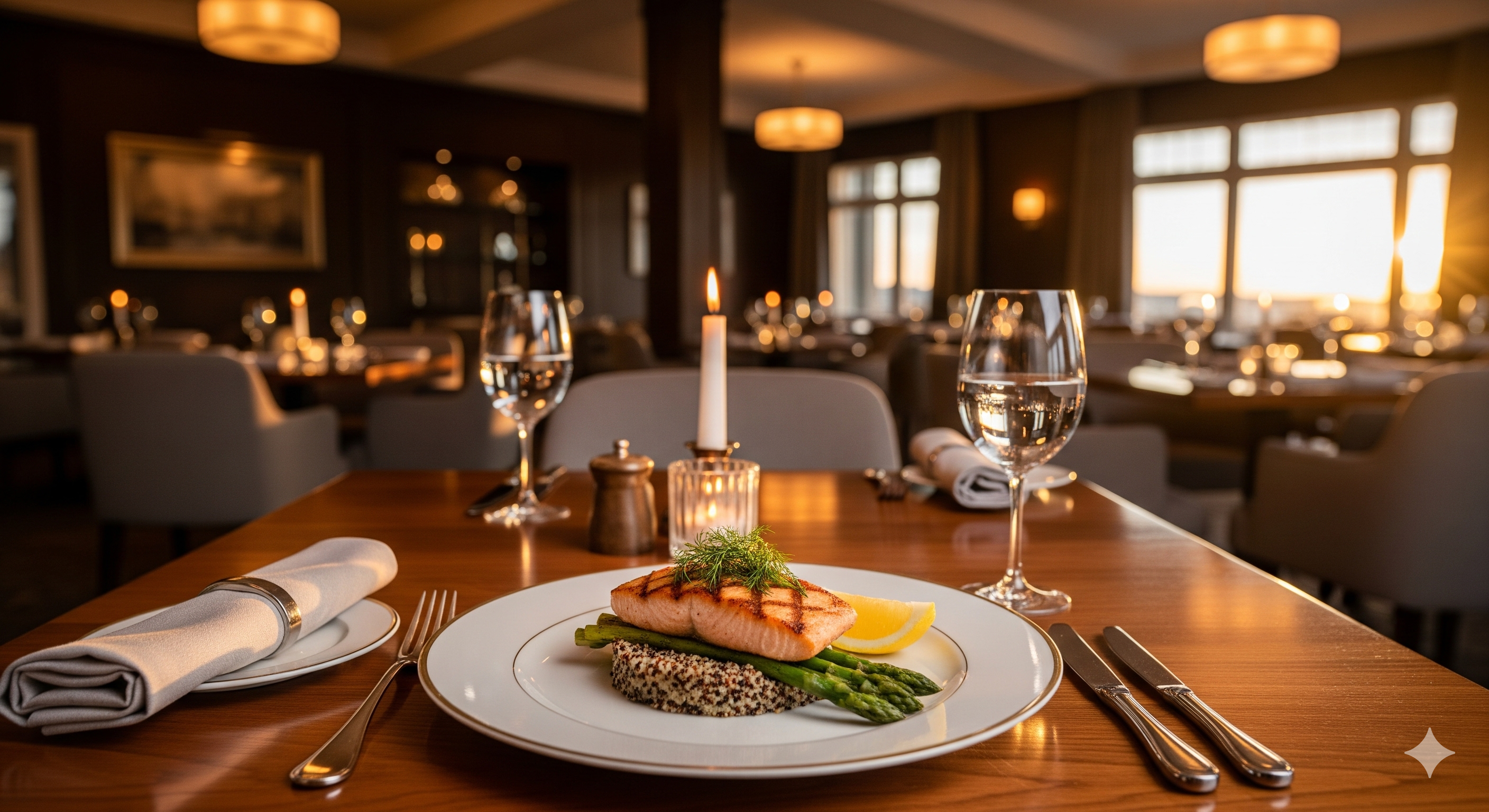
I started breaking it down. At a restaurant, you make one decision before the food ever appears. You order from a menu. The kitchen makes exactly that amount. A server brings it to the table, already portioned, already plated. There's no pot of pasta sitting next to you. No giant serving bowl of anything calling your name while you eat. The meal has edges. It has a beginning and a clear, defined end.
At home? I was doing the exact opposite of every single one of those things. Cooking huge batches. Putting the pot on the table. Serving myself while still standing. Going back while still deciding if I was full. Eating bites during cleanup. And then wandering to the pantry an hour later, not sure if I was hungry or bored or just looking for something to do with my hands.
When I saw the difference laid out that clearly, the question answered itself: What if I just brought the restaurant structure home? Not the food. Not the service. Just the design — the environmental setup that makes eating a contained, intentional, complete experience.
That's what I now call the Restaurant Rule. And six months after building it into my life, I had lost 18 pounds — without counting a calorie, giving up a food I loved, or using a single ounce of willpower.
RESTAURANT
- Choose from a menu
- Kitchen preps exact portion
- Plated meal arrives at table
✓ Meal ends. Clear boundary.
HOME (BEFORE)
- Cook huge batch, decide later
- Serving dishes on the table
- Eat while cooking, cleaning
- Graze at 10 PM from Tupperware
The Five Rules That Recreate Restaurant Structure at Home
Here's where it gets practical. These aren't abstract concepts — each one is a specific, actionable change you can make starting tonight. I'd encourage you to implement them one at a time, in order, the way I did. Stacking too many changes at once is how people burn out and quit. One rule, mastered, is worth more than five rules half-heartedly attempted.
- Rule One · The Foundation
Plate Your Food in the Kitchen — Always
At restaurants, your food arrives already portioned. There's no serving bowl of mashed potatoes at the table tempting you for more. Do the same at home: plate your exact portion in the kitchen, put all leftovers in containers in the fridge before you sit down, and bring only your plate to the table. Research shows we eat 20–30% more when serving dishes are within arm's reach — that's the proximity effect, and it has nothing to do with hunger. Removing the food from the table creates a "friction point" that gives your brain the 15–20 minutes it needs for satiety signals to arrive.
Rule Two · The Pre-Decision
Decide Your Portion Before You Cook
At a restaurant, you commit to your order before you ever see or smell the food. That's intentional — it removes the decision from the peak temptation moment. Apply this at home: before you turn on the stove, decide exactly how many servings you're making and what each one is for. Write it on the container. "Monday lunch." "Tuesday dinner." That label transforms "extra food" into a future meal with a purpose — and the psychological commitment that comes with that label is surprisingly powerful. You're not avoiding seconds; you're being honest about what the food is actually for.Rule Three · The Friction
Make Seconds Genuinely Inconvenient
Getting more food at a restaurant requires real effort — flagging a server, waiting, ordering. That friction gives your body time to assess whether it actually wants more. At home, seconds require zero effort. So create some: immediately after plating, portion all leftovers into individual containers and put them away. Now "a little more" means committing to an entire second meal from a sealed container labeled for tomorrow. Ask yourself honestly: am I hungry enough for a full second meal? Ninety-nine times out of a hundred, you'll realize you're not. That's not willpower. That's just honest assessment with the right framing.Rule Four · The Presentation
Plate It Like You Mean It
This is the rule I was most skeptical about. It's also the one that surprised me most. When you take 30 seconds to arrange your food with intention — on an actual plate, at a cleared table — you signal to your brain that this is a complete, satisfying meal. Studies confirm people report higher satisfaction from the same amount of food when it's presented attractively versus carelessly served. More than that: when you've created a "finished" meal, going back for more means dismantling that sense of completion. The effort you put in creates a subtle but real psychological finish line.Rule Five · The Closure
Give the Meal a Clear Beginning and End
Restaurant meals have a shape: you arrive, you order, you eat, the plates are cleared, you leave. The ending is unambiguous. At home, meals bleed into everything — eating while cooking, while cleaning, while watching TV, and then grazing for hours after. The fix: set a meal start time. Don't taste food while cooking beyond one intentional seasoning check. Sit at a cleared table. And when the meal is done — brush your teeth immediately. That minty freshness is the most effective "kitchen is closed" signal I've ever found. It's not restrictive. It's a hard stop. Late-night snacking nearly disappeared for me within two weeks of adding this single habit.
The Advanced Rules That Took It Further
Once the five core rules were locked in, I found a few more restaurant behaviors worth stealing. These aren't essential for the first week, but they'll significantly level up your results once the foundation is solid.
The "No Reservations Available" Rule
When a restaurant runs out of the special, you can't have it. You pick something else. At home, we do the opposite — we keep backup snacks, frozen pizzas "just in case," emergency crackers, abundance upon abundance. That abundance works against us. When there's always something to eat, we eat from availability rather than hunger. I stopped keeping backup easy foods. If I've meal prepped five dinners, I have five dinners. When they're gone, I'm out — just like a restaurant that's closed the kitchen. This forces me to actually eat the portions I planned, rather than treating my planned meals as the starting point and the backups as the real food supply.
The "Prix Fixe Menu" Rule
Prix fixe is a restaurant concept where you choose from a set menu — maybe three courses, fixed price, limited options. Instead of forty decisions, you make four. I applied this to my meal prep by building a rotating roster of eight to ten meals I know well and genuinely enjoy. Every Sunday, I cook two or three of them. Every day, I'm "ordering" from pre-made options — not starting from scratch. Decision fatigue around food is real. When you come home exhausted and face an empty kitchen with infinite choices, depleted brains make terrible choices. Pre-made options eliminate that moment of vulnerability entirely.
The "Fine Dining Pace" Rule
At a nice restaurant, there's a natural cadence to the meal. Courses arrive with pauses between them. You might be there for 90 minutes. At home, most of us eat a full meal in under ten minutes — shoveling food faster than our bodies can process that it's receiving anything. I introduced what I call the halfway checkpoint: when my plate is half empty, I put my fork down, drink some water, and sit for two or three minutes. Then I honestly ask: on a scale of one to ten, how satisfied am I right now? Almost every time, I realize I'm already at a six or seven — meaning the second half of the meal will bring me to comfortably full. That small pause completely changed my relationship with satiety.
The Psychological Shift That Makes This Stick
Here's what I really want you to understand — not just the tactics, but the underlying shift in how I think about eating at home now.
For most of my life, I operated on an unconscious belief: home eating is different from restaurant eating. At home, eating was casual. Informal. Ongoing. There were no rules, no structure, no clear endings. That was the freedom of being home. Nobody's watching. Nothing's formal.
But that "freedom" was actually the problem. Because human beings didn't evolve in environments with unlimited access to calorie-dense food at all hours of the day. Our instincts are calibrated for scarcity, not for the fully stocked modern kitchen. In the absence of structure, we default to: eat what's available, when it's available, in whatever amount is in front of you. That's not weakness. That's biology doing exactly what it was designed to do in an environment it was never designed for.
Structure doesn't restrict. Structure enables. When a meal has a clear ending, the question "should I eat more?" simply doesn't arise. — Six months into the Restaurant Rule
Before the Restaurant Rule, I was thinking about food almost constantly between meals. Not obsessively — just a low-level background hum. I wonder if I should have a snack. I kind of feel like something sweet. What do we have in the kitchen. I'll just see what's in the fridge. All day, every day, this running negotiation between me and my own appetite.
After six months of the Restaurant Rule, that mental hum is simply gone. Meals happen. They're satisfying. They end. And between them, I'm just living. I'm not managing cravings, battling urges, or making endless food decisions. The mental bandwidth I got back from eliminating that constant negotiation is, honestly, the biggest benefit of this entire system. And it's one I never saw coming.
Okay But What About...
I've shared this system with a lot of people, and certain objections come up consistently. Let me address them directly.
"What if I'm genuinely still hungry after my portion?"
Then eat more. Seriously — this isn't a restriction system. The rule is not "never eat seconds." It's "make seconds a conscious, deliberate decision rather than a reflexive response to food availability." If you've waited fifteen minutes and you're genuinely still hungry for another full portion, open the container and eat. Honor real hunger. The entire goal is to eliminate eating that has nothing to do with hunger — not to white-knuckle through actual hunger. Those are very different things.
"This sounds like a ton of work."
Two hours of meal prep on Sunday creates 10–12 full meals. That's roughly 10–12 minutes per meal. Compare that to figuring out what to make every single night, cooking it, cleaning up, and probably ordering takeout twice because you were too tired to cook. The Sunday prep actually saves significant time. And the mental energy saved from eliminating daily food decisions is harder to quantify but very real.
"What about cooking for a family? I can't control everyone else's portions."
You don't have to. You plate your own portion in the kitchen while keeping serving dishes on the table for everyone else. Or — and this is what many families end up doing — keep family-style serving for weekends and special occasions, and do individual plating on weeknights. Adapt it to your situation. The rules are a framework, not a rigid script.
"Isn't this just portion control with extra steps?"
Yes. In the same way a seatbelt is just "don't fly through the windshield with extra steps." The steps are the mechanism. "Just eat less" doesn't work because it requires constant, active willpower in an environment designed to make you eat more. The Restaurant Rule works because the steps create friction, structure, and decision points that let your biology catch up with your intentions. The extra steps aren't obstacles. They're the whole point.
Six Months Later
I didn't start this to lose weight. I started it because I was tired of my relationship with food. Here's what happened anyway.
⚖️ Lost 18 pounds without tracking a single calorie, restricting any food type, or feeling deprived at any point.
🌙 Late-night snacking stopped completely within the first two weeks. Something I'd struggled with for years, gone.
🛒 Grocery spending dropped by about 30% — less waste, no impulse snacks, actually eating what I bought.
🍽️ Enjoyed meals more. Eating intentionally instead of mindlessly made the actual experience of food better, not worse.
🧠 Stopped thinking about food between meals. That constant low-level mental hum — gone. Just living my life between eating events.
The 7-Day Restaurant Rule Challenge
Don't try to implement all five rules on day one. I've watched people do that and burn out by Wednesday. Here's the staged approach that actually works — one rule at a time, building on each other.
- Plate in kitchen
- Leftovers away first
- Pre-decide portions
- Label containers
- Plate with intention
- Brush teeth after
- Full system, all rules
Days 1–2: Only Rule #1. Plate in the kitchen. Leftovers in the fridge before you sit. Nothing else.
Days 3–4: Add Rule #2. Before cooking, decide exact portions. Pre-label your containers.
Days 5–6: Add Rule #4 and #5. Plate with care. Sit at a cleared table. Brush your teeth when done.
Day 7: Full implementation. All rules active. Notice how different dinner feels as a structured event.
Week 2+: Add the advanced rules — No Reservations, Prix Fixe Menu, Halfway Checkpoint.
You Are Not Broken. Your Environment Was.
I spent years believing I had a self-control problem. A discipline problem. A character flaw that made me fundamentally different from people who naturally ate reasonable amounts. I tried willpower-based approaches over and over. "Just stop eating when you're full." "Just have more self-control." "Just eat smaller portions." All of it failed, repeatedly, because I was fighting my environment with my psychology — and psychology loses that battle almost every time.
The Restaurant Rule isn't about restriction. I eat the same foods I always loved. I'm not tracking macros. I'm not avoiding anything. I've simply recreated the structural boundaries that restaurants naturally provide — and those boundaries freed me from the exhausting, constant mental negotiation of "should I eat more?"
If you eat reasonable amounts at restaurants and then struggle to stop at home, you don't have a hunger problem. You have a structural problem. And structural problems are something you can actually fix — starting tonight, with one container, one cleared table, and thirty seconds to plate your food like it matters.
Because it does matter. And so do you.
"I don't think about food between meals anymore. Meals are contained events, and between them, I'm just living my life."
Watch Video