Upside-Down Logic: Tales from a Topsy-Turvy World
Fairy tales? I’ve heard and read many. But Enid Blyton didn’t just tell stories — she carried me into an entirely imagined world. Even now, I haven’t come across fiction that felt quite as absorbing as hers… or maybe it was the age, when imagination came without effort and belief didn’t need proof.
I think I have read most of her work she wrote for ages five to twelve. Elves, pixies, fairies, goblins — I didn’t learn about them, I met them through her pages. Her worlds felt familiar, like places you could accidentally wander into and never question how you got there. While reading this assignment by @weisser-rabe in Dream Steem, asking us to retell a fairy tale in a modern, catapulted way, my mind kept drifting back to one particular place — Enid Blyton’s topsy-turvy world. The one where logic was flipped, rules were bent, and everything strange somehow made perfect sense. So this is my attempt — not to rewrite her work, but to share something that may or may not resonate with you, in this upside-down world we live in... The Land of Topsy-Turvy (A little sneak peek into the original story⬆️) And now we come to this: In a Very Sensible Office It was one of those offices where everyone was very decent, very polite, and permanently annoyed. People said “Hope this finds you well” even when they hoped nothing of the sort. They signed emails with Warm regards while grinding their teeth. The printer had been broken since before the holidays, but nobody mentioned it directly. Directness was considered rude. One day, a young intern, the kind who still believed problems were meant to be solved, sent an email. Nothing dramatic. Just tired. “For fuck sake, the printer is jammed again.” That was it. The office didn’t explode. It paused. Like when a child says something too honest at a family gathering and all the adults suddenly remember manners. Meetings were cancelled. HR clutched pearls they didn’t own. The Legal Department convened immediately to discuss The Sake Question. “Is it fuck or fucks?” asked one committee member. Someone cleared their throat. Someone else adjusted their chair. A meeting was called, not about the printer, of course, but about fuck in the sentence. “Is it one fuck or many?” People who had never given a single fuck in their professional lives suddenly became very concerned about ownership. Emails multiplied. Entire threads ignored the actual problem — toner, paper, basic functionality — and focused instead on whether the phrase represented a lone, overworked fuck or the cumulative exhaustion of all fucks ever given. By lunchtime, which happened at 4 p.m. because nobody ever took breaks on time, the email had been rewritten six times. Softer. Politer. Emptier. “An emergency memo was released: Effective immediately, no fucks shall be referenced without prior approval..” The printer was still jammed. Someone replied: “Neither. It’s ‘for fuck’s sake’. The ‘sake’ is on behalf of the fuck, which makes it possessive. Get yourself together. This is a workplace.” Another someone added: “As many have pointed out, it should include an apostrophe to show possession. The real question, however, is whether it should be ‘for fuck’s sake’ or ‘for fucks’ sake’. Are we talking about the sake of all fucks, or just this particular one?” “That’s easy. It’s ‘for fuck’s sake’ — because generally we have zero fucks to give. So if, for some reason, a fuck is found, it is usually that one lone, single fuck for whose sake we are inquiring.” By evening, the office was on fire, metaphorically, emotionally, and eventually literally, yet the final email read: Apologies for any inconvenience this may have caused. The printer, naturally, survived another day. What the f***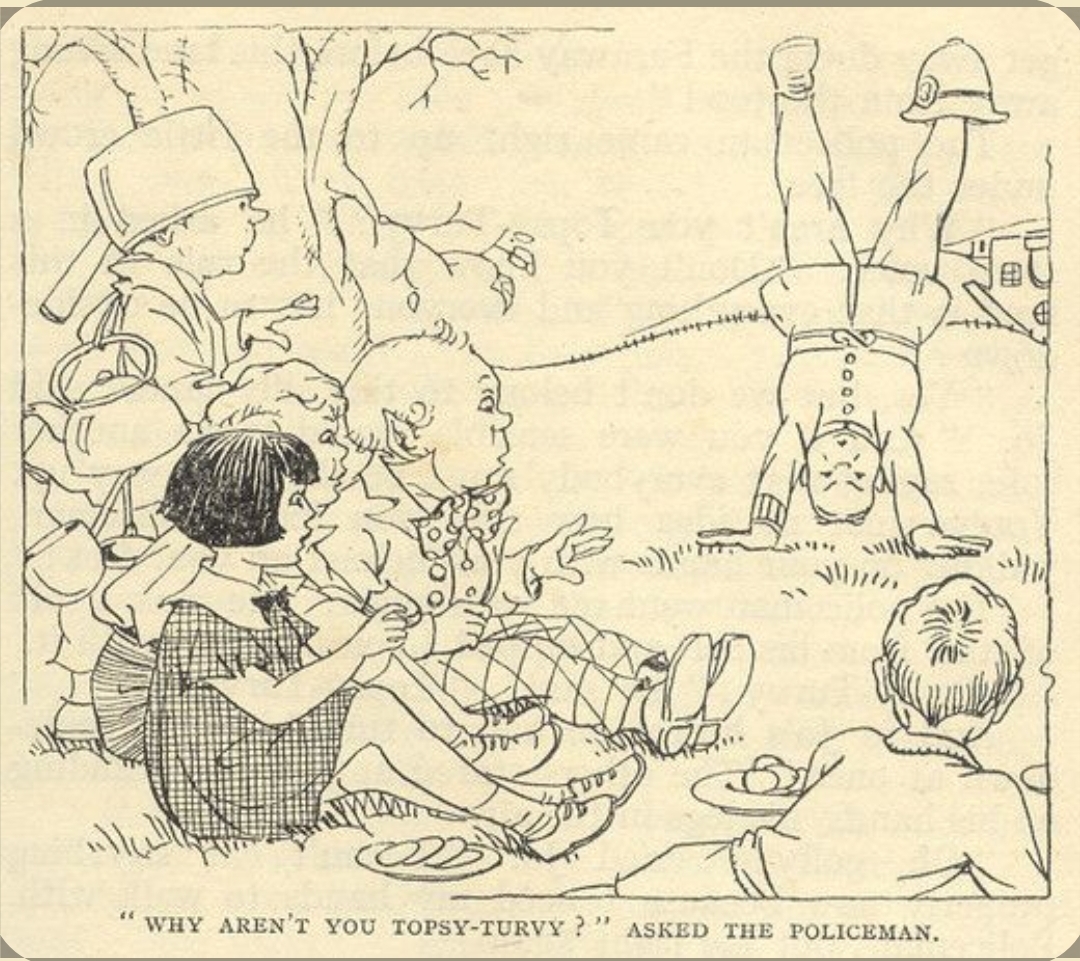
sr
The one where everything is backwards: houses hang from the sky, people walk on their hands with their feet in the air, the sea is made of sand, people say goodbye when they arrive, eat dessert first, and night comes in the morning… that delicious childhood confusion.
“Is the fuck singular or collective?” said another.
“And most importantly,” the chair whispered, “whose fuck is it?”
“Does the fuck belong to anyone?”
“Is this workplace-appropriate exhaustion or personal exhaustion?”