Advanced DeFi – Liquid Staking and Real-World Asset Integration [UA/EN]

Ліквідний стейкінг - що це таке?
Звичайний стейкінг криптовалюти, можна порівняти із класичним вкладом фіатних коштів на депозит. Де передбачено відсоток винагороди від банку, за їхнє використання. Лише із тією відмінністю, що це відбувається на блокчейні і тип активу дещо інший. В обох випадках, відбувається блокування ресурсу, і скористатись ним до повернення не можна.
Ліквідний стейкінг, має розширені можливості, схожі із кредитом під заставу. Тільки, відсотки будуть отримуватись, а не виплачуватись. А процедура простіша й швидша. Влаштовано це так:
- Підключається криптогаманець, до потрібної платформи;
- Криптовалюта направляється на блокування;
- Відповідно до її кількості, видаються ліквідні токени (SLT). Наприклад stETH.
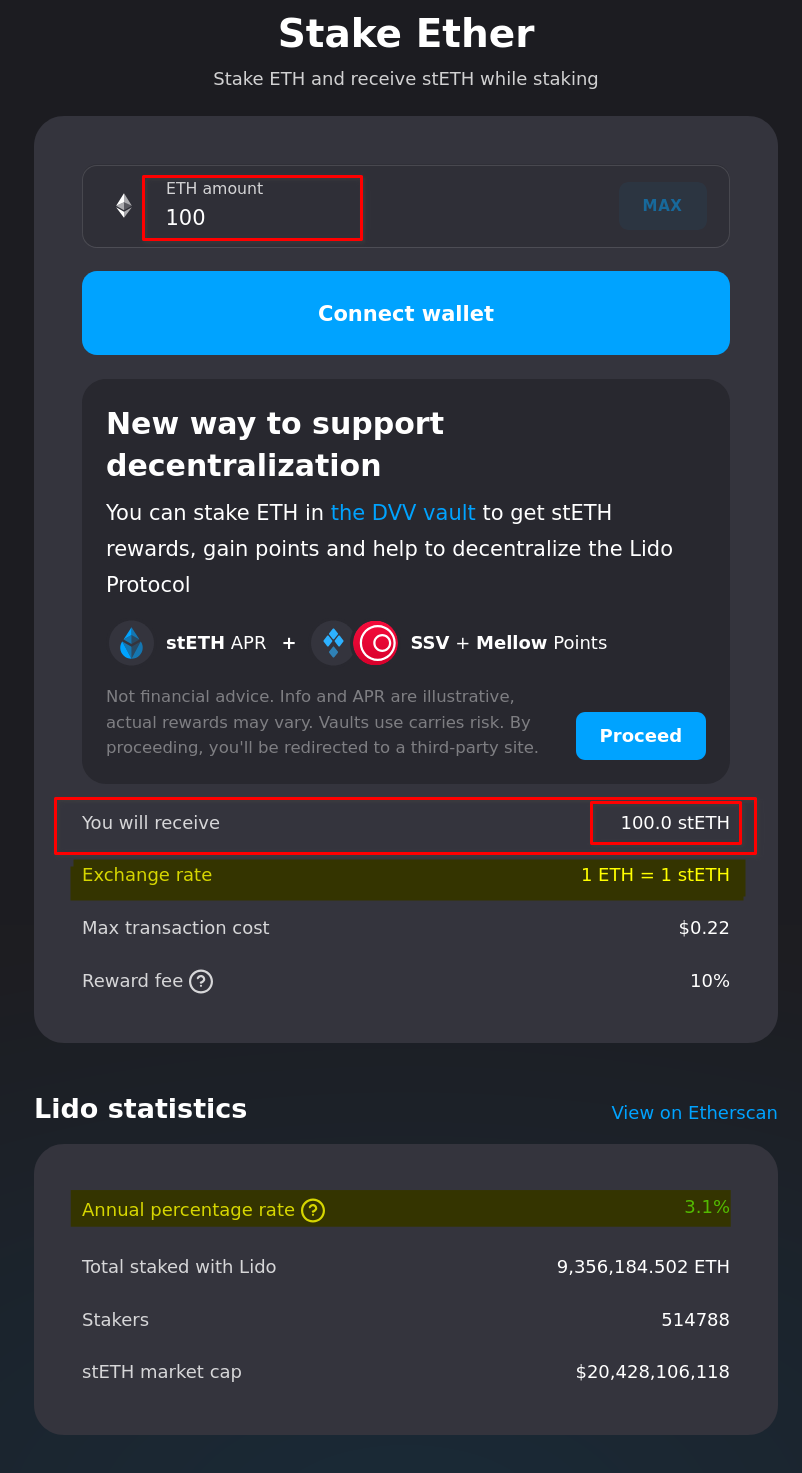
lido.fi
Приставка st біля імені ETH інформує що це ліквідні токени, однак саме маркування залежить від платформи надання послу. Це може бути stETH, rEHT та інші
Отримані SLT (або інші), доступні для різних маніпуляцій, щоб отримати додатковий дохід. А це:
- Рестейкінг;
- Надання ліквідності за винагороду;
- Участь у різних проєктах;
- Та багато іншого в категорії DeFi.
Якщо прикинути, то це дає розширений сценарій використання власних активів. Вклад собі лежить і приносить відсоток прибутку. А його еквівалент ще й активно бере участь в інших фінансових заходах.
Є в цьому одна підступна штука. Відсоток винагороди виражається не окремими нарахуваннями, а зростанням вартості самих stETH, які можна обміняти на базові у більшій кількості. Наприклад вкладено 100 ETH, а вартість stETH зросла до 1.001, тоді можна тримати назад 100.1 ETH.
Тож виходить, що stETH буде єдиним у розпорядження, без ніякого зв'язку із первинним токеном. І щоб його повернути SLT має бути у володінні. Що вимагає обережного поводження із ними.
Ризики можуть згадуватись у ЧаП, під формою проведення операції на платформі. Однак, до основних належать:
- Волатильність, якщо відбувається знецінення основної, то ймовірний відсоток прибутку вже не рентабельний. Це може призвести до депегу, коли прив'язка STL, бо базового активу втрачається;
- Якщо STL залучений в інших проєктах DeFi, то є загроза ліквідації активів. Тож палка з двох кінців;
- Смарт-контракт - він може мати помилки або бути вразливим для впливу третіх осіб;
- Централізація;
- Хакерські атаки.
Можливості токенізації реальних активів (RWA)
Токенізація RWA (активів реального світу) це можливість прив'язати їх до токенів, щоб реалізувати їх фінансові взаємовідносини у цифровому світі блокчейнів.
По суті це давно відомі інструменти із можливістю із можливістю долучення до DeFi. Адже це акції, нерухомість та багато іншого.
Переваги:
- менше посередників;
- без купи паперової роботи;
- швидкість обробки;
- економія часу;
- більша ліквідність;
- прозорість;
- розширення ринку;
- зниження мінімального порогу для інвестицій в дорогі активу, шляхом розділення їх на менші частки.
Тому, що це щось нове й лише набирає обороти, то й має багато викликів:
- відсутність регуляції на законодавчому рівні. Тому набуття та передача права власності, ще не визначена. Особливо гостро стоїть питання транскордонні операції;
- достовірнітсь даних, які треба подавати в блокчейн;
- волатильність ринку.
Приклади платформ, що дозволяють токенізацію RWA:
- Centrifuge: рахунки-фактури для підприємств;
- MakerDAO: використання RWA, у якості застави для кредиту;
- RealT: сфера нерухомості;
- Ondo Finance: облігації та фонди грошового ринку.
Практичні застосування ліквідного стейкінгу в DeFi

Перше коло ліквідного стейкінгу, це свого роду отримання доходу, як описано на початку теми. Друге коло відкриває додаткові можливості. Тобто вже наявні stEHT, можна додати у пул ліквідності для обміну. За що будуть надані токени LP (чи аналог), які можуть зростати у вартості для зворотного повернення stETH.


https://app.uniswap.org/positions/create/v2i
Наприклад на Uniswap можна додати створити пул із stETH.
Або додати до вже існуючого.


https://app.uniswap.org/positions/create/v2i
Ризики: Окрім згаданих раніше, це ще може бути зміна курсів у парах обміну ліквідності.
Більше кіл, передбачають можливість використання SLT для отримання кредиту в стейблкоїнах. Який потім направити для дохідного фермерства. За оптимістичних умов, це дає можливість зростання вартості на кожному колі токенів. Якщо їх потім розблоковувати у зворотному порядку. Також існує загроза більших збитків.
Приклад стратегії DeFi з ліквідним стейкінгом та RWA
Це складніший шлях, який розглядається за умови, що вже проаналізовано й обрано надійні платформи надання послуг.
Стратегія передбачає отримання подвійного доходу.
Складається із основних кроків:
- Стейкінг Token > SLT.
- SLT > позика в стейбілкоїнах із кредитним плечем.
- Інвестиції в RWA токени, наприклад нерухомість.
Оскільки кредит можна отримати в більшому обсязі, ніж кількість наявних активів, то придбані RWA будуть давати більше доходу.
Управління RWA:
- Бичачий ринок (коли маєбути): збільшена кількість RWA у володінні;
- Ведмежий ринок: просто очікування нової хвилі росту.
У разі втрати коштів, застава SLT буде просто ліквідована і все (але це не точно).
Розгляд сценарії
Оптимістичний гіпотетичний
Розглянувши приклад стратегії вище. То отримавши за SLT більше кредитних коштів у стеблкоїнах, їх можна вигідно інвестувати. Коли все складається успішно, то прибуток збільшується. В першу чергу через задіяну більшу масу капіталу. Який потім погашає кредит й ще має бути залишок. Далі SLT, який зростає у вартості відносно базового токена, теж обмінюється. Від чого крипти стає більше, як і потенційно отриманого за них фіату. А додатковим бонусом може бути зростання вартості, що вже буде потрійним доходом.
Реальний Terra (LUNA)
У 2022 році екосистема Terra (LUNA) розпалась на інвестиційному рівні. Тобто відбувся відтік капіталу через падіння вартості активів.
По-перше, це була система взаємопов'язаних механізмів і послуг на одному блокчейні. Де був власний стейблкоїн, ліквідний стейкінг, кредитування із плечем. Оскільки все залежало від монети LUNA, то її зниження призвело до ланцюгової реакції та втрати прив'язки до SLT. Цьому слугувало й велике кредитне плече до нього. Оскільки всі хотіли продати ліквідні токени, щоб вивести капітал у безпечну гавань й запобігти ліквідації. Це збільшило обсяги й ще більше відхилило ціну LST від LUNA.
В результаті на кожному рівні були збитки. Наразі функціонує нова версія Tera 2.0 із певними відмінностями.
Ключові висновки:
- Потрібно диверсифікувати ризики, тобто не зосереджувати капітал в одному місці;
- Проводити дослідження та звертати увагу, яку кількість кредитування і плечем надає сервіс;
- Обирати платформи та стратегії із більшим різноманіттям та кращим забезпеченням. Наприклад, ліквідний стейкінг у надійній криптовалюті, а кредитування вже в USDT.
Матеріал представлено для ознайомлення, який не є інвестиційними рекомендаціями
Використані джерела та ресурси:
- https://crypto.com/en/university/staking-vs-liquid-staking
- https://ripple.com/insights/real-world-asset-tokenization/
- Консультації із ШІ.
| EN translated by AI |
|---|
Liquid Staking - What is it?
Regular cryptocurrency staking can be compared to a classic deposit of fiat funds in a bank. Where a percentage of reward from the bank is provided for their use. The only difference is that it happens on the blockchain and the type of asset is somewhat different. In both cases, the resource is blocked, and it cannot be used until it is returned.
Liquid staking has advanced features, similar to a loan secured by collateral. Only, interest will be received, not paid. And the procedure is simpler and faster. It's structured like this:
- A crypto wallet is connected to the desired platform;
- Cryptocurrency is sent for blocking;
- According to its quantity, liquid tokens (LST) are issued. For example, stETH.
lido.fi
The prefix st near the name ETH informs that these are liquid tokens, but the marking itself depends on the service platform. It can be stETH, rEHT, and others
The received LST (or others) are available for various manipulations to generate additional income. Namely:
- Restaking;
- Providing liquidity for a reward;
- Participation in various projects;
- And much more in the DeFi category.
If you think about it, this provides an extended scenario for using your own assets. The deposit lies there and brings a percentage of profit. And its equivalent also actively participates in other financial activities.
There is one tricky thing about this. The percentage of reward is expressed not by separate accruals, but by the increase in the value of the stETH itself, which can be exchanged for the base ones in a larger quantity. For example, 100 ETH is invested, and the value of stETH has increased to 1.001, then you can get back 100.1 ETH.
So it turns out that stETH will be the only one at your disposal, without any connection to the primary token. And to return it, the LST must be in your possession. Which requires careful handling of them.
Risks can be mentioned in the FAQ, under the form of the transaction on the platform. However, the main ones include:
- Volatility, if the main one depreciates, the probable percentage of profit is no longer profitable. This can lead to a depeg, when the LST's peg to the base asset is lost;
- If the LST is involved in other DeFi projects, there is a threat of asset liquidation. So it's a double-edged sword;
- Smart contract - it may have errors or be vulnerable to third-party influence;
- Centralization;
- Hacker attacks.
Real World Asset (RWA) Tokenization Opportunities
RWA (Real World Asset) tokenization is the ability to link them to tokens in order to realize their financial relationships in the digital world of blockchains.
In essence, these are long-known instruments with the ability to join DeFi. After all, these are stocks, real estate, and much more.
Advantages:
- fewer intermediaries;
- no piles of paperwork;
- processing speed;
- time saving;
- greater liquidity;
- transparency;
- market expansion;
- lowering the minimum threshold for investing in expensive assets by dividing them into smaller shares.
Because this is something new and just gaining momentum, it has many challenges:
- lack of regulation at the legislative level. Therefore, the acquisition and transfer of ownership rights are not yet defined. The issue of cross-border operations is particularly acute;
- data reliability, which must be submitted to the blockchain;
- market volatility.
Examples of platforms that enable RWA tokenization:
- Centrifuge: invoices for businesses;
- MakerDAO: using RWA as collateral for a loan;
- RealT: real estate sector;
- Ondo Finance: bonds and money market funds.
Practical Applications of Liquid Staking in DeFi
The first round of liquid staking is a kind of income generation, as described at the beginning of the topic. The second round opens up additional opportunities. That is, the existing stEHT can be added to the liquidity pool for exchange. For which LP tokens (or an analog) will be provided, which can increase in value for the reverse return of stETH.
https://app.uniswap.org/positions/create/v2i
For example, on Uniswap, you can add and create a pool with stETH.
Or add to an existing one.
https://app.uniswap.org/positions/create/v2i
Risks: In addition to those mentioned earlier, this may also be a change in exchange rate pairs of liquidity.
More rounds involve the possibility of using LST to obtain a loan in stablecoins. Which is then directed to yield farming. In optimistic conditions, this allows the value of tokens to grow in each round. If they are then unlocked in reverse order. There is also a threat of greater losses.
Example of a DeFi Strategy with Liquid Staking and RWA
This is a more complex path, which is considered provided that reliable service platforms have already been analyzed and selected.
The strategy involves obtaining double income.
It consists of the following main steps:
- Token Staking > LST.
- LST > loan in stablecoins with leverage.
- Investments in RWA tokens, such as real estate.
Since a loan can be obtained in a larger volume than the number of available assets, the acquired RWA will generate more income.
RWA Management:
- Bull market (when it should be): increased number of RWAs in possession;
- Bear market: just waiting for a new wave of growth.
In case of loss of funds, the LST collateral will simply be liquidated and that's it (but that's not for sure).
Scenario Review
Optimistic Hypothetical
Considering the example of the strategy above. Having received more loan funds in stablecoins for the LST, they can be profitably invested. When everything is successful, the profit increases. First of all, due to the larger mass of capital involved. Which then repays the loan and there should still be a balance. Next, the LST, which increases in value relative to the base token, is also exchanged. From which there is more crypto, as well as potentially received fiat for them. And an additional bonus may be an increase in value, which will already be triple income.
Real Terra (LUNA)
In 2022, the Terra (LUNA) ecosystem collapsed at the investment level. That is, there was an outflow of capital due to the fall in asset values.
First, it was a system of interconnected mechanisms and services on one blockchain. Where there was its own stablecoin, liquid staking, leveraged lending. Since everything depended on the LUNA coin, its decline led to a chain reaction and loss of the LST peg. This was also facilitated by a large leverage to it. Since everyone wanted to sell liquid tokens to withdraw capital to a safe haven and prevent liquidation. This increased volumes and further deviated the LST price from LUNA.
As a result, there were losses at every level. Currently, a new version of Tera 2.0 is functioning with certain differences.
Key conclusions:
- You need to diversify risks, that is, not concentrate capital in one place;
- Research and pay attention to how much lending and leverage the service provides;
- Choose platforms and strategies with greater diversity and better security. For example, liquid staking in a reliable cryptocurrency, and lending in USDT.
The material is presented for informational purposes only, which is not investment advice
Used sources and resources:
- https://crypto.com/en/university/staking-vs-liquid-staking
- https://ripple.com/insights/real-world-asset-tokenization/
- Consultations with AI.
#ukraine #cryptoacademy-s23w3 #steemexclusive #crypto #defi #staking