Another threat looming over the solar system
in Popular STEM17 hours ago

Another threat looming over the solar system


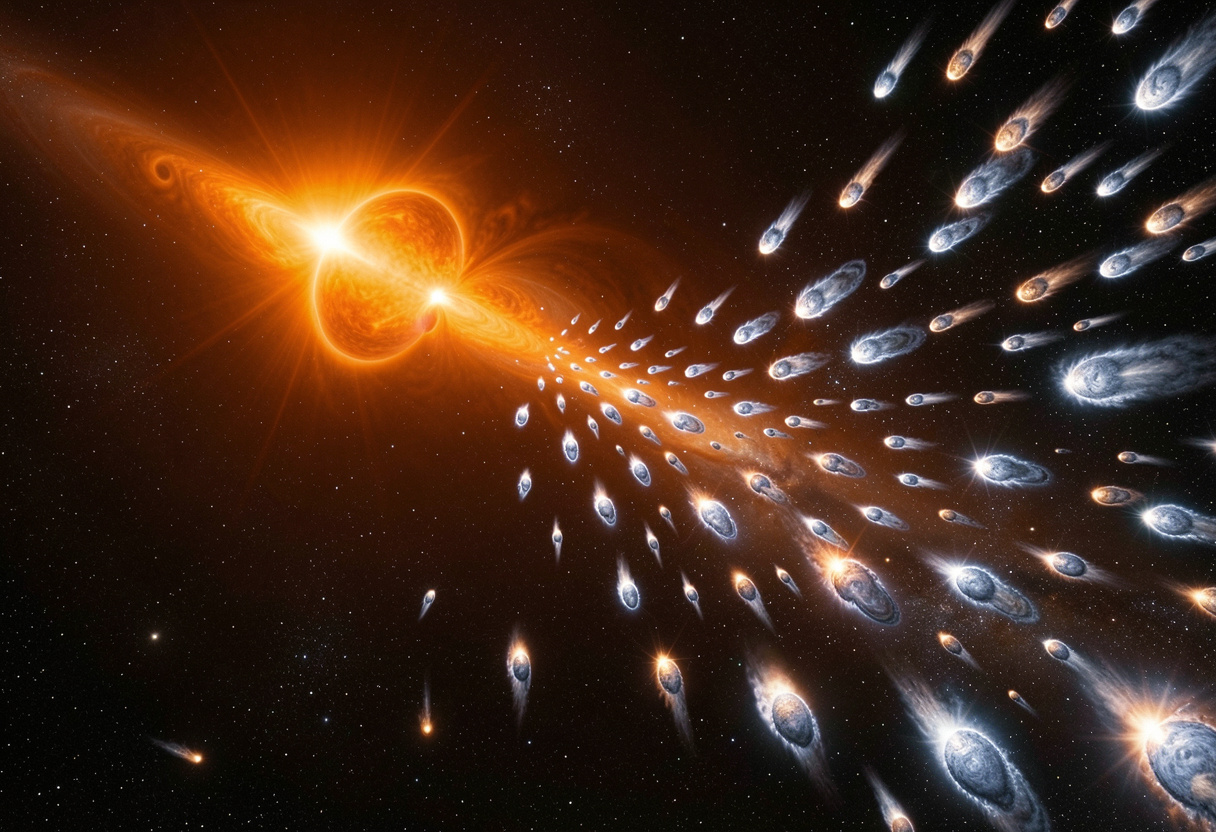
Our planet could face a cosmic cataclysm—a shower of comets capable of causing mass extinctions or even the total extinction of life on Earth. The outcome—specifically regarding total extinction—would depend on the comet's size: an object around 10 to 14 kilometers in diameter would trigger a mass extinction, but one exceeding 50 kilometers would mean the complete end of life on Earth. It would be catastrophic because, among other things, a 50-kilometer-wide comet could vaporize an entire ocean and drastically alter Earth's climate, potentially leaving the planet unable to recover from the impact.


Could this actually happen? Yes, because we have refined new data regarding an old star known as Gliese 710. And the news isn't good. What do we know about Gliese 710? It is an orange dwarf star. It has slightly more than half the mass of the Sun—a very respectable size; it is not a red dwarf, but a substantial star in its own right. It is also presumed to have a significant habitable zone where planets could exist—though, notably, we haven't discovered any yet, it is entirely possible that it has them.


It is currently located about 62 light-years away in the constellation Serpens, but the interesting part of this story begins in approximately 1,340,000 years—give or take a couple of thousand years, as estimates of the timeline have been refined. That is when it will make a very close approach to our solar system; in fact, when the star was first discovered—and it was realized that it was moving toward us (or we toward it)—initial predictions suggested it would pass within one light-year of the Sun.


Let us recall that the star currently closest to us is Proxima Centauri, located 4.2 light-years away. A distance of one light-year would correspond to the radius of the solar system—extending to the outermost comet still gravitationally bound to the Sun (albeit weakly), marking the solar system's ultimate gravitational boundary. However, calculations based on refined data indicate that the star will not pass at a distance of one light-year, but rather at 2.4 light-months; it will not merely skirt the edge of the Oort Cloud—the solar system's outer region—but will plunge directly into it at a distance of about 13,000 astronomical units.


This is far closer than any other star will come in the foreseeable future; for context, Pluto is about 40 astronomical units away. These findings were achieved using data from Gaia—a space observatory and European Space Agency mission—combined with ground-based observations from the CARMENES instrument, located at the Calar Alto Observatory in Almería, Spain. One of the new findings is that this star is traveling slightly slower than previously thought; this is actually quite inconvenient for us, because traveling more slowly means it will pass closer to us.


What are the implications? Well, for the moment, it won't be a problem for the planets, because it will pass very far away from bodies like Earth, Neptune, Jupiter, and so on. The diameter of the solar system is about 8 light-hours and 20 light-minutes—since Neptune is 4 light-hours and 10 light-minutes away. By the end of this year, Voyager 2 will be one light-day away, so we are nowhere near the 73 light-days at which this star will pass. Of course, this isn't a comet or an interstellar object like 3I/Atlas; it is a star with a little over half the mass of the Sun. Gravitationally, then, it could throw the comets in the Oort cloud into chaos, potentially triggering comet showers toward the inner solar system.


Furthermore, Gliese 710—like the vast majority of stars similar to ours (since, even though it is an orange dwarf, it falls into the category of stars similar to the Sun)—almost certainly has its own Oort cloud; it might be smaller, but it exists. Given that its mass is just over half the Sun's, let's assume a radius of one light-year for its Oort cloud; the cloud's reach might extend to, say, six light-months. This means the outer edge of this star's Oort cloud will reach the planetary zone. Admittedly, there would be very few objects at that outer boundary—most would be concentrated closer to the star—but the situation would still be chaotic.


This star has another notable characteristic: it is very young—only 300 million years old. It might have planets, though they could still be in the process of forming; we haven't found any yet. However, its youth is actually a disadvantage for us, as it implies that its Oort cloud, comet zones, and Kuiper belt will be much denser. It retains far more material from its formation era—whereas our own solar system has spent 4.5 billion years clearing away those original comets and primordial matter, this star has only had 300 million years, so it hasn't been able to clear much of it out.


Consequently, in 1.3 million years, things could get quite complicated for anyone still in that solar system.


Source


The images without reference were created with AI
Thank you for visiting my blog. If you like posts about #science, #planet, #politics, #rights #crypto, #traveling and discovering secrets and beauties of the #universe, feel free to Follow me as these are the topics I write about the most. Have a wonderful day and stay on this great platform :) :)


! The truth will set us free and science is the one that is closest to the truth!