The first products manufactured in space.
in Popular STEM3 days ago

The first products manufactured in space.


On September 24, 1970, something happened that is not in the history books and that is little talked about, but it is that the Soviets achieved something extraordinary, they reached the moon, collected samples and brought them to Earth, it was with a robotic mission, not a human mission, Luna 16, but this meant that, if there was a scientific interest in studying lunar material in detail, it was no longer necessary to send humans. It was enough to send a robotic probe for a much lower cost than that of the Apollo missions.

At that time there was “nothing” on the moon with which to pay the expense of human travel to the Moon, nor of the establishment of a base there on the Moon, and neither in the United States nor in the Soviet Union could they charge that expense to the taxes of their citizens, stealing the money that could finance public works or other lines of scientific research. Why then now? for something that began shortly after the Apollo missions, for space stations, that is the key to everything that is currently happening in terms of space technology.


Space stations are sophisticated laboratories where experiments are carried out in conditions that cannot be reproduced here on Earth. There is prolonged weightlessness or issues like the vacuum of space that can be achieved here on Earth, but it costs a lot of money, apart from radiation and other phenomena that occur in weightlessness, the same way we use particle accelerators to put those particles in extreme and new situations and allows us to study physics, high energy laboratories and plasma to achieve nuclear fusion energy.


Souce


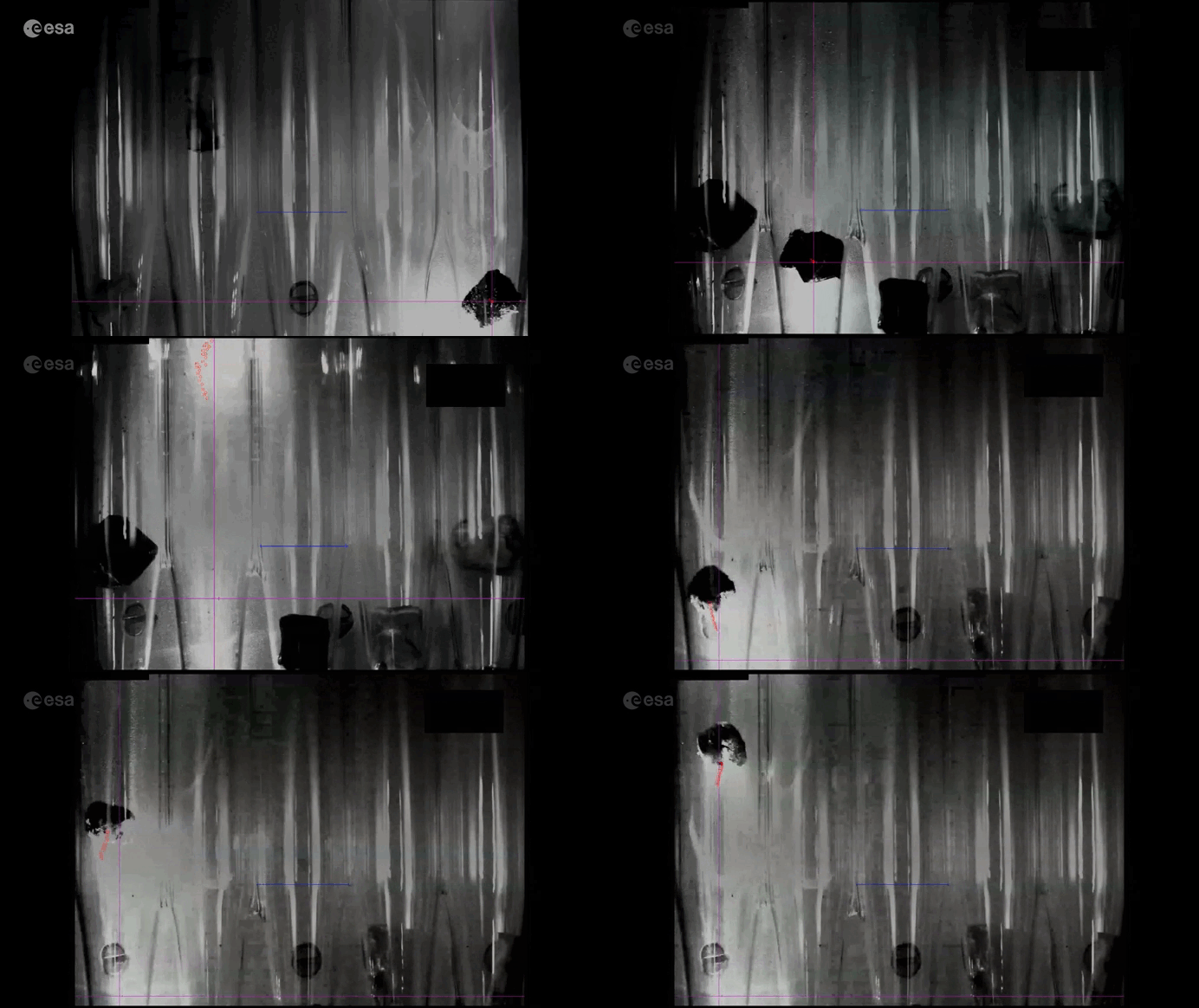
In space we have been experimenting for many years and achieving achievements and new patents, a recent example of these days, the images above are from a press release published by the European Space Agency a few days ago, on April 7, it is an experiment on the use of graphene aerogels, the famous graphene that is proposed for many technological things that is already being used, in different electronic systems, and that perhaps there is a lot of talk about it for the future and that in the future this material promises a lot. Graphene, I remind you, is carbon, but capable of no more than one atom thick.


Those little balls that you are seeing are graphene balls and they are flying away, propelled by the light of a laser, which shows that this ultra-light material could revolutionize the way we move in spaceships and move satellites in space without the need for traditional fuel or chemical fuel. This experiment was not carried out in space, but on parabolic flights, which are a type of roller coaster flight that simulates the micro-gravity of space, they are expensive because you need a large plane and very experienced pilots and also the micro-gravity conditions only last about 20 or 30 seconds for each descent.


But the interesting thing is this, simply with light it was possible to make the airgel shoot out with the laser light, because what we are seeing is in slow motion, they have reduced the speed 10 times, graphene is already being applied in many computer systems, electronics, etc. The thing is that it's not that attractive, you don't see a graphene car or a graphene case or a phone, I think mobile phones already have some graphene.


This would lead us, for example, to light sails to propel spaceships that are much more efficient and with less surface area than current light sails, because in this case it is not only an effect of the pressure of the photons, but there is also a thermal effect of the laser, by heating the illuminated side of the airgel it creates a very pronounced temperature gradient and in this way a thrust force is generated, these sails could propel, as I said, spacecraft, satellites, travel to deep space at high speed and even travel to other stars. A light sail driven by a laser can reach 20% of the speed of light, it takes time to reach that speed and powerful lasers are needed, ideally located on the Moon.


There are also alternative systems that would allow the creation of other impulse systems through these graphene aerogels, this graphene airgel that you have seen would not only work in space to propel these ships in the form of an airgel sail, but to get this airgel you need to produce it in space, because here on Earth it is produced, but with many impurities, in space it is achieved with an extraordinary quality and purity, so your light sail would be much more efficient.


Official website


The images without reference were created with AI
Thank you for visiting my blog. If you like posts about #science, #planet, #politics, #rights #crypto, #traveling and discovering secrets and beauties of the #universe, feel free to Follow me as these are the topics I write about the most. Have a wonderful day and stay on this great platform :) :)


! The truth will set us free and science is the one that is closest to the truth!


Sort:  

Congratulations!

Your post has been selected and upvoted by the SteemPro Team 🚀

Explore more on SteemPro:
🌐 https://www.steempro.com
🎮 Play SteemHeights: https://www.steempro.com/games/steem-heights
💬 Join our Discord: https://discord.gg/Bsf98vMg6U

💪 Supporting the growth of the Steem ecosystem together.

🟩 Vote for witness faisalamin:
https://steemitwallet.com/~witnesses
https://www.steempro.com/witnesses#faisalamin

steempro-cover-black.png
This is an automated message.