Humanoid robot breaks half marathon world record

Humanoid robot breaks half marathon world recordn


Souce


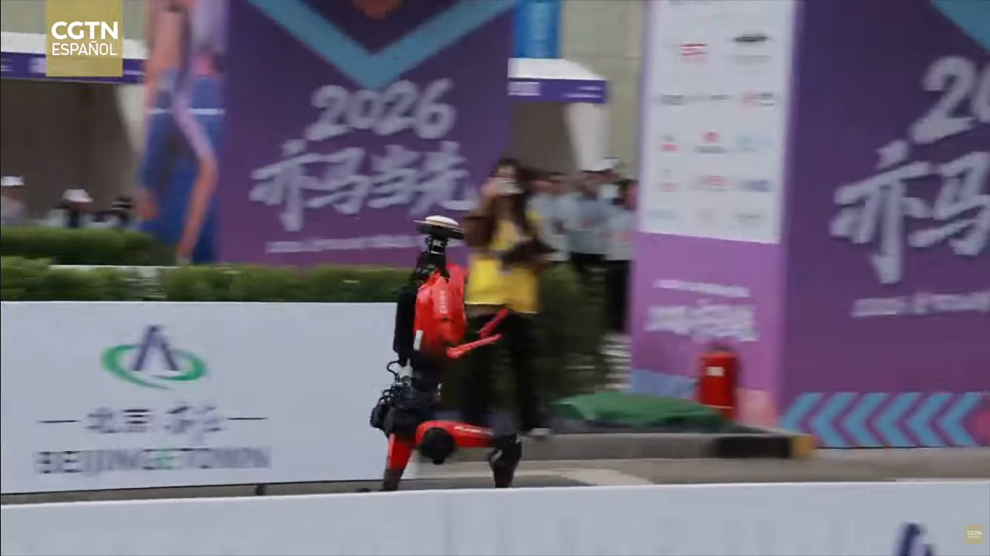
What seemed impossible a few years ago has just happened in front of the entire world, for the first time, humanoid robots officially surpassed the human record in a half marathon, marking a new chapter in the evolution of machines. The incident occurred on April 19 during the second edition of the Beijing Humanoid Robot Half Marathon held in the Shenzhen technology zone, one of the main innovation centers in China.


There, dozens of machines ran the same 21 km in a traditional half marathon, but one of them drew attention in a historic way, the winning robot called Lightning completed the test in just 50 minutes and 26 seconds, this means a time higher than the human world record for the distance, which was 57 minutes and 20 seconds.


In other words, a machine ran faster than any human being recorded in this test, for years, the great challenge of humanoid robotics was simple, walking without falling, then it came to running small sections, now we talk about resistance, balance, sustained speed and autonomous decision making for more than 20 km, the most impressive thing is that the robot ran autonomously, without direct human control during the course.


It is not just about powerful motors, there is integrated intelligence that manages pace, stability, direction and adaptation in real time, other models also attracted attention, Tiangong Ultra, winner of the previous edition, concluded the test in 1 hour and 15 minutes without human intervention, being praised for having the most human-like running style, and of course, Unitree Robotics took advantage of the event to show the raw speed of its H1 model, reinforcing the technological competition between Chinese manufacturers.


These events are not just shows, they function as extreme engineering tests, if a robot manages to run 21 km without failing, that implies advances in motors, batteries, cooling, joints, software and durability, all of this can later be applied in factories, logistics, rescue and dangerous environments.


The marathon is ultimately a public laboratory and the result shows something increasingly clear: machines are not only learning to imitate humans, they are beginning to overcome physical limits that previously seemed exclusive to our species, although for now they still need us. In the event scenes, engineers had to take the Lightning robot to an occasional pit stop, where it received a battery change, a generous dose of industrial coolant, and plenty of lubrication on its joints, all done by humans.


Sorry for my Ingles, it's not my main language. The images were taken from the sources used or were created with artificial intelligence
