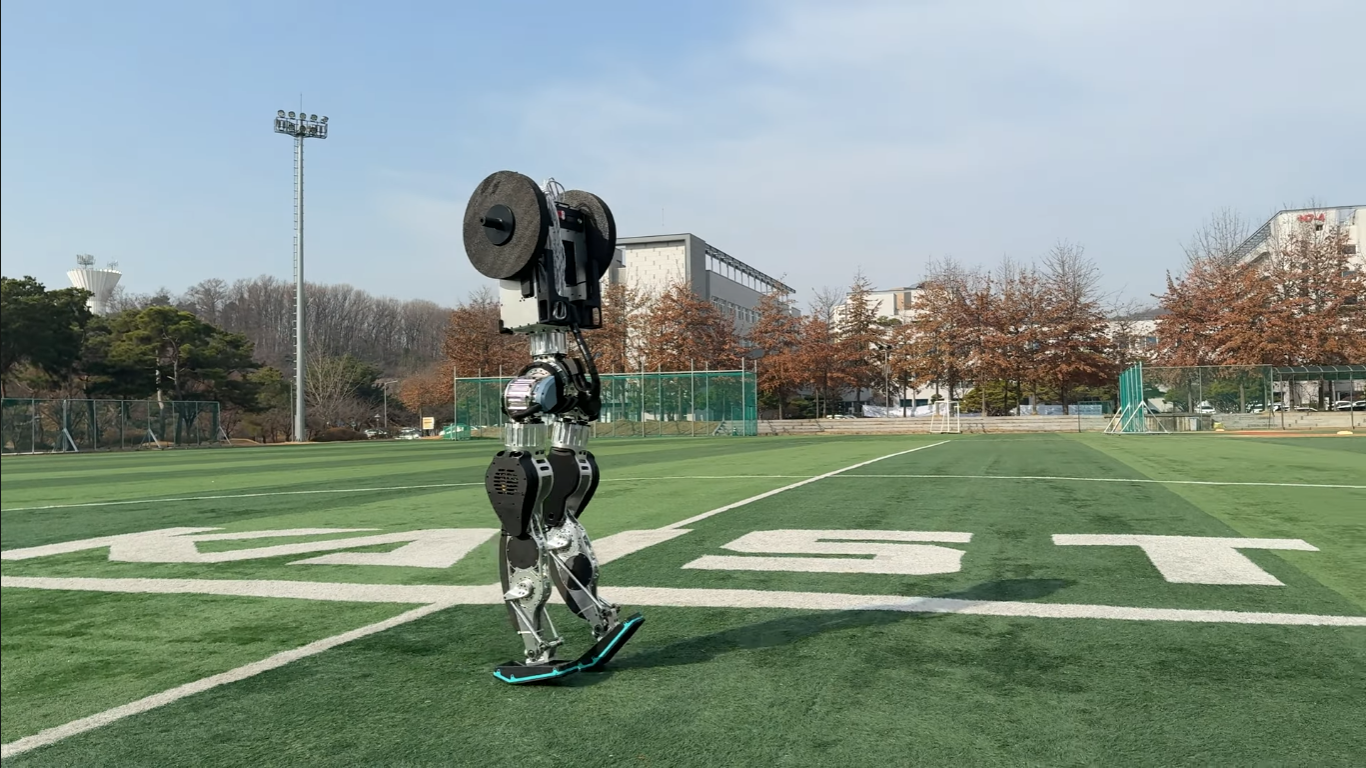
The Humanoid Body-Aware Robot

in Popular STEM19 hours ago

The Humanoid Body-Aware Robot


A few years ago, when we saw the old Atlas walking, it was already impressive, then we saw videos with jumps, races and even parkour, and the public began to get used to it, today that is no longer enough. Kaist researchers developed the V0.7 humanoid, a 75kg machine that was not created just to impress, but to function in the real world.


At first glance it may seem like just another robot, but this robot was designed with a completely different approach, instead of depending on existing industrial parts, the engineers developed practically everything from scratch, motors, controllers and transmission systems, all optimized for a single objective, balancing power, precision and control in real time and there comes one of the biggest innovations, a so-called “almost direct” actuation system that allows extremely fast and sensitive responses, something essential to maintain balance in motion.


In addition, the robot uses an advanced type of gear capable of generating high torque in a much smaller space. In practice, this means more strength, more weight controls, but what really differentiates this system is not just the hardware, it is how it learns. Instead of simply programming movements, the researchers used deep reinforcement learning, a type of artificial intelligence that learns through trial and error. In a crucial detail, the robot does not learn alone, it learns by observing humans.


Motion capture data was used as a basis for teaching natural movement patterns. Result, more fluid, more natural, less robotic and still totally controlled movements. Another classic challenge of robotics was also solved here, the difference between simulation and real world, many robots work perfectly on the computer, but fail when facing the physical environment, to avoid this, the engineers limited the learning according to the real capabilities of the motors, that is, the robot only learns what it can really execute.


And perhaps most impressive, it can move even without vision, using only internal sensors to understand position, balance and movement, as if it had a kind of body consciousness. This means that robots are no longer simple programmed machines and are beginning to become systems capable of learning, adapting and acting with true physical autonomy.


And it is not an isolated project, it is part of a larger South Korean plan that aims to bring humanoids to scale production in the coming years, but there is an ironic detail in all this, up to this point the biggest challenge was to get the robots to move like us, now the challenge has changed, they can now move, the next step is for them to look exactly like us.


Sorry for my Ingles, it's not my main language. The images were taken from the sources used or were created with artificial intelligence


Sort:  

Congratulations!

Your post has been selected and upvoted by the SteemPro Team 🚀

Explore more on SteemPro:
🌐 https://www.steempro.com
🎮 Play SteemHeights: https://www.steempro.com/games/steem-heights
💬 Join our Discord: https://discord.gg/Bsf98vMg6U

💪 Supporting the growth of the Steem ecosystem together.

🟩 Vote for witness faisalamin:
https://steemitwallet.com/~witnesses
https://www.steempro.com/witnesses#faisalamin

steempro-cover-black.png
This is an automated message.

Coin Marketplace

STEEM 0.06
TRX 0.32
JST 0.067
BTC 73166.28
ETH 2252.33
USDT 1.00
SBD 0.49