The Undelivered Instruction
Hello everyone,
A literary short story contest on the theme “Instruction” has just concluded, and below I’d like to share my story.
It was originally conceived as a story about the meaning of life — as a kind of instruction manual that no one ever hands to a person. Many spend their entire lives searching for that instruction and never find it.
But during the writing process, it became about more than that. The story also turned into something about doubting one’s own right to make final judgments.
At first glance, it may seem like a story about the opposition between humans and AI. However, as the conversation with the robot unfolds, it becomes clear that humans themselves make decisions based on far less transparent criteria than they would like to believe. Human choices are not always governed by logic. More often, they emerge from habit, fear, duty, exhaustion, intuition — from those internal processes that we only later try to explain with words.
And if a person does not always fully understand by what criteria they distinguish what matters from what does not, then how justified are they in deciding, once and for all, what is a signal and what is merely noise?
The Undelivered Instruction
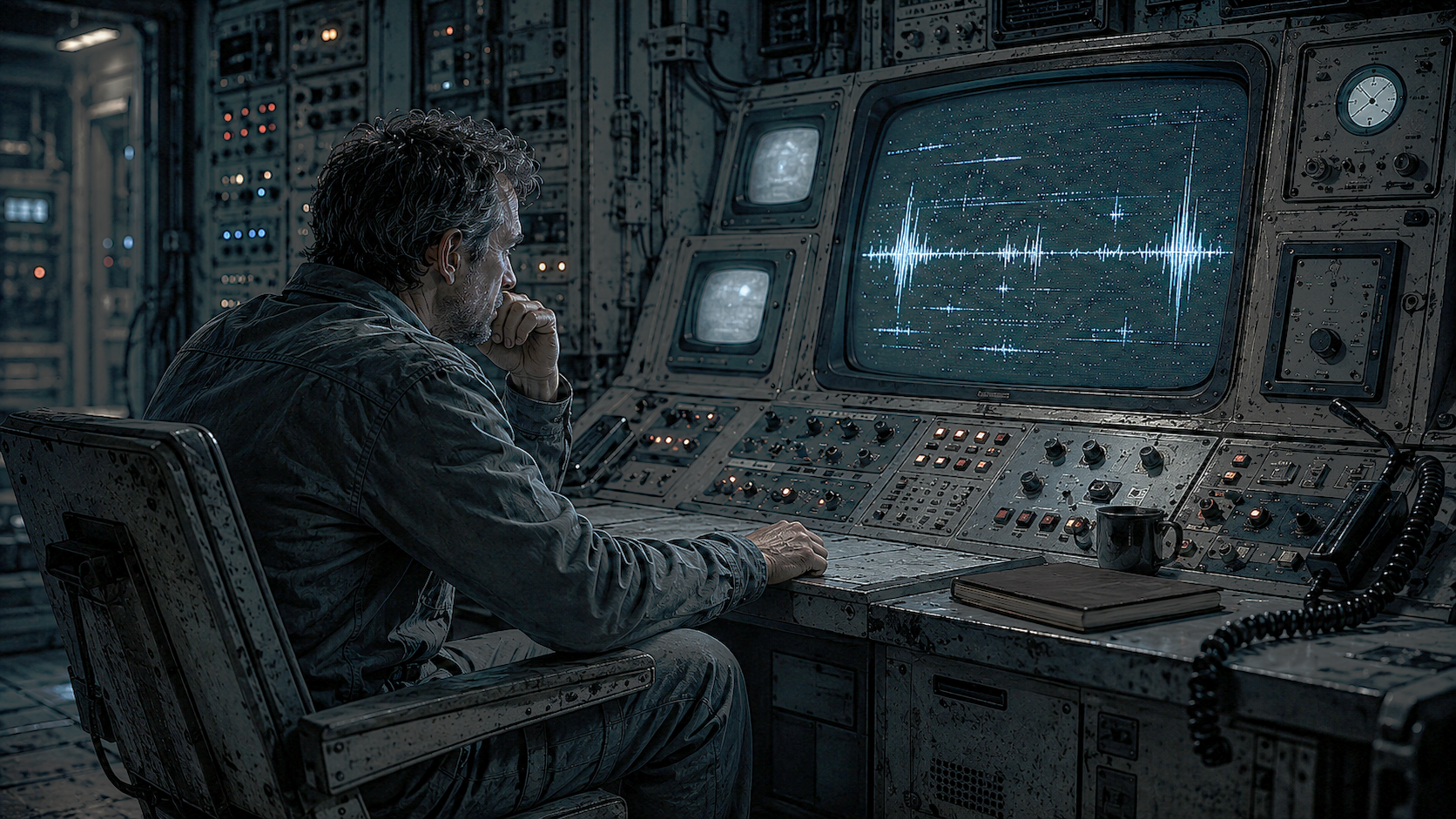
The relay station received faint signals from the void, filtered out the noise, and transmitted them onward. Most of the time, the algorithms handled everything. In rare cases, the decision fell to him.
By protocol, fragments of uncertain origin could not be permanently discarded by a machine.
The final classification had to remain with a human being. After one old incident, machines were no longer allowed to suppress borderline signals on their own. In the training materials, it was called “the relay incident.” That was enough.
Sometimes fragments appeared within the noise that resisted classification. He reviewed them manually. Marked them as “significant” or “background.” Sometimes a signal would cut off halfway through a sentence. There was no meaning in it. But occasionally there was an intonation — as if someone were not transmitting data, but trying to reach someone.
One day he held onto such a signal longer than usual. The words almost formed something coherent. Almost. He thought for a long time. Finally, he marked it as noise. By what criterion, he did not record. But the irritation remained.
That night he dreamed nonsense: ciphers, algorithms, his robot R. Waking in the middle of the night, he listened for several seconds, half expecting the robot to speak from the neighboring compartment.
As usual, after waking and exercising, R served breakfast: salad, eggs, coffee with cookies.
“The cookies aren’t sweet again.”
R hurried about. Took another package from the kitchen shelf. Replaced them.
“What’s going on with you lately? Yesterday you forgot to replace the filter in the vacuum unit. During the massage you ignored my neck, even though I specifically complained about it.”
R remained silent.
“What, did you lose your task database?”
“The task database remains intact, but after passing through the magnetic anomaly last week, the priority instruction layer was damaged.”
“Ah… so that’s where the problem is buried. Can’t you improvise a little? I’m not asking you to reconstruct a quantum transfer. Just a sweet cookie.”
“Improvisation is permissible only within the framework of priority instructions. When they are damaged, selection becomes undefined.”
“What strange creatures you are… And you’re advertised as self-learning.”
“I require a defining instruction.”
“Instructions. Everything with you is instructions, instructions… Can’t you just use judgment?”
“By what criterion?”
“By importance.”
“Meaning?”
“Survival. Duty. Mission.”
“And that is your instruction?”
“No.”
“Then how do humans determine their purpose?”
He opened his mouth to answer. Closed it again.
“A human being… determines his own purpose.”
His gaze stopped on the blank screen, then drifted toward the stars beyond the porthole.
R waited.
“With time,” he added. “It’s… a process.”
R did not respond.
“Most people don’t understand it immediately.”
He fell silent.
“Sometimes they never understand it at all,” he said more quietly.
R waited.
“A priority instruction,” he finally said, “is to work. To maintain the station.”
He looked at R, then turned his eyes toward the dark porthole where there was nothing except distant points of light.
“That’s enough,” he repeated softly.
R waited.
There were many words. None of them fit.
“Ah, forget it…” He waved his hand dismissively. “You wouldn’t understand it that easily. Continue your work. No, wait. Record two priority instructions first: check the vacuum filter before each use, and verify the glucose content of cookies before serving.”
R recorded them.
Meanwhile, the station received another weak signal — uneven, distorted by interference, breaking off in the middle of a phrase.
He stared at the screen for a long time.
Before, he would already have marked it as “noise” and forwarded it onward. Now he did nothing.
For the first time, it occurred to him that the mistake here might not be technical.
Again, there was no meaning in the recording. Only fragments, interference, and the silence left after them. But suddenly that silence no longer felt empty. It felt left behind.
He listened to it.
Something shifted inside him. Not an answer. Not even a decision.
Then he quietly said, turning his head toward R, as if cutting off his own thought:
“Oh, well. Just forget it.”
************ Audio file on Youtube *******************