QS Learning Series – Part 03 | What is a BOQ (Bill of Quantities)?
Hello friends 😊
In Part 01 & part 02, we learned who a Quantity Surveyor is and their main responsibilities & the different types of QS roles, their responsibilities and the challenges they face in the construction industry.
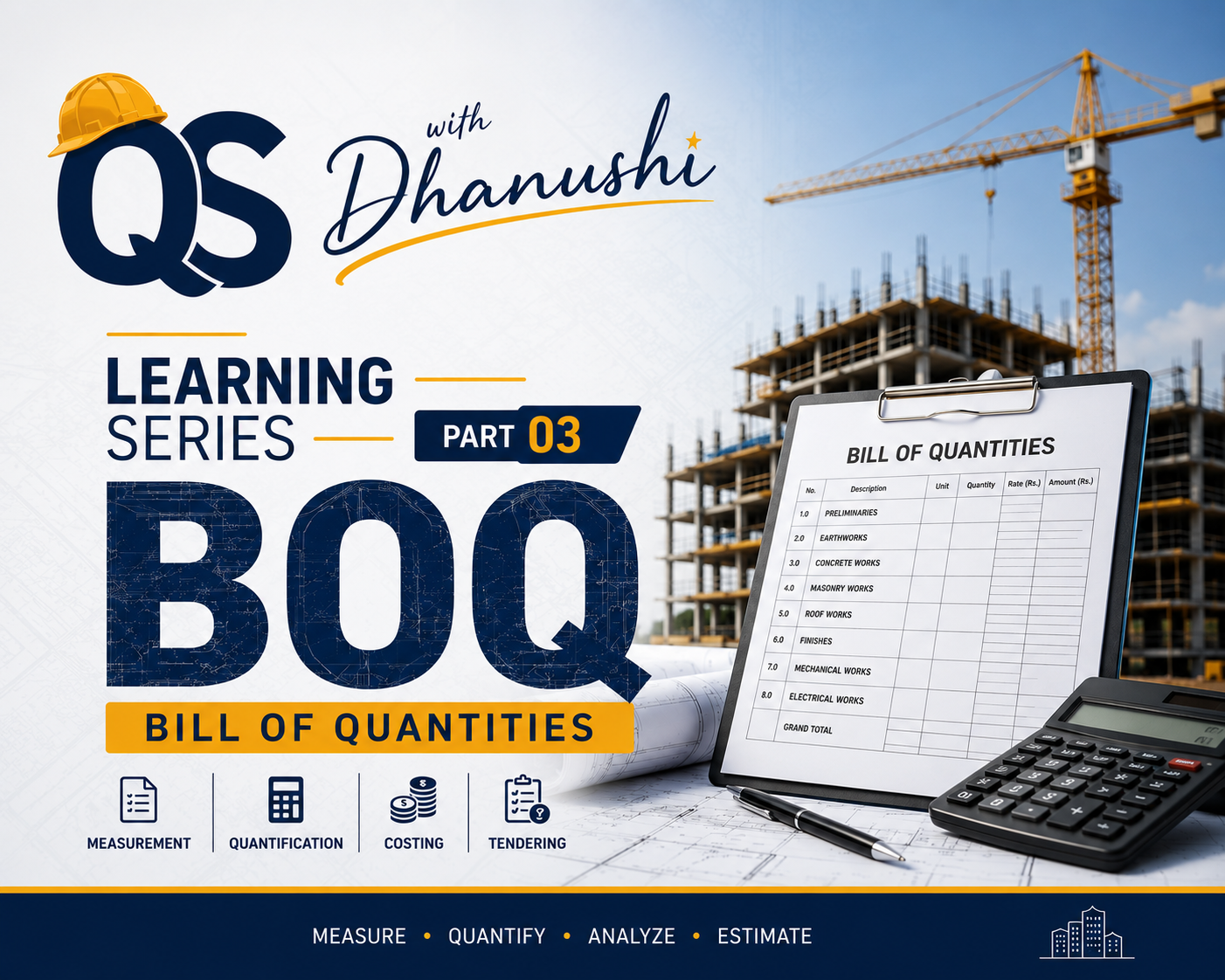
Today we are learning about BOQ(Bill of Quantity) in construction project.
Introduction
To successfully manage a construction project, proper planning, accurate cost estimation, and effective cost control are essential. One of the most important documents in the Quantity Surveying profession that helps achieve these objectives is the Bill of Quantities (BOQ).
A BOQ is a document that lists all the work items required for a construction project, together with their quantities and rates. It serves as a key tool for tendering, cost management, payment certification, and contract administration throughout the project lifecycle.
What is a BOQ?
A Bill of Quantities (BOQ) is a document that itemizes all the work required for a construction project, along with the measured quantities and units for each item.
A BOQ is typically prepared by a Quantity Surveyor based on the project's drawings and specifications.
Main Objectives of a BOQ
✅ Tendering and bid evaluation
✅ Project cost estimation
✅ Contractor selection
✅ Interim payment and final account preparation
✅ Cost control and financial management
Main Components of a BOQ
🧾 1. Preliminaries
Preliminaries include the general costs required to establish and manage the project but are not directly related to the actual construction work.
Examples:
- Site offices and storage facilities
- Temporary electricity and water supply
- Safety requirements (PPE, fencing, signage)
- Insurance and bonds
- Mobilization and demobilization
- Site supervision staff and overheads
Key Idea: These are project running costs rather than physical construction work.
📏 2. Measured Work
Measured work consists of the actual construction activities quantified from drawings and specifications.
Examples:
- Earthworks
- Excavation
- Concrete works
- Reinforcement
- Masonry works
- Road works
- Drainage works
- Finishing works
Key Idea: This is usually the largest cost component within a BOQ.
🔧 3. Provisional Sums (PS)
A Provisional Sum is an estimated allowance included for work that has not been fully defined at the time of tender.
Examples:
- Landscaping
- External drainage systems not yet designed
- Specialist subcontract works
Key Idea: The final cost may increase or decrease depending on the actual scope of work.
💰 4. Prime Cost (PC) Sums
Prime Cost Sums are allowances for items that have not yet been selected by the Client or Consultant.
Examples:
- Floor and wall tiles
- Sanitary fittings
- Electrical fixtures
Key Idea: The allowance generally covers the supply cost only, while installation and handling costs are measured separately.
👷 5. Dayworks
Dayworks are used when certain work cannot be measured in advance and payment is based on the actual resources utilized.
Examples:
- Labour hours
- Materials consumed
- Plant and equipment usage
Key Idea: Commonly used for variation work or emergency work instructed during construction.
📊 6. Price Contingencies
Price contingencies are allowances included to cover uncertain future costs.
Examples:
- Inflation
- Material price fluctuations
- Minor unforeseen changes
Key Idea: Acts as a risk management provision for the client.
🔄 7. Variations
Variations refer to any changes made to the contract scope after the contract has been awarded.
Examples:
- Additional work
- Omitted work
- Changes to design or specifications
Key Idea: Variations can affect both project cost and completion time.
🧠 Quick Summary
| Category | Purpose |
|---|---|
| Preliminaries | Site setup and project running cost |
| Measured Work | Actual construction quantities |
| Prime Cost Sums | Items not yet selected |
| Provisional Sums | Work not fully defined |
| Dayworks | Work paid based on actual resources used |
| Variations | Contract scope changes |
| Contingencies | Risk and uncertainty allowance |
Importance of a BOQ
©. Accurate Cost Estimation
Provides a clear understanding of project costs before construction begins.
©. Fair Tender Comparison
Allows contractors' bids to be compared on a consistent basis.
©. Cost Control
Helps monitor and control project expenditure throughout construction.
©. Payment Certification
Forms the basis for Interim Payment Certificates and Final Accounts.
©. Valuation of Variations
Provides a structured method for pricing additional or omitted work.
©. Dispute Reduction
Minimizes misunderstandings and disputes between the Employer and Contractor.
Problems That May Arise Without a BOQ
❌ Difficulty in controlling project costs
❌ Inaccurate tender comparisons
❌ Payment disputes
❌ Budget overruns
❌ Increased variation claims
❌ Project delays
Conclusion
A BOQ can be considered the "Financial Road Map" of a construction project.
From project inception to completion, it plays a critical role in cost control, payment management, tendering, and contract administration. Therefore, understanding the BOQ is essential not only for Quantity Surveyors but also for Engineers, Contractors, and Project Managers involved in construction projects.
📌 QS Learning Series – Part 03
Question for Readers
Have you ever worked with a BOQ in a construction project?
What challenges did you face when preparing or using a BOQ?
Share your experiences in the comments below! 👇
Thank you so much for reading my post 🥰
With Love
Dhanu 🩷