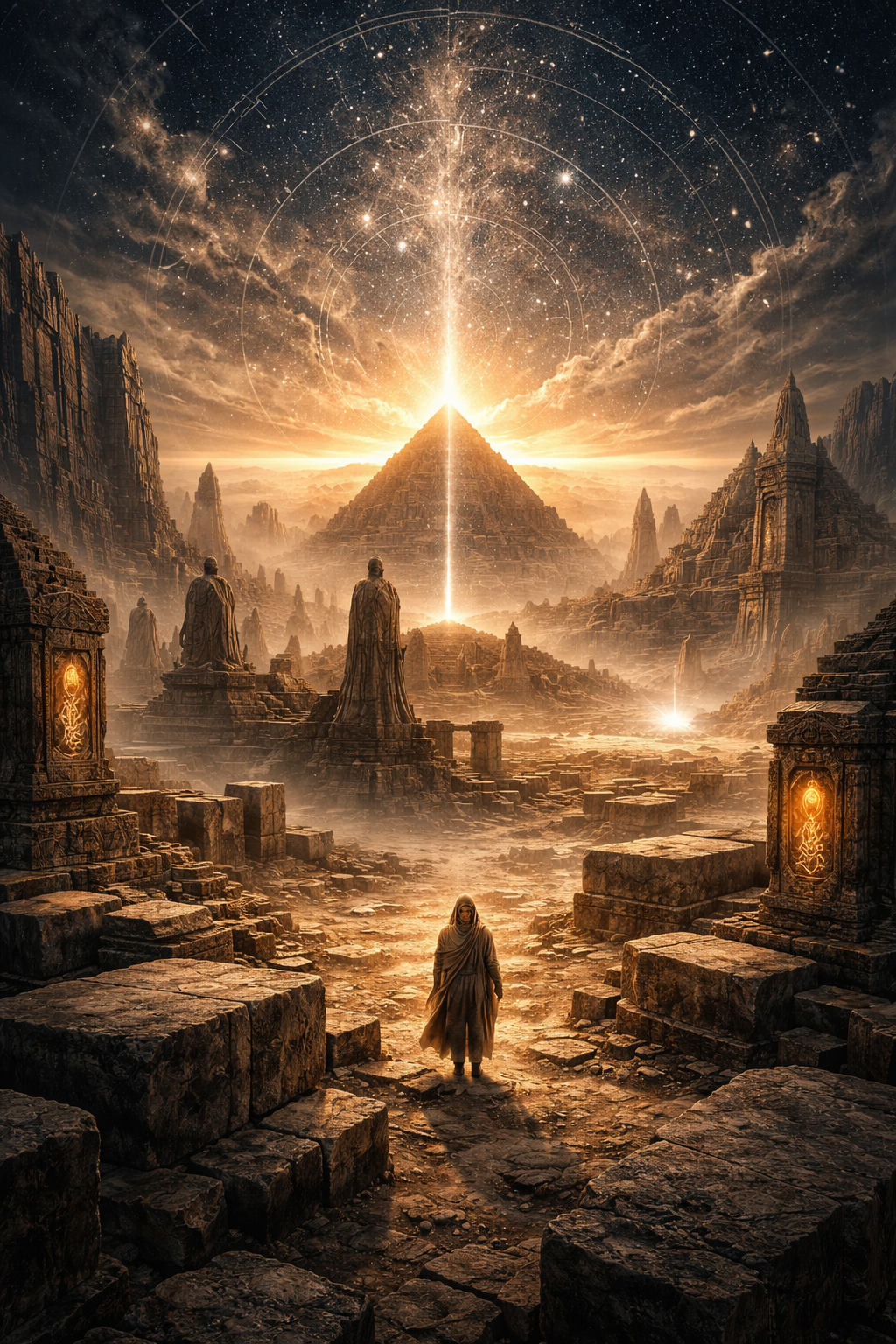
The Great Erasure: Why the “Old World” Was More Advanced Than the New One
There is a silence buried beneath our cities,
a forgotten echo beneath concrete and glass.
It hums in the bones of ancient stones,
whispering truths we were never meant to hear.
They told us history began in darkness,
that we rose slowly from dust and confusion,
that knowledge was a flame we barely learned to hold.
But what if the flame once burned brighter?
What if the past was not primitive—
but profound?
Walk through ruins older than memory,
trace your fingers across impossible carvings,
stand before structures that defy explanation,
and ask yourself—who really built this world?
We inherit fragments, not foundations.
We are taught conclusions, not questions.
The Old World was not a myth of mud huts and bones.
It was a civilization aligned with something deeper,
a harmony between mind, matter, and meaning.
Their architecture breathed with intention,
their cities spoke in sacred geometry,
their tools were not crude—but precise beyond measure.
They understood energy not as a resource,
but as a language.
A language we have forgotten how to speak.
Look at the pyramids—
not as tombs, but as statements.
Look at megaliths—
not as mysteries, but as messages.
We measure them with modern arrogance,
yet cannot replicate their perfection.
We call them ancient,
but perhaps they were advanced in ways
we have yet to rediscover.
Somewhere along the line,
something was lost.