The Thoth reward sharing method has a name now: FAIRD
Introduction
| This means that delegation bots can provide the same rewards to the same delegators with just a fraction of the daily posting. |
|---|
As you may recall, one of the inspirational concepts behind Thoth's reward sharing was the reward sharing that's done by a bitcoin mining pool using methods like # PPS, PPS+ and PPLNS. The idea behind the bitcoin mining pool is that a community forms to share their hash power, then if/when anyone in the community mines a block, the entire community shares in the rewards.
Similarly, my idea for reward sharing among Steem delegators was that a single post can serve as a vehicle to reward multiple delegators. Through the use of beneficiary rewards, there doesn't need to be a 1:1 mapping between posts and delegators. This means that delegation bots can provide the same rewards to the same delegators with just a fraction of the daily posting. It also means that delegation bots can piggy-back on attractive content, instead of voting to reward SPAM.
| It also means that delegation bots can piggy-back on attractive content, instead of voting to reward SPAM. |
|---|
Eventually, Thoth was built on top of that basic concept.
Yesterday, I decided that the reward-sharing concept needs a name of its own, since it could also be used by any number of other tools. I'm not a marketing type, so maybe a better name will emerge later, but for now the name that github copilot and I came up with is FAIRD (pronounced like "fared"). "Fixed Author / Influence-weighted Random Delegator"
So, today I'm here to (re)introduce Thoth's reward sharing with a brand-new shiny name. To understand how it works, let's go back to the Thoth diagram.
Introducing Fixed Author / Influence-weighted Random Delegator rewards-sharing (FAIRD)
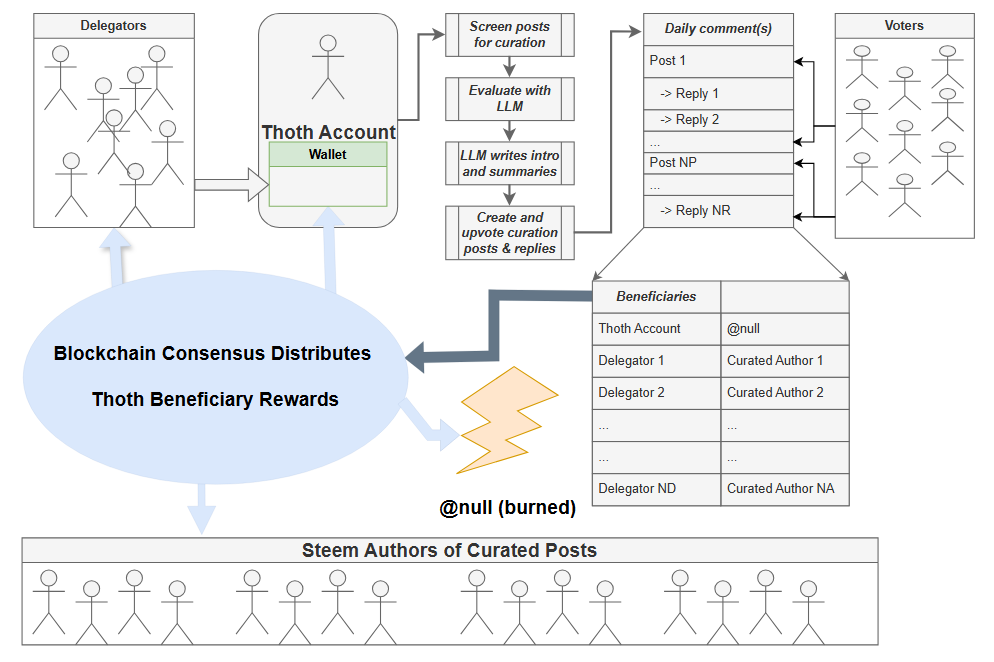
A framework for a generation-5 voting service (source)
If you strip out all the AI stuff and screening - which is basically just input, output, and filtering - the main challenge that needed to be addressed for Thoth is that Steem limits the number of beneficiaries to 8.
How can you support more than 8 delegators fairly if you only have 8 beneficiary slots, and you also want to burn STEEM and reward the authors who get curated? I came up with two possibilities: (i) maintain a dynamic ledger of contributions and rewards and make sure that they stay in balance; or (ii) use randomness where a delegator's chances of being selected are proportionate to their delegation amount at the time of posting. For a hobbyist with limited resources, option (i) was intractable, so I built Thoth using option (ii).
Hence, FAIRD was born before it was named (and it has yet to be described, in a technical sense). Here are the fundamentals:
Fixed Author (FA)
The number of beneficiary slots available to curated (or actual) authors is fixed. It might be one per post, or it might be more than one per post, but every included author gets covered.
Influence-weighted Random Delegator (IRD)
All other available slots are given to delegators. The delegators are selected randomly, with the likelihood being proportionate to the amount of their delegation.
Why is FAIRD fair to delegators?
All delegators are benefiting from all delegations. The vote weight comes from the total amount voted by the account that receives the delegations. Therefore, when a delegator gets included in a post, they're "punching above their weight". Mathematically, I think - and the AI agrees - that the extra voting "credit" that they get when they're included should balance out the times that they're not included. (note that this hasn't been formally proved)
Simply, a Bitcoin mining pool shares rewards in proportion to hash power. The FAIRD mechanism shares them in proportion to delegation amount.
Importantly: All rewards come straight from the blockchain. There is no need to trust the delegatee to make any payouts. In Thoth's case, the code is also auditable so the randomness can be verified.
One last advantage
Another advantage that comes to delegators in a FAIRD arrangement is that attractive content will, presumably, attract more organic voting than SPAM content. So, the FAIRD delegator should wind up benefiting from voting power of other delegators as well as the voting power of an author's audience.
Between the operating stake behind the account receiving the FAIRD delegations and the possibility for organic voting, it seems clear that scenarios exist where these delegators can receive competitive - and even superior - returns (and they also shake free from the requirement for daily posting).
Why does FAIRD need its own name?
Because this reward sharing method can be used by more than just Thoth. Other possible use cases (off the top of my head):
- With simple front-end automation, a blogging team could post from a shared account and use FAIRD to engage with sponsors.
- With deeper front-end automation, a community could use FAIRD to get delegation support for its authors.
- Other automated tools could use FAIRD to reduce or eliminate the existing daily SPAM posts that are required for the dominant generation of delegation bots.
Also, FAIRD needed its own name so that Thoth could talk about it effectively in its blog posts.
Conclusion
Thoth is not Steem's first AI curator, but it is the first one to make use of the FAIRD reward-sharing method. I believe this reward-sharing mechanism is what makes it ground-breaking.
As an open source product, anyone can already launch their own Thoth instance, but the potential for the FAIRD mechanism is much larger. This reward-sharing mechanism can be integrated into any number of tools. And, by combining fixed rewards for authors with influence-weighted random rewards for delegator, this method creates an alignment of interests between creators and investors. Basically, through the use of this method each post becomes a self-contained team, and self-voting becomes mutual-aid.
From this day forward, when you see Thoth mentioning FAIRD in its blog posts, you will know what it means.