HYKSOS ☆ JEWS

Hyksos (hyk "ruler", sos "nomads") what Egyptians, I think, have called an invasion of Semitic pastoral nomads, who were also traders, with Phoenicians (sea people), and metal workers running smelting of copper and mining of turquoise at Sinai desert, as part of Hittite military alliance consisting of other Asiatic tribes as part of Indo-Aryan expansion as Caddies, Hatties, Hurrians, Mitanni, Elamites merging with Babylonians, Amorites/Amurru, Canaanites etc. which they have amassed against Egypt.
Anyway, just thinking aloud here. The 15th dynasty was most likely the final stage of take over of Egypt which started at the beginning of 12th dynasty when the Sinai Semites led by Abraham like character from Ur of the Chaldeans (Culds, Sumerians, ancient Irish who came there across the Atlantic from Atlantis aka Americas) who upon killing the new king at Lower Egypt has installed himself as Amenemhat I (Amun is first) as part of his alliance with the priests of Thebes.
Later, with the rise of 18th dynasty, the Egyptian royals have managed to take control back from Hyksos killing and expelling most of them out of Egypt, enslaving the rest who stayed behind along with other foreigners. King David as a victorious military power is modeled after king Thutmose III who have expanded Egypt all the way to Canaan where his great grandson Amenhotep III, king Solomon in the bible where it is in reversed sequence, has built the first Temple in Jerusalem. Reportedly one of his many wives was from there and have explained him the cult of god Yahw (light, fire, heat) who was chief diety of Semitic metal workers & traders and is Egyptian Egyptian equivalent to god of Chaos, royalty, and deserts Sutech, Greek Set.
Here is where the story of biblical Joseph with his multicolored raincoat comes into play. The Semites, i.e. Hyksos, didn't give up on regaining control and have sent their own to infiltrate Egyptian politics. Joseph being sold into slavery by his brothers instead of killing him is because Judah, the royal messianic bloodline, has intervened suggesting it which is a metaphor for the infiltration. Then follows the story of Captain of king's guard who has bought him with his wife trying to seduce Joseph who refuses and is being blamed by her for the crime he didn't commit thus he ends up in Egyptian jail. Well, this is reinterpreted version of ancient Egyptian famous tale of Two Brothers, the original is even more dramatic and is a good read.
Then while in jail Joseph interprets king's baker's dream that he will be executed in three days which comes to pass, then also predicts that king's cup bearer will be released who then tells about it to the king who upon having his own dream in need of understanding summons Joseph to his palace. Well, here again is borrowed famous story about the dream of king Djoser.
"The dream story of King Djoser (Netjerikhet) is primarily known from the "Famine Stele," a large granite inscription on Sehel Island near Aswan, dated to the much later Ptolemaic period (approx. 300 BCE) but describing events from Djoser's reign in the 3rd Dynasty (circa 2670–2610 BCE).
The Seven-Year Famine
According to the inscription, Egypt suffered a devastating seven-year famine because the Nile failed to flood properly. Crops failed, seeds dried up, people robbed each other, and temples were neglected.
The Dream of Khnum
Distressed by the suffering, King Djoser sought counsel from his trusted adviser, Imhotep. Imhotep researched ancient records and discovered that the solution lay in the city of Yebu (Aswan/Elephantine), the source of the Nile.
Djoser fell asleep, and in his dream, the god Khnum—the creator god associated with the fertility of the Nile—appeared to him.
Khnum complained that his temple on Elephantine Island was in ruin, neglected, and filled with rubble, which caused him to withhold the Nile's floods.
The god promised to make the Nile flood again if Djoser restored his temple and properly honored him.
The Resolution
Upon waking, Djoser immediately ordered the reconstruction of the Temple of Khnum. He issued a decree, the "Famine Stela," which gave the temple specific land, revenues, and priestly tributes. As a result of this action, the legend states that the famine ended, and the Nile returned to its normal, high-flooding state."
The Yahweh temple at Elephantine (c. 6th-5th century BCE) was a significant Jewish sanctuary in Egypt, built by a community of Jewish mercenaries, where sacrifices were offered to YHW (Yahweh) outside of Jerusalem. The temple coexisted with the local Egyptian god Khnum, but was destroyed in 410 BCE due to conflicts with local priests." AI Overview
JOSEPH aka YUYA
Well the story of biblical Joseph is stylized retelling of the life of Yuya who was a Yahw worshiping Semite and rose to power as second in command after the king. Apparently Yuya has somehow managed to marry a noble Egyptian woman and their daughter became the great royal wife of king Solomon aka Amenhotep III, whose son later became rebellious king Akhenaten, biblical Moses, I think, a composit of mythological and historical characters and events.
"Yuya was a powerful 18th Dynasty Egyptian courtier (c. 1390 BC) and nobleman from Akhmim, best known as the father of Queen Tiye and grandfather of Akhenaten. He held high titles such as "King’s Lieutenant," "Master of the Horse," and "Father of the God" under Pharaoh Amenhotep III. His remarkably preserved, near-intact tomb (KV46) was discovered in 1905 in the Valley of the Kings.
Family: Married to Thuya, a noblewoman connected to the royal family. Their children included Queen Tiye (wife of Amenhotep III) and Anen, a high-ranking priest.
Role & Titles: Though not a king, Yuya held immense power as a "God’s Father," High Priest of Min, and Overseer of Cattle.
Foreign Origins Theory: Many historians believe, based on his name and features, that Yuya may have had foreign (possibly Mitanni) origins rather than being a native Egyptian.
The Tomb (KV46): Located in the Valley of the Kings, the tomb was discovered in 1905 by Theodore Davis. Despite ancient looting attempts, it was mostly intact, yielding many artifacts and well-preserved mummies.
Appearance: His mummy was so well preserved that his features were instantly recognizable, with hair and soft tissues intact, allowing for detailed study.
While sometimes mistaken for a Vizier due to his high status, his primary titles were religious and military, specifically within the court of Amenhotep III." AI Overview
MOSES AKHENATEN
From this development in royal Egyptian saga we get the story of Moses, who is adopted into the royal family after being found in a floating reed basket, which is a tradition started by Sargon the Great as his claim to the throne, a metaphor for being of royal blood.
"According to the Neo-Assyrian "Birth Legend of Sargon" (c. 8th-7th century BCE), the founder of the Akkadian Empire was an abandoned child, born to a high priestess in secret, placed in a reed basket sealed with bitumen, and cast into the Euphrates River. He was rescued and raised by Akki, a water drawer (gardener), eventually rising to power.
The Field of Reeds (Aaru) is the Ancient Egyptian paradise, a perfected, eternal version of life along the Nile where worthy souls lived forever without pain or suffering. Ruled by Osiris, it was described as a lush, fertile place to enjoy farming, family, and loved ones, sometimes requiring shabtis (magical statues) to handle chores." AI Overview
So Akhenaten has learned of the Temple to Yahw his father has built at Jerusalem and from his mother queen Tiye about the cult of Yah / Yahw. When he grew up to become king Amenhotep IV as he was known has changed his name to Akhenaten by adopting minor Egyptian god Aten, representing the power behind the sun and depicting as a solar ring that rules them all, making Aton official chief state diety as Egyptian equivalent of Semitic Yahw. He then closes all Amun temples and dismantles its priesthood. Well he tried but failed. The Amun priests have organized army leaders under Ramses generals to overthrow the 18th dynasty causing the exodus of Akhenaten with his Atonist Semitic entourage out of Egypt proper, fleeing to Yahw Midianites at Sinai before taking over Canaan and according to the Book of Jasher also Ethiopia.
So basically that's how it begun to form into early Judaism traditions. A bit of history mixed with religious mythology, folklore storytelling, laws and customs. Anyway, the alternative chronology based on Emmanuel Velikovsky's book Ages in Chaos where he suggests that 500 years were unceremoniously added to the Egyptian timeline would place the Akhenaten fiasco around 850 BCE, while the mainstream is claiming that it was around 1350 BCE.
"Akhenaten reigned during Egypt's 18th Dynasty, typically dated to 1353–1336 BC or 1351–1334 BC. While biblical chronology varies, some traditions align the life of Moses or the Exodus with this late 18th Dynasty period (circa 1300s BCE), leading to theories linking Moses to this timeframe.
Reign of Akhenaten
Name: Originally Amenhotep IV, he changed his name to Akhenaten in his 5th year.
Period: Roughly 1353–1336 BC.
Significance: Known for his religious revolution, moving away from traditional polytheism to "Atenism" (worship of the sun disc, Aten).
Capital: He built a new capital city, Akhetaten (modern-day Amarna).
End: His reign was followed by a period of turmoil, leading to the restoration of traditional gods under his successor, Tutankhamun.
Placement of Biblical Moses
Traditional Alignment: Some researchers place Moses' birth around 1386 BCE and the Exodus around 1313 BCE, placing him roughly during the 18th Dynasty.
Alternative Theories: Others suggest Moses was a contemporary of Akhenaten, or even influenced by the Atenism movement.
Chronological Debate: The traditional biblical date for the Exodus can vary, with some suggesting a 13th-century BCE date (placing the oppression under Ramesses II of the 19th Dynasty).
No Direct Evidence: There is no direct, mainstream archeological evidence confirming a direct link between Akhenaten and Moses, though the proximity in time (around 3,300 years ago) has led to significant scholarly and literary speculation." AI Overview
So here we have at least chronological agreement between history Akhenaten and biblical Moses, as was also suggested by Sigmund Freud.
"Moses and Monotheism (German: Der Mann Moses und die monotheistische Religion, lit. 'The man Moses and the monotheist religion') is a 1939 book about the origins of monotheism written by Sigmund Freud, the founder of psychoanalysis. It is Freud's final original work and it was completed in the summer of 1939 when Freud was, effectively speaking, already "writing from his death-bed."" AI Overview
This connection was also noticed by other authors such as Ahmed Osman. Albeit I think the biblical narrative came much later perhaps the process has begun during the Babylonian exile, when Persians acting as Babylonians basically hijack the narrative of early Judaism merging it with Zoroastrianism, Canaanite, and Mesopotamian traditions and perhaps shifting the whole timeline five centuries back to make it more ancient and original. If we look what was happening in the Levant region from around 850 BCE there is a lot of changes and movements taking place. During thus time the ancient Phoenician paleo Hebrew is being replaced with imperial Assyrian Aramaic script.
"The Assyrian Imperial Script, commonly known as Imperial Aramaic or Achaemenid Aramaic, was a highly standardized, cursive-based alphabet adopted by the Neo-Assyrian (i.e. Persian) Empire in the 8th century BCE and later perfected by the Neo-Babylonian (i.e. Persian) and Achaemenid Empires to manage their vast territories. It became the official lingua franca for administration, diplomacy, and trade across the Near East, displacing Akkadian cuneiform as the primary written language of the region.
Alphabetical Nature: Unlike the Akkadian cuneiform it replaced, which was syllabic, the Aramaic script is an abjad (a consonantal alphabet) of 22 letters, derived from the Phoenician script.
Standardization: Imperial Aramaic was highly standardized, with a focus on historical spelling rather than local dialect, largely influenced by Old Persian administrative requirements.
Cursive and Lapidary Styles: While and lapidary (monumental) forms existed, a more practical, ink-written cursive script was commonly used for administration, contributing to its fast adoption across the empire.
"Ktav Ashuri": In Jewish literature, this script is known as K'tav Ashuri ("Assyrian Script"), acknowledging that the script used to write Hebrew from the late Persian period onward was adapted from the imperial Assyrian/Aramaic standard.
Historical Significance
Administrative Efficiency: The switch from Akkadian cuneiform on clay tablets to Aramaic in ink on parchment or papyrus allowed for faster communication, better record-keeping, and improved administrative efficiency.
Replacement of Old Hebrew: The Assyrian/Aramaic script completely replaced the Paleo-Hebrew script for writing Hebrew, becoming the ancestor of the modern Hebrew alphabet.
Ancestor of Middle Eastern Scripts: Almost all modern Middle Eastern writing systems can be traced back to Imperial Aramaic, including Square Hebrew, the Syriac alphabet, the Nabataean alphabet, and consequently, the Arabic alphabet.
Lingua Franca: By the 7th century BC, Aramaic was the common language of trade and communication in the Neo-Assyrian Empire, to the extent that it was used in diplomatic negotiations between Assyrian commanders and Judean officials.
Even after the fall of the Assyrian Empire in 612 BCE, the script and language continued to be used by the Babylonian and Achaemenid Empires, maintaining its status until about the 3rd century BCE, when it began to evolve into regional variations." AI Overview
https://www.youtube.com/live/-LpgmxrfNQs
The Midianites were Semitic metalworkers smelting copper, which they got from Phoenicians (sea faring traders) who have brought it from the mines at lake Michigan, at Sinai desert and mining turquoise which they traded with Sumerians while Egyptians were raiding their operations at the start of new dynasty as a custom started by king Nemrer of 1st dynasty. The story of Abraham begins at the beginning of the 12th dynasty.
~o~
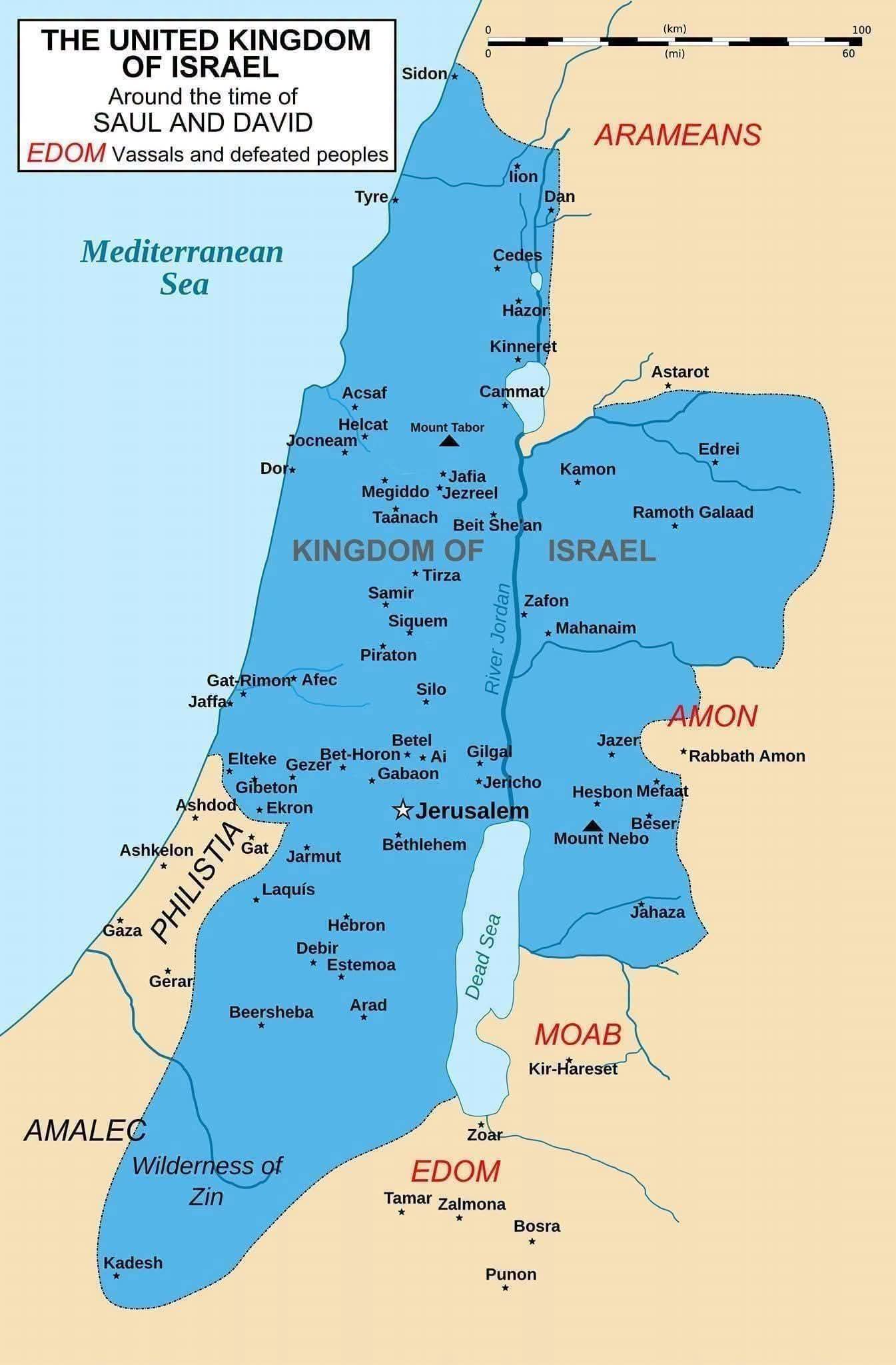
I saw this map posted by some tiny hat moron being all proud of the former glory that has nothing to do with him. So I got inspired to write my customary antisemantic rant.
Sure. Those were the days for the Jews in Judea. Yes there was an independent kingdom briefly in the land of Canaan in Levant. However it has nothing to do with Ashkenazi Khazarian Habad-Lubavitch so called Jews who have adopted Judaism only in 8th century CE and who are of white Japheth's line not Shem's melanated Abrahamic patrilineal line. The Levites and Karaite Jews still follow patrilineal tradition. However the Rabbinical Jews follow their matrilineal line, the mtDNA of which traces back to a genetic bottleneck of four white women somewhere in Italy. They then make a leap of faith connecting them and Judahites saying that they have fled the Judea. Sure, and turned pale from all the horrors of war. 8/
Yes, their patrilineal Y chromosom can have indeed, and for many does, a genetic connection to Canaanite Judeans who were living there at that time yet who were not necessarily the original melanated ancient Hebrew Israelites, i.e. Phoenicians aka the sea people, who were of about dozen tribes. However that patrilineal link is irrelevant since the Rabbinical Jews deny the patrilineal connection completely and only follow matrilineal line to decide who is considered to be Jewish. In reality the Judean was anyone who resided in Judaea and who may or may not have been a Judahite, i.e. of Judah's bloodline, which is another story that has more to do with ancient Atlantian kings, who were black Shemites.
So where did this matrilineal Rabbinical Jews came from who preceded the Khazarian Ashkenazi conversion? The Persian Babylonians who have "returned" from "exile" to control the important trading region were already not the original Hebrew Israelites but their replacement. They have replaced the original paleo Hebrew of ancient Phoenicians with Aramaic imperial block script of the Assyrian empire and called it Hebrew. The Elamites, who were absorbed by the Persians, trace their line via mother's line so they have more in common with the modern "Jews" and customs wise, i.e. wearing black boxes etc. with Japanese demon Tengu cult than ancient Hebrew Israelites.
Then the Edomites, line of Esau, the black nobility of old Roman-Persian dynasties with Nimrodian background, and last but not least, the line of Cain whose genealogy mirrors in parts to that of Seth. So the descendants of Cain have been marked with a recognizable sign and cursed to wander the world. Think of it what you will but the modern Jews fit that description perfectly. So they are all that minus being actual Jews/Hebrew Israelites/Shemites/Judahites. Add to it a Canaanite/Carthaginian child sacrifice cults of Moloch ("king") god of fire and Baal Hammon (sky god/equivalent to Greek Kronos).*
Besides the point is that Torah is referring to geography, flora and fauna of the Americas not West Asia. The Abrahamic Covenant of promised land is the land between the Mississippi and Colorado with parts of Arizona and Utah i.e. Judah. Anyone can take a map of some old kingdom and claim to be connected to those people by blood. Even then, most people don't care about their bloodlines and claims. At this point the Jews, i.e. Rabbinical 4.0 version, are seen as a black plague with Zionist apartheid genocidal entity as a malevolent tumour. Fuck them and their idiotic ideas of God. The bible has accurately described them in Revelation 3:9 "I will make those who are of the synagogue of Satan, who claim to be Jews though they are not, but are liars—I will make them come and fall down at your feet and acknowledge that I have loved you." I personally can't wait.
*"Phoenician Origins: The practice was rooted in the broader Canaanite/Phoenician world, where firstborn children were sometimes offered to gods such as El or Moloch. The name Moloch (or Molech) may derive from the Hebrew root word for "king".
Baal Hammon: In the Phoenician colony of Carthage (modern-day Tunisia) and its Mediterranean territories, the chief deity was Baal Hammon. He was a sky and vegetation god whom Greco-Roman writers identified with Cronus.
The "Tophets": Excavations of Carthaginian and Sardinian sanctuaries—known as tophets—have unearthed thousands of urns containing the cremated remains of infants and small animals. Inscriptions on stone slabs above these urns often act as dedications to Baal Hammon and the goddess Tanit, thanking the gods for "hearing my voice and blessing me".
The Ancient Accounts: Historians like Diodorus Siculus and Plutarch claimed Carthaginian elites ritually slaughtered their own children—and sometimes bought children from the poor when they had none of their own—to appease the gods during military and political crises.
Contemporary Archaeological Consensus: Recent studies, such as those published in the peer-reviewed journal Antiquity, have largely corroborated the ancient claims. Extensive examinations of the remains and stone inscriptions conclude that infant sacrifice was a socially and religiously sanctioned practice. It was performed as an act of profound, desperate piety to secure divine protection or to thank the gods for a major victory or blessing." AI Overview
♡
\ |/ /