8 Investor Expectations Every ICO Development Platform Should Meet
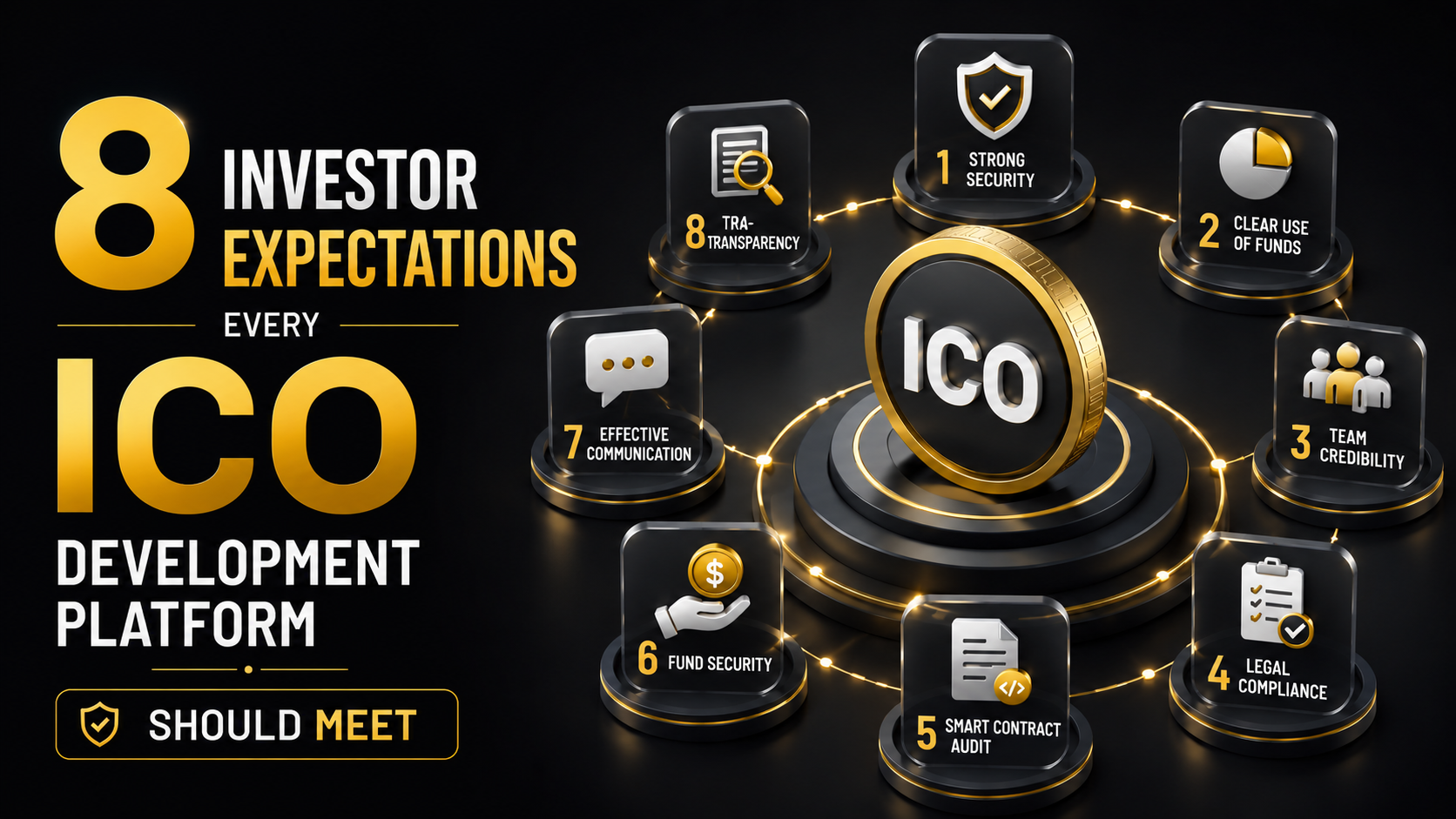
Investors evaluating a token sale typically look beyond the token itself. They may consider how clearly the project communicates its purpose, how easily they can participate, how transactions are handled, what security measures are in place, and whether the platform provides useful information throughout the process.
For businesses, this means an ICO platform needs to be designed around the participant experience as well as the project's technical requirements.
A strong platform should aim to provide:
- Clear project and token information.
- A straightforward participation journey.
- Reliable wallet connectivity.
- Transparent transaction status.
- Appropriate security controls.
- Useful investor dashboards.
- Accessible support and communication.
- A platform architecture that can evolve.
These features cannot guarantee investor participation or fundraising success. However, addressing them can help businesses create a more professional and understandable environment for eligible participants.
1. What Information Do Investors Expect Before Participating?
Investors need enough information to understand what they are considering before they connect a wallet or initiate a transaction.
A professionally planned ICO Development platform can organize information around:
- Project objectives.
- Token purpose.
- Token utility.
- Distribution structure.
- Sale stages.
- Participation requirements.
- Relevant project documentation.
- Applicable risks.
The information should be presented clearly rather than hidden behind unnecessary interface elements.
Businesses should also distinguish between factual project information and promotional claims.
Participants should be able to understand what the token does, how the sale works, and which conditions apply before deciding whether to participate.
Clear information does not guarantee investment interest, but it gives users a stronger basis for making their own decisions.
2. How Can a Simple Investor Journey Meet Expectations?
Blockchain participation can involve several unfamiliar steps.
An effective investor journey can guide eligible users through:
- Reviewing project information.
- Understanding token details.
- Registering an account.
- Completing applicable verification.
- Connecting a wallet.
- Reviewing sale conditions.
- Approving a transaction.
- Waiting for confirmation.
- Viewing allocation information.
Each stage should communicate what the participant needs to do.
For example, if a transaction is waiting for blockchain confirmation, the platform should clearly show it as pending.
If verification is incomplete, the interface should explain what action remains.
Our ICO Development Services can incorporate these workflows into the platform architecture so that the investor experience is considered from the beginning rather than added after the core technology is completed.
3. Why Is Reliable Wallet Connectivity Important?
Wallets provide the connection between participants and blockchain transactions.
Investors may expect the platform to clearly communicate:
- Supported wallets.
- Supported networks.
- Connection instructions.
- Transaction details.
- Approval requirements.
- Pending status.
- Confirmation status.
- Failed transactions.
A wallet integration that works inconsistently can create unnecessary friction.
Businesses should therefore test wallet functionality across the environments they intend to support.
Users should maintain control of their own wallets, and the platform should never request private keys or recovery phrases.
Clear wallet instructions can help make blockchain interactions easier to understand without removing transparency from the process.
4. What Transaction Transparency Should Investors Receive?
Participants generally need to know what happened after initiating a blockchain transaction.
A platform should distinguish between states such as:
- Transaction initiated.
- Transaction pending.
- Transaction confirmed.
- Transaction failed.
An ICO Development Company can connect blockchain activity with the investor-facing interface so that relevant information is presented accurately.
For example, a participant should not be encouraged to submit a second transaction simply because the first one is still waiting for confirmation.
Transaction history can also help users review previous activity.
Accurate information builds a clearer connection between the blockchain layer and the investor's experience.
5. How Can Security Expectations Be Addressed?
Investors may reasonably expect a token sale platform to take security seriously.
A platform can involve:
- Smart contracts.
- User accounts.
- Wallet integrations.
- APIs.
- Administrative dashboards.
- Infrastructure.
Security-focused development can incorporate:
- Smart contract testing.
- Code review.
- Authentication.
- Authorization.
- Role-based access.
- Transaction validation.
- API protection.
- Infrastructure monitoring.
No platform can responsibly promise complete protection against every possible threat.
Instead, businesses should establish appropriate controls and continuously review their security posture.
Where personal information is collected, the project should also obtain qualified privacy and regulatory advice for the jurisdictions in which it operates.
6. Why Do Investors Need a Useful Dashboard?
An investor dashboard can give participants a central place to review important information.
Depending on the project's requirements, an ICO Token Development platform can connect token-related information with features such as:
- Token allocation.
- Transaction history.
- Sale-stage information.
- Vesting details.
- Account status.
- Verification status.
- Connected wallet.
- Relevant project updates.
The dashboard should prioritize information that participants actually need.
Adding too many metrics can make the interface more difficult to navigate.
A well-structured dashboard can also provide a foundation for future ecosystem functionality after the initial token sale.
7. What Support and Communication Do Investors Expect?
Even a well-designed platform can generate questions.
Participants may need assistance with:
- Account registration.
- Verification.
- Wallet connections.
- Transaction status.
- Allocation information.
- Platform navigation.
Businesses should therefore establish appropriate support channels and communication procedures before launch.
The platform can also provide contextual guidance within relevant screens.
For example, a wallet-connection page can explain the required network, while a transaction page can explain what a pending status means.
This reduces dependence on support teams for basic questions while ensuring participants can find assistance when a more complex issue occurs.
Technology should support communication rather than attempting to replace it.
8. How Can a Platform Meet Expectations Beyond the Initial Sale?
Investor expectations may not end when the token sale concludes.
If the token is intended to support a broader ecosystem, participants may eventually expect access to additional functionality.
Depending on the project roadmap, this could include:
- Governance.
- Staking.
- Ecosystem applications.
- Additional wallet support.
- Token-holder features.
- Analytics.
- Community functionality.
This is why ICO Development Solutions should consider the platform's future requirements during architecture planning.
Not every future feature needs to be developed before launch.
Instead, businesses can separate essential launch functionality from later ecosystem capabilities.
A flexible architecture can make future expansion more manageable without unnecessarily increasing the complexity of the initial release.
How Can Inoru Help Build Around Investor Expectations?
At Inoru, we approach ICO Development around both business requirements and the participant experience.
Our capabilities can include:
- Requirement analysis.
- Technical architecture.
- Token functionality.
- Smart contract development.
- Wallet integration.
- Investor dashboards.
- Administrative tools.
- Security testing.
- Deployment.
- Post-launch support.
We understand that different projects can have different investor journeys.
Some may require a simple participation flow, while others may need multiple sale stages, eligibility controls, vesting information, advanced dashboards, or future ecosystem functionality.
Rather than applying the same structure to every project, we focus on the requirements that actually matter for the intended platform.
What Should Businesses Do Before Building Their Platform?
Before development begins, businesses should identify what participants need to understand and accomplish.
Important questions include:
- What information should investors see before participating?
- Which participants are eligible?
- What verification is required?
- Which wallets and networks will be supported?
- How will transactions be displayed?
- What information should appear in the dashboard?
- What support channels will be available?
- What features may be required after the sale?
Legal and regulatory requirements should be reviewed with qualified professionals before technical implementation.
Once these decisions are established, developers can convert them into interface requirements, smart contract specifications, backend workflows, and testing scenarios.
Conclusion
Investors expect more from a modern token sale platform than a simple purchase button.
They need clear information, a straightforward journey, reliable wallet connectivity, transparent transaction status, appropriate security, useful dashboards, accessible support, and a platform that can continue evolving after the initial sale.
At Inoru, we focus on building these capabilities around the project's actual requirements rather than treating every token sale as a generic solution.
Technology cannot guarantee investor confidence, participation, or fundraising results. Those outcomes depend on the project's value, market demand, token utility, regulatory preparation, communication, and execution.
But by addressing these eight expectations during the development process, businesses can create a more professional platform that respects the investor journey and provides a stronger technical foundation for the token ecosystem.