From Tokenomics to TGE: Understanding the ICO Development Journey
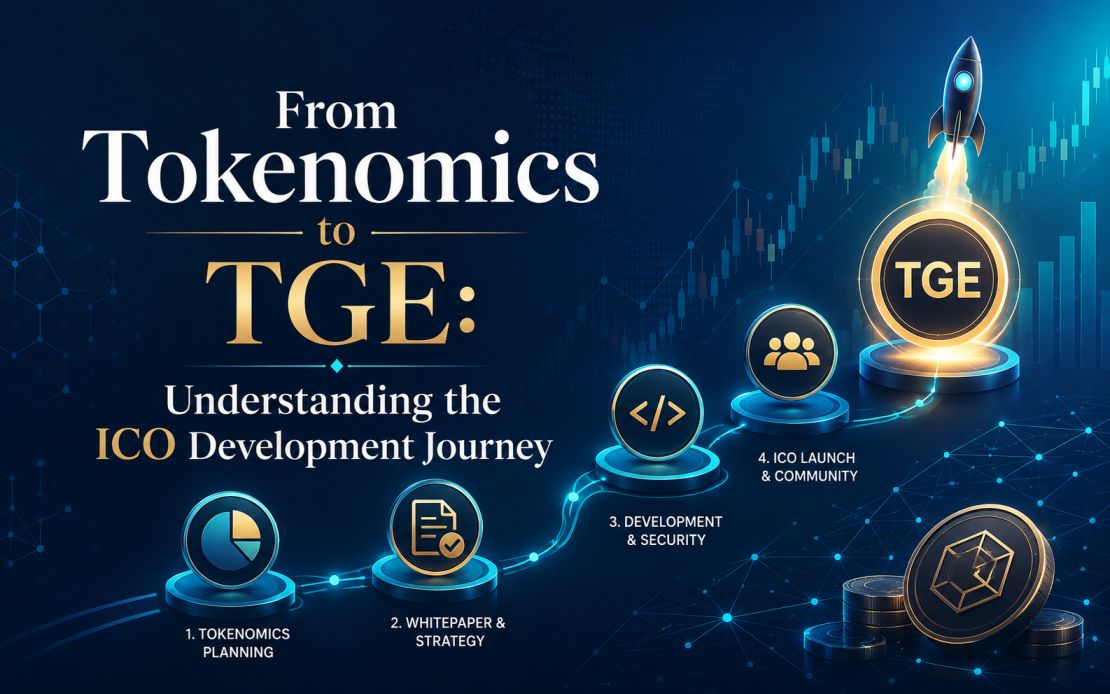
Launching a crypto token involves far more than deploying a smart contract and opening a public sale. A successful ICO requires a coordinated journey that connects the project's business model, tokenomics, technology, compliance framework, fundraising strategy, community, liquidity, and Token Generation Event (TGE).
This process has become more structured as the Web3 market matures. Investors now examine how a token fits into a working product, how supply is distributed, when tokens unlock, and whether the project has a credible plan for creating long-term demand. Regulatory expectations have also become more detailed. Under the European Union's Markets in Crypto-Assets Regulation (MiCA), for example, applicable crypto-asset whitepapers must provide information about the project, token, offer, underlying technology, rights and obligations, and associated risks. The information must be fair, clear, and not misleading.
The ICO journey therefore starts long before the TGE. Each stage influences what happens at the next one, making proper sequencing one of the most important aspects of token development.
Defining the Token's Purpose Before Designing the Economics
The starting point of ICO development should be the token's purpose. A project needs to establish why a blockchain token is necessary and what role it plays within the product or ecosystem.
A token can support payments, access to services, governance, staking, rewards, asset representation, or other ecosystem functions. The important factor is that its utility should connect directly to the project's product or economic activity.
This distinction matters because token demand needs a reason to exist beyond speculation. If users need the token to access a service, participate in governance, pay fees, or receive ecosystem benefits, demand can develop from actual activity. If the token has little connection to the product, its value proposition becomes heavily dependent on market sentiment.
The broader crypto market is also becoming more utility-driven. Chainalysis reported that APAC's on-chain crypto activity grew 69% year over year in the 12 months ending June 2025, reaching $2.36 trillion in transaction value. India ranked first in its 2025 Global Crypto Adoption Index.
For project founders, this creates an opportunity to build for real users rather than designing exclusively around fundraising.
Building Tokenomics That Connect Supply With Demand
Once the token's role is established, the next stage is tokenomics. This is where the project's economic structure takes shape.
Tokenomics determines how many tokens exist, how they are allocated, how tokens enter circulation, and what incentives encourage users to hold or spend them. A strong model must connect these variables to the project's expected growth.
A typical tokenomics framework examines:
- Total and maximum supply
- Initial circulating supply
- Public and private allocations
- Team and advisor allocations
- Treasury reserves
- Ecosystem incentives
- Liquidity allocation
- Vesting schedules
- Token unlocks
- Utility and governance rights
- Minting or burning mechanisms
The circulating supply deserves particular attention. A project can have a carefully designed total supply but still face market pressure if a large percentage of tokens enters circulation soon after launch.
Vesting is equally important. Team members and early investors often receive tokens under schedules that restrict immediate selling. These schedules align stakeholder incentives with longer-term development and give the market time to absorb additional supply.
The objective is not to engineer a particular token price. It is to create an economic structure that remains functional as users, liquidity, and circulating supply change.
Choosing the Blockchain and Technical Architecture
Tokenomics defines the economic system, while blockchain architecture determines how that system operates.
Ethereum remains a major token-development ecosystem because of its established smart-contract infrastructure, developer tooling, wallets, decentralized applications, and liquidity. Other networks can provide different combinations of transaction costs, speed, ecosystem access, and technical capabilities.
The decision should be based on the project's requirements rather than simply choosing the chain with the most attention at a particular time.
Developers need to consider transaction volume, smart-contract functionality, security, wallet compatibility, liquidity, interoperability, deployment costs, and the expected location of users.
The technical architecture also needs to account for future expansion. A project that expects to operate across multiple networks should consider how tokens, liquidity, governance, and user balances will work across those environments before the initial launch.
This stage is where the token's economic design becomes an actual technical system.
Developing the Smart Contract and Security Framework
After the architecture is established, developers translate the tokenomics into smart-contract logic.
The contract may include standard transfer functions along with minting, burning, pausing, access control, vesting, staking, governance, or other mechanisms. Every additional function introduces another component that needs testing and security review.
Testing should cover normal transactions as well as unusual conditions. Developers need to examine authorization controls, edge cases, token allocation logic, upgrade permissions, and interactions between different contracts.
Independent security audits provide another layer of scrutiny. They can identify vulnerabilities that internal development teams overlook and help projects address weaknesses before deployment.
Security is particularly important at the ICO stage because a newly launched token can attract significant attention from attackers. A vulnerability affecting token distribution, treasury management, or privileged functions can create financial losses and undermine the credibility of the entire project.
For this reason, security should be treated as part of the development lifecycle rather than as a final certificate obtained immediately before launch.
Creating the Whitepaper and Compliance Framework
The whitepaper connects the technical and economic architecture with the information presented to prospective participants.
A strong whitepaper should explain the project's purpose, technology, token functionality, economic model, roadmap, risks, fundraising structure, and use of funds. It should give readers enough information to understand what they are participating in without relying on promotional claims.
Regulatory requirements make this stage even more important. Under MiCA, applicable whitepapers must cover information about the issuer or offeror, the crypto-asset project, the offer, the token, underlying technology, rights and obligations, and risks. ESMA also states that the information must be fair, clear, and not misleading.
MiCA also requires applicable whitepapers to be published before the public offer or admission to trading and kept available while the relevant crypto-assets are held by the public.
The exact legal requirements depend on the token and jurisdiction. Projects therefore need qualified legal advice rather than treating one regulatory framework as universally applicable.
Designing the Fundraising Structure
With the token model and documentation established, the project can determine how fundraising will take place.
An ICO can include different allocation stages, such as strategic or private participation followed by a broader public sale. Each stage needs carefully defined pricing, allocation limits, vesting conditions, participation rules, and eligibility requirements.
The fundraising structure should also align with the project's capital requirements. Raising more money than the business can responsibly deploy can create unnecessary treasury pressure and unrealistic expectations. A clearly defined use-of-funds strategy gives participants greater visibility into how capital supports development.
Regulatory requirements can also affect how an offering is structured. Under MiCA, applicable crypto-asset whitepapers must contain information on payment methods, transfer arrangements, technical requirements for purchasers, offer expenses, potential conflicts of interest, and applicable law.
This demonstrates why fundraising design cannot be separated from legal, technical, and operational planning.
Preparing the Community and Market Before the TGE
The TGE is the moment when the token is created or made available according to the project's launch structure. But the groundwork for that event should begin much earlier.
A project needs an audience that understands the product and the token before tokens become transferable or tradable. Community channels, educational content, product demonstrations, development updates, partnerships, and transparent communication can help establish this foundation.
The focus should be on informed participation rather than short-term hype. A large social following does not necessarily translate into sustainable token demand. Active users, developers, contributors, partners, and community members who understand the product provide stronger foundations for the ecosystem.
This is particularly relevant as crypto adoption expands beyond traditional trading audiences. Chainalysis' 2025 data showed strong growth across APAC and other emerging markets, reflecting increasing use of crypto infrastructure across a broader population.
Executing the Token Generation Event
The TGE is the point where the project's planning becomes an operational launch.
Before the event, the team needs to verify token contracts, distribution wallets, vesting contracts, treasury controls, claim mechanisms, liquidity arrangements, and communication channels. Any discrepancy between the published tokenomics and the actual on-chain configuration can quickly damage confidence.
The TGE itself can involve token creation, allocation to eligible participants, claim activation, liquidity provisioning, or coordinated exchange availability depending on the project structure.
Timing also matters. A project needs to coordinate token distribution with liquidity and market access. If users receive tokens but have limited ways to use or trade them, the launch experience can become disconnected from the project's broader objectives.
A successful TGE is therefore not simply a technical transaction. It is the coordinated execution of the project's economic, technical, operational, and communication plans.
Managing the Post-TGE Phase
The ICO journey does not end when tokens reach users. In many respects, the post-TGE period is where the project's economic model faces its first real market test.
Teams need to monitor circulating supply, token distribution, liquidity, trading activity, user adoption, treasury movements, and upcoming unlocks. Product usage should be tracked alongside token activity because genuine utility is ultimately what supports long-term ecosystem development.
The project should also communicate material changes openly. Under MiCA, applicable issuers or offerors must modify published whitepapers when significant new factors, material mistakes, or material inaccuracies could affect an assessment of the crypto-asset.
This reflects a broader principle for token projects: documentation and communication should evolve as the project develops rather than becoming static documents published only for the initial sale.
Connecting Tokenomics, Technology, and the TGE
The ICO development journey works best when each stage supports the next.
Token utility defines why the asset exists. Tokenomics establishes how economic incentives work. Blockchain architecture provides the infrastructure. Smart contracts implement the rules. Compliance and documentation establish the information framework. Fundraising converts market interest into capital. Community development builds an initial user base. The TGE activates the token economy. Post-launch operations determine whether that economy can sustain itself.
Weakness at one stage can create problems later. Poor tokenomics can create selling pressure after the TGE. Weak security can expose treasury assets. Inadequate compliance planning can restrict market access. Poor liquidity preparation can create a difficult trading environment.
The journey therefore needs to be managed as one interconnected system rather than a collection of independent tasks.
Conclusion
From tokenomics to TGE, ICO development has become a structured process that combines economic design, blockchain engineering, compliance, security, fundraising, and community building. The strongest projects do not treat the TGE as the destination. They use it as the transition point between development and a functioning token economy.
As global crypto adoption expands and regulatory frameworks become more detailed, projects need greater preparation before entering the market. Blockchain App Factory supports businesses through the ICO development journey with solutions spanning token development, smart contracts, tokenomics, security, and launch infrastructure. A carefully planned path from token design to TGE can give Web3 projects a stronger foundation for sustainable ecosystem growth.