How to Create an ICO Admin Dashboard to Manage Token Sales
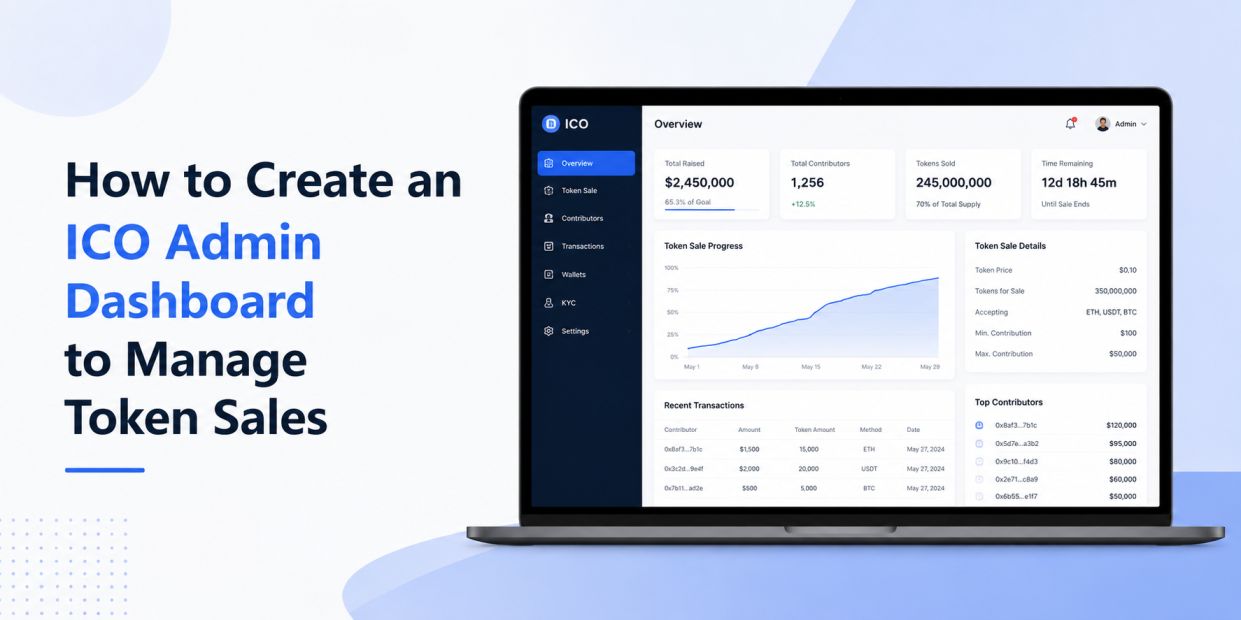
An ICO admin dashboard is the operational control center behind a token sale. While investors see the public-facing sale page, administrators need a much broader view of the offering. They must manage token allocations, monitor contributions, verify participants, track transactions, configure sale phases, review analytics, and respond to operational issues from one secure environment.
Building this dashboard requires more than designing an attractive interface. The platform must connect blockchain infrastructure, smart contracts, wallet systems, databases, authentication, compliance workflows, analytics, and administrative controls. A well-designed ICO admin dashboard can reduce manual work and provide the visibility required to run a token sale with greater consistency.
For projects planning an ICO, the right approach starts with the business rules of the sale. Those rules should then shape the dashboard architecture, permissions, workflows, and reporting capabilities.
What Is an ICO Admin Dashboard?
An ICO admin dashboard is a secure backend interface that allows a project team to manage and monitor its token sale. It typically provides controls for token configuration, sale stages, investor records, contributions, wallet activity, allocation rules, token distribution, KYC status, reports, and administrative permissions.
The dashboard acts as the operational layer between the token-sale smart contracts and the project's internal team.
For example, suppose a project launches three sale stages. The private round has one token price, the community round has another, and the public round has a third. Administrators need to configure the dates, allocation limits, accepted assets, eligibility rules, and vesting conditions for each stage.
Without a centralized dashboard, teams may depend on spreadsheets, blockchain explorers, manual transaction checks, and separate systems. That increases the chance of inconsistent records and operational mistakes.
A well-built dashboard brings these functions into a controlled environment.
Start With the ICO's Business Logic
The most important step in ICO dashboard development happens before coding begins.
The development team needs to document exactly how the token sale works.
This includes the token supply allocated to the sale, pricing structure, sale phases, contribution limits, supported chains, accepted payment assets, wallet eligibility, vesting periods, distribution rules, refund conditions, and administrative responsibilities.
Consider a hypothetical token sale with a total public-sale allocation of 20 million tokens. The project could divide it into:
- Private sale: 8 million tokens
- Community sale: 5 million tokens
- Public sale: 7 million tokens
The dashboard should understand these allocations as enforceable business rules rather than simple numbers displayed on a screen.
If the public-sale allocation reaches its limit, the system should prevent additional purchases according to the sale's defined rules. If an investor exceeds a contribution limit, the system should flag or reject the transaction according to the configured policy.
This is why requirements engineering matters. A visually polished dashboard with poorly defined sale logic can still create serious operational problems.
Core Modules of an ICO Admin Dashboard
Token and Sale Configuration
Administrators should be able to configure the fundamental parameters of the token sale.
This can include token price, sale dates, allocation limits, accepted payment assets, vesting schedules, wallet restrictions, and sale-stage settings.
Changes to sensitive parameters should not be treated like ordinary content edits. The system should require appropriate authorization and record who made the change.
Investor Management
The investor module gives administrators a structured view of participants.
Depending on the project's legal and operational model, it can display wallet addresses, registration status, eligibility, contribution history, allocation, claim status, and relevant verification information.
A strong design separates information that administrators need from sensitive information that should remain restricted.
Contribution and Transaction Monitoring
Blockchain transactions should be synchronized with the administrative system.
The dashboard can show transaction hashes, wallet addresses, amounts, timestamps, payment assets, confirmation status, and allocation outcomes.
This helps administrators identify failed transactions, pending confirmations, duplicate records, unexpected values, and other exceptions.
Blockchain data should remain the authoritative source for on-chain events. The dashboard should provide a usable operational view without pretending that an internal database alone proves a transaction occurred.
Wallet and Smart Contract Integration
An ICO dashboard depends heavily on blockchain integration.
The system typically interacts with smart contracts through blockchain nodes, RPC providers, indexing services, or other infrastructure.
When an investor completes a token purchase, the backend needs to identify the relevant blockchain event and update the dashboard.
A simplified flow looks like this:
Investor Wallet → Smart Contract → Blockchain Transaction → Event Detection → Backend → Admin Dashboard
The dashboard should not directly expose sensitive signing credentials to administrators.
Administrative transactions should use controlled signing infrastructure, appropriate wallet policies, and strong access restrictions.
Smart contracts should also undergo rigorous testing before the token sale. A dashboard cannot compensate for flawed contract logic.
Role-Based Access Control Is Critical
An ICO team rarely consists of one administrator.
A realistic platform may have finance staff, compliance personnel, technical administrators, marketing staff, and senior executives.
Each role should have only the permissions required for its responsibilities.
For example, a marketing administrator may need campaign analytics but should not be able to change token pricing. A compliance officer may need access to eligibility information but should not be able to modify smart-contract parameters.
OWASP recommends designing authorization carefully, denying access by default, applying least privilege, and logging authorization events.
A practical permission model might include:
- Super Administrator
- Token Sale Manager
- Compliance Administrator
- Finance Manager
- Support Agent
- Analytics Manager
- Read-Only Auditor
The system should also require strong authentication for privileged accounts. Multi-factor authentication can provide an additional security layer for administrative access.
Security and Audit Trails
Security should be treated as a core architecture requirement rather than a final testing stage.
An ICO dashboard can contain sensitive investor information and controls over valuable assets. A compromised administrator account can create consequences far beyond an ordinary website breach.
The system should incorporate controls such as secure authentication, least-privilege access, session management, input validation, encryption where appropriate, secure API design, infrastructure monitoring, and regular security testing.
Audit logging deserves particular attention.
Administrators should be able to determine who changed a sale parameter, when the change occurred, what the previous value was, and what the new value became.
OWASP recommends logging administrative functions, authentication failures, access-control violations, input-validation failures, and other security events. It also recommends protecting log integrity and restricting access to logs.
For an ICO platform, this creates an operational record that can support incident investigation and internal accountability.
KYC and Compliance Workflows
Not every ICO requires the same compliance process. Requirements depend on the token, offering structure, jurisdictions, investor categories, and applicable laws.
The dashboard should therefore be designed around the project's actual legal framework.
In the United States, the SEC states that federal securities laws apply to crypto assets when they qualify as securities, and its current 2026 interpretation addresses the application of federal securities laws to certain crypto assets and transactions.
For projects operating under the European Union's MiCA framework, requirements can include publication and notification of crypto-asset white papers and rules governing marketing communications, depending on the type of crypto-asset and offering. MiCA requires applicable marketing communications to be fair, clear, and not misleading and consistent with the relevant white paper.
The dashboard can support compliance operations through features such as:
- KYC status tracking
- Investor eligibility
- Geographic restrictions
- Whitelist management
- Contribution limits
- Verification records
- Restricted-wallet controls
- Compliance reporting
The software should support compliance procedures. It should not be presented as a substitute for legal advice.
Analytics and Reporting
An ICO dashboard should turn raw sale activity into useful management information.
Executives may want to know how much capital has been raised, while finance teams may need transaction-level records. Compliance teams may need eligibility reports, and growth teams may want to understand conversion across the investor journey.
Useful dashboard metrics can include:
Total funds raised: Tracks contributions across supported payment assets.
Tokens allocated: Shows how much of the sale inventory has been committed.
Remaining allocation: Indicates available inventory by sale phase.
Unique participating wallets: Shows the number of addresses that have participated. This should not automatically be treated as a count of unique people.
Conversion rate: Measures the proportion of eligible participants who complete the desired purchase action.
Average contribution: Provides a high-level view of contribution patterns.
Claim or distribution status: Shows how many allocated tokens have been distributed or claimed.
Charts should support decision-making rather than simply filling dashboard space.
Designing the Investor and Admin Workflow Together
A common development mistake is designing the admin panel independently from the investor experience.
The two systems are connected.
Suppose an investor submits a contribution. The admin dashboard needs to reflect whether the wallet is eligible, whether the transaction succeeded, how many tokens were allocated, and whether vesting applies.
That means the underlying workflow needs consistent states.
A useful lifecycle could be:
Registered → Verified → Eligible → Contribution Initiated → Transaction Confirmed → Allocation Recorded → Vesting Active → Claimable → Distributed
Each state should have defined conditions.
This makes support easier because administrators can identify exactly where an investor's transaction stopped.
Build the Right Technical Architecture
A scalable ICO admin dashboard usually requires several layers rather than a single application.
The frontend provides the administrative interface.
The backend handles business logic, authentication, permissions, APIs, and integrations.
The database stores operational records.
Blockchain infrastructure provides transaction and contract data.
Smart contracts enforce on-chain rules.
External services can handle KYC, analytics, notifications, payment processing, or blockchain indexing.
A simplified architecture can be represented as:
Admin Interface → API Layer → Business Logic → Database
Business Logic ↔ Blockchain Infrastructure
Business Logic ↔ KYC / Analytics / Notification Services
This separation makes the system easier to test and maintain.
Sensitive operations should not depend solely on frontend validation. Important rules must be enforced server-side and, where appropriate, through smart contracts.
Testing Before the ICO Goes Live
Testing should cover both normal operations and failure scenarios.
Developers should test contribution limits, token allocation, sale-stage transitions, invalid wallet conditions, duplicate processing, failed transactions, network congestion, contract errors, API failures, and administrator permission boundaries.
Smart-contract testing deserves special attention because blockchain transactions can create irreversible consequences.
The team should also conduct security testing on the dashboard itself.
OWASP recommends testing access-control rules through unit and integration tests and enforcing authorization on requests rather than relying on interface-level restrictions.
A production launch should happen only after the system has been tested against realistic transaction and operational scenarios.
How Much Does ICO Admin Dashboard Development Cost?
The cost depends heavily on the platform's scope.
A basic dashboard with token-sale configuration, investor records, transaction monitoring, and analytics requires less engineering than a multi-chain platform with custom allocation logic, KYC integrations, vesting, payment processing, advanced reporting, and complex role management.
The major cost drivers include:
- Number of supported blockchains
- Smart-contract complexity
- Custom sale mechanics
- KYC and compliance integrations
- Wallet integrations
- Admin roles and permissions
- Analytics requirements
- Security testing
- Third-party services
- Post-launch maintenance
Projects should avoid selecting a development approach based solely on the lowest initial quote. Security, maintainability, scalability, and operational reliability can have a greater impact on the total cost of ownership.
Conclusion
An ICO admin dashboard should function as the operational backbone of a token sale rather than a simple reporting screen. It needs to connect sale configuration, investor management, blockchain transactions, wallet activity, allocation rules, compliance workflows, analytics, and administrative permissions into one controlled system. The most important development decisions should begin with the project's sale mechanics and regulatory requirements, then translate those requirements into secure technical workflows.
For projects planning an ICO, Blockchain App Factory can support the development of custom ICO infrastructure with features tailored to token-sale operations, investor management, blockchain integration, analytics, and administrative control. A well-designed ICO dashboard gives project teams greater visibility over fundraising activity while creating a structured foundation for secure token distribution and post-sale operations.