How Global Infrastructure Spending Is Creating the Next Steel Supercycle-APL Apollo TMT
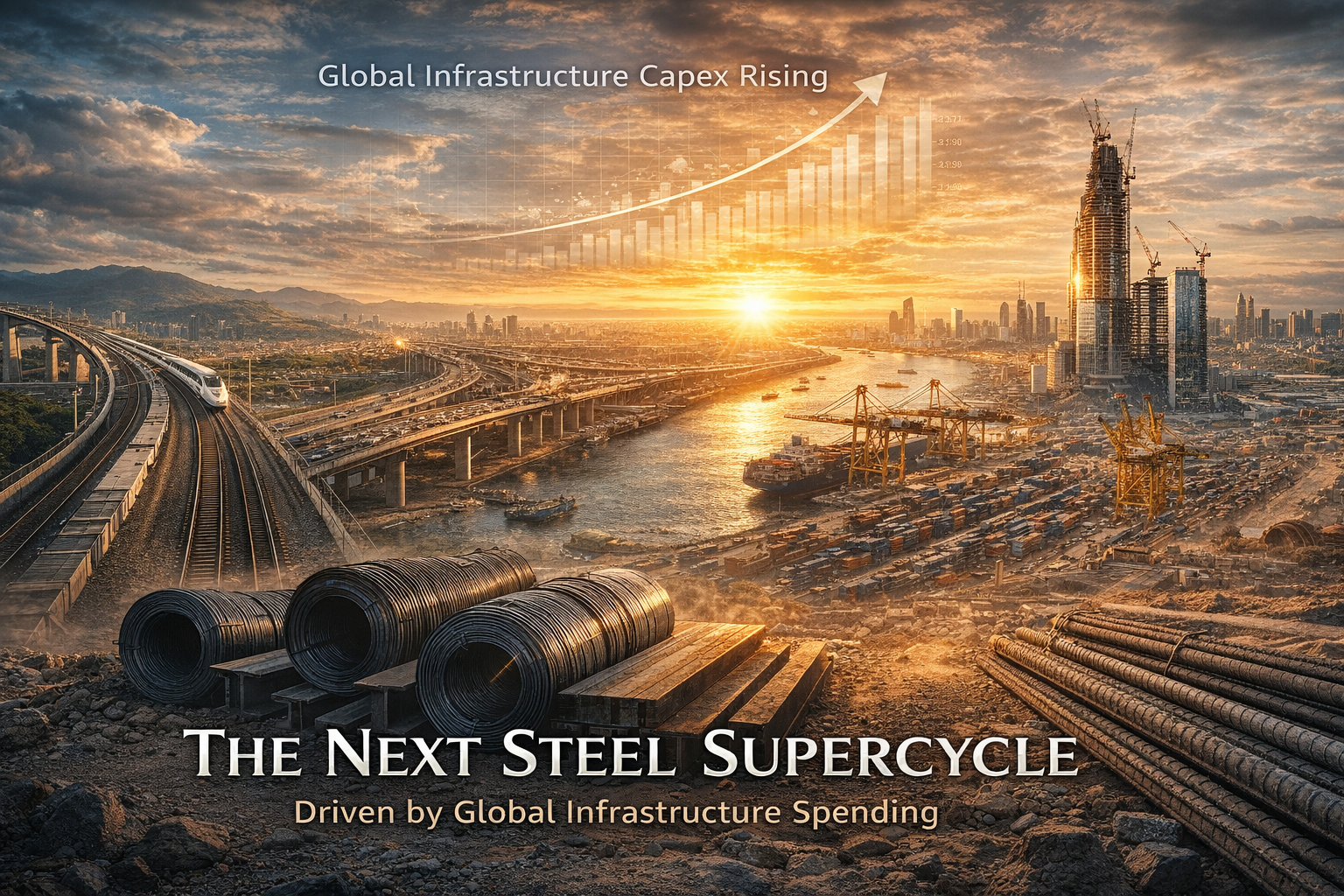
🌍 A New Phase for Global Steel Demand
Over the past few decades, steel demand has followed a familiar pattern — growth during economic expansion, slowdown during recessions, and recovery when governments invest in development again.
But something different appears to be happening now.
Around the world, countries are entering what could become one of the most significant infrastructure investment phases in modern history. This shift has the potential to reshape steel demand for years to come.
🏗️ Why Infrastructure Spending Matters So Much
When governments invest in infrastructure, they are not just building roads or bridges.
They are:
• Stimulating economic activity
• Creating employment
• Improving logistics efficiency
• Strengthening long-term productivity
Infrastructure spending has always acted as a powerful economic multiplier. Today, however, multiple global forces are converging at the same time, making the impact on steel demand much stronger than in previous cycles.
🌆 Urbanization Is Accelerating Steel Consumption
Emerging economies continue expanding their cities rapidly, requiring:
• Housing
• Transportation networks
• Utilities
• Commercial infrastructure
At the same time, developed countries are upgrading aging infrastructure built decades ago.
Bridges need reinforcement.
Rail systems require modernization.
Energy networks must adapt to new technologies.
All of this requires massive quantities of steel.
⚡ Energy Transition Is Increasing — Not Reducing — Steel Demand
Renewable energy projects such as:
• Solar farms
• Wind installations
• Transmission infrastructure
• Energy storage systems
are extremely steel-intensive.
Unlike traditional energy systems, renewable infrastructure often requires larger structural frameworks distributed across wide geographic areas.
Cleaner energy does not mean less steel.
In many cases, it means more steel.
🌐 Geopolitics and Economic Strategy Are Also Driving Demand
Many nations are prioritizing:
• Domestic manufacturing
• Supply chain resilience
• Strategic independence
Infrastructure spending has become a tool not only for economic growth but also for national competitiveness.
Industrial corridors, logistics hubs, ports, and transportation networks are expanding globally to support trade efficiency.
📈 Are We Entering a Steel Supercycle?
These combined factors are creating conditions similar to what economists call a supercycle — a prolonged period of strong demand driven by structural changes rather than short-term fluctuations.
Unlike temporary booms, supercycles are supported by long-lasting trends that reinforce each other over time.
The indicators today are unusually strong.
🔍 A Major Shift in Buyer Thinking
An important transformation is also happening inside the steel market itself.
Buyers are becoming more focused on:
• Reliability
• Quality consistency
• Lifecycle performance
• Structural safety
rather than simply choosing the lowest price.
Large infrastructure projects involve long time horizons and significant financial risk. Procurement decisions increasingly consider durability and maintenance costs over decades.
This indicates a maturing global market.
⚠️ Opportunities — But Also Challenges
Rising infrastructure demand can create:
✅ Manufacturing growth
✅ Employment generation
✅ Industrial expansion
But it can also lead to:
⚠️ Price volatility
⚠️ Supply chain pressure
⚠️ Raw material cost fluctuations
⚠️ Energy price impact
At the same time, environmental regulations are pushing the steel industry toward lower-carbon production technologies, which may reshape cost structures in the future.
📊 What This Means for the Global Economy
Infrastructure investment is rarely short-term.
It reflects long-term national planning.
When multiple countries simultaneously invest in infrastructure modernization, energy transition, and industrial capacity, the cumulative impact on steel demand becomes substantial.
Whether this becomes a true global steel supercycle remains to be seen — but the underlying trends are clearly aligned.
🧠 Final Thought
Infrastructure is often described as the backbone of economic progress.
Steel remains one of its most fundamental building blocks.
Understanding these structural trends is essential not only for businesses directly involved in construction and manufacturing, but also for anyone interested in global economic development.
What are your thoughts? Do you believe we are entering a new steel supercycle?