Stronger Ground, Better Drainage: The Case for Interlocking Pavers
Anyone who has dealt with a gravel driveway that, after a few storms, becomes a rutted, washed-out mess knows that the lack of structure beneath the gravel is the real issue. By providing loose material with something to hold onto, interlocking pavers address this issue and turn an unstable surface into one that can support actual weight without degrading or shifting.
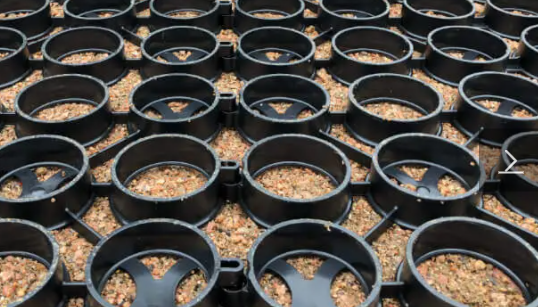
These grid systems create a single, continuous, stable layer across the ground by connecting edge to edge via a locking mechanism. The pavers hold everything in place while allowing water to reach the soil below once they are filled with gravel or planted with grass. This permeability is important because rainwater naturally seeps back into the ground, reducing erosion and runoff, rather than collecting on the surface or rushing off into storm drains.
Interlocking Pavers are sturdy enough to sustain vehicles, trucks, and even RVs without creating the ruts that occur with unreinforced gravel or dirt because they distribute weight uniformly. Additionally, they are a much more environmentally friendly substitute for concrete, avoiding the significant carbon footprint associated with the production of cement while maintaining a high level of durability.
Installation is surprisingly easy; no special equipment, mixing, or curing is required. For driveways, parking pads, and paths alike, the pavers snap together by hand, making them a feasible weekend project. For a stable, water-friendly surface without the cost or mess of concrete, interlocking pavers are hard to beat.