AI bubble: Taiwan is next
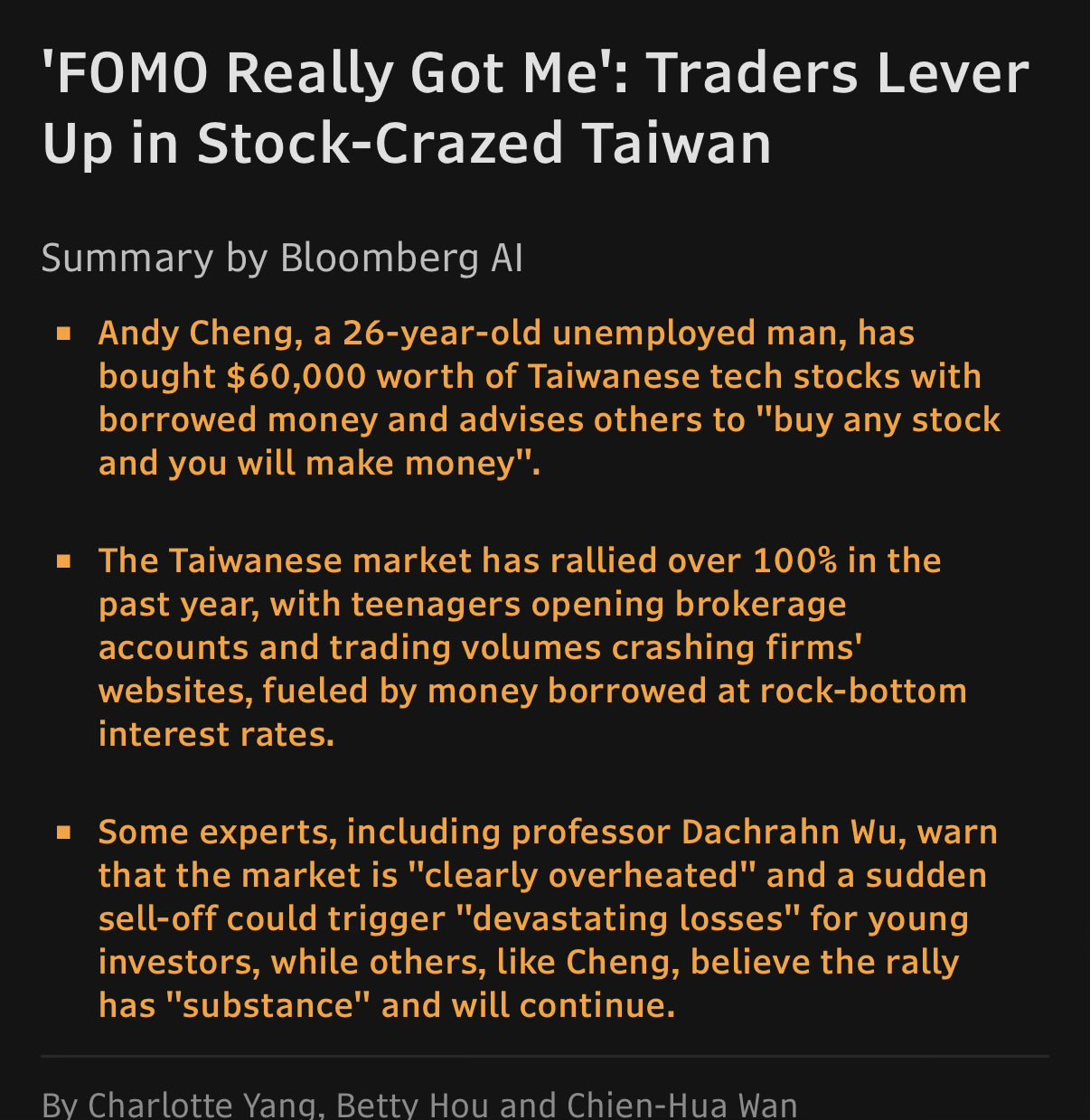
Taiwan today looks remarkably similar to South Korea only months ago. Teenagers are rushing to open brokerage accounts, social media influencers are taking out six-figure loans to buy stocks and even unemployed young investors are borrowing money to build concentrated positions in technology companies. One of them, 26-year-old Andy Cheng, owns roughly $60,000 worth of Taiwanese tech stocks financed partly with borrowed money and confidently offers advice that has become emblematic of the national mood: “Buy any stock and you will make money.”
The scale of the enthusiasm is extraordinary. Taiwan’s stock market has more than doubled in a year, overtaking much larger economies to become the world’s fifth-largest market, while trading activity has surged so dramatically that brokerage websites have periodically struggled to handle demand. In restaurants, universities, workplaces and social media feeds, conversations increasingly revolve around AI, semiconductor stocks and the next investment opportunity.
The bullish argument is easy to understand. Taiwan sits at the center of the global AI supply chain, producing the overwhelming majority of the world’s most advanced semiconductors through companies that occupy an almost irreplaceable position in the global economy. Unlike many historical bubbles, this one is built on genuine industrial strength rather than purely speculative promises. Yet every major bubble in history possessed a compelling story and perhaps the most dangerous phrase in financial markets remains the conviction that “this time it has substance.”
More revealing than the price gains themselves is the explosion in leverage beneath the surface. Margin debt has surged roughly 160% over the past year, exceeding the pace recorded before the dot-com collapse and even surpassing South Korea’s recent borrowing boom. Investors who cannot obtain enough leverage from brokerages increasingly turn to banks, cancel savings products or borrow against existing assets in order to increase their exposure. The demand for borrowed money has become so intense that brokerages themselves have entered a borrowing spree, issuing bonds and seeking additional funding simply to keep pace with clients eager to buy more stocks.
The consequences are already beginning to appear around the edges. Investor defaults linked to stock trading have climbed to record levels, brokerages have started stress-testing their loan books against sharp market declines and some lenders have tightened lending conditions after approaching internal risk limits. Regulators insist that risks remain manageable, yet financial institutions are simultaneously raising collateral requirements, increasing borrowing costs and reducing leverage for selected securities. Such actions suggest a growing awareness that the system has become increasingly dependent on continuously rising prices.
Perhaps the most striking feature of the Taiwanese boom is that nearly every participant acknowledges the lessons of previous bubbles while remaining convinced that those lessons do not apply today. Investors openly reference the dot-com era, discuss valuations and recognize the dangers of leverage, yet continue borrowing because the fear of missing gains has become stronger than the fear of losing capital. The result is a market driven not only by optimism about AI, but by a collective belief that standing aside is riskier than participating.
Related source:
https://uk.finance.yahoo.com/news/fomo-really-got-taiwanese-deep-002818497.html