The Space Between Stations
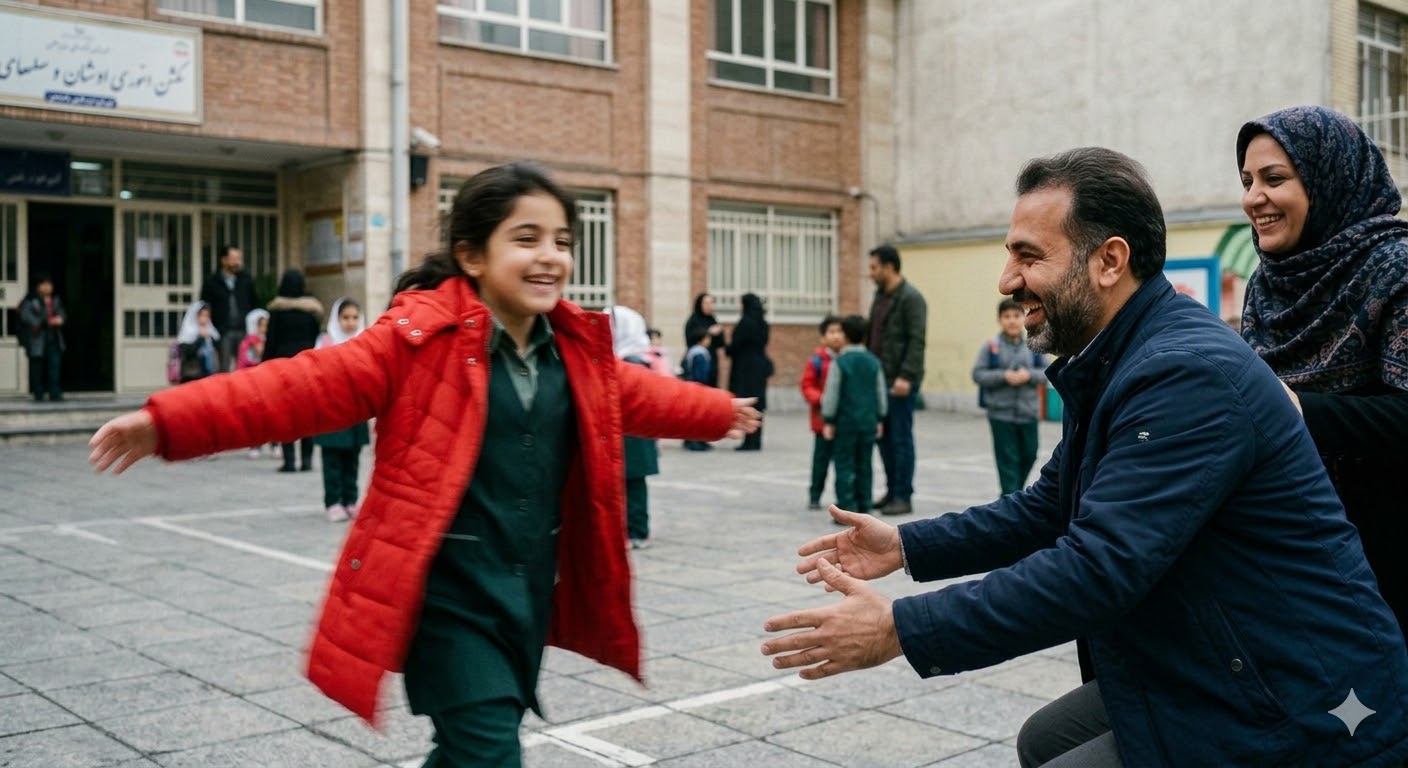
The last photograph Dariush had of his daughter was blurry.
She had been running toward him, arms out, laughing at something he had said he couldn't remember what now, and that forgetting felt like a second death. The image was motion-smeared, her face half-turned, her red coat bright against the grey courtyard of her school. He had meant to take a better one. He had thought there was time.
There is always the assumption of time.
He had grown up in Tehran in a household that was, by the standards of their neighborhood, quietly rebellious. His father had owned more books than was comfortable. His mother had taught school without wearing her headscarf quite as tightly as the women on either side of her. They had satellite dishes hidden behind water tanks on the roof, and on Friday nights when the call to prayer drifted over the city, Dariush and his brother Omid would sit cross-legged on the kitchen floor and listen to American music through a small set of speakers his father had bought from a man at the bazaar who asked no questions.
He had loved it with a specific, almost embarrassing intensity, the way you love things you're not supposed to have.
Bruce Springsteen. Fleetwood Mac. Later, when he was older, Miles Davis and then hip-hop, the sharp lyrical anger of it, the grief underneath the anger. He had read about America in books, seen it in films smuggled in on hard drives. He understood it was not perfect. He was not a child. He knew about its hypocrisies, its own violences, its own corruptions. But he had believed, genuinely, stubbornly, against the daily instruction of state television and Friday sermons, that it was a place organized around an idea worth believing in. That individuals mattered there. That a person could build something and be who they chose to be.
He had told Omid once, when they were teenagers lying on the roof in summer: I think if I were born there, I would be a different person.
Omid had laughed. You would be fat and you would watch football and you would not know where Iran is on a map.
Maybe, Dariush had said. But my children would be safe.
He became an engineer. He married Shirin, who was a literature teacher and who read poetry aloud while she cooked and who cried at films and never apologized for it. They had two children: Maryam, nine, who collected rocks and wanted to be a geologist, and Sina, six, who was afraid of dogs and loved them anyway and would approach every one he saw with his hands trembling and his face lit up.
They lived a life of small negotiations. You learned what to say in public and what to save for the kitchen. You learned the texture of the invisible walls and you moved within them, and you told yourself it was fine, it was manageable, it was how everyone lived.
He never stopped listening to American music. He never stopped believing, quietly, privately, in the idea of a world where that music could simply exist in the open air without anyone deciding it was dangerous.
The strike happened on an otherwise normal day.
He was at work. Shirin was at school, her school, not the children's school, two kilometers apart. Maryam and Sina were in class. The missiles came from the sky and the intelligence, it was later said, had identified the sites as military infrastructure. Command and control. Strategic assets.
Maryam's school was not a military asset.
Shirin's school was not a military asset.
He found out about the children first. Then his wife. His mother, who had been visiting a neighbor three streets away from Shirin's school, had died of her injuries two days later in a hospital that was running low on everything.
He did not cry at the funerals. He stood in the grey light and felt the absence of feeling, which was worse. Omid stood beside him and neither of them spoke. Their cousins Farid, Leila, Bahram moved around them like people in a dream, performing the gestures of grief, bringing food that nobody ate.
He did not cry for three weeks, and then one night he put on Springsteen, The River, which Shirin had always said was too sad, and he sat on the floor of his children's bedroom and he cried until there was nothing left and then he kept crying anyway.
The regime's response was immediate and orchestrated.
State television ran the footage constantly. Vigils were organized. Officials who had spent forty years calling America the Great Satan now stood at podiums with photographs of dead children, and their outrage was real, he thought, or at least their opportunism was real, which amounted to the same thing in front of a camera.
We told you, the narrative went. We always told you. And you doubted us.
Dariush had doubted them. He had doubted them his entire adult life. He had been right to doubt them, they were liars, they were thieves, they had stolen the revolution and turned it into a machine for their own preservation. He knew this. He still knew this.
But his daughter had been running toward him, arms out, laughing, and now she was in the ground.
And the missiles had come from American ships.
These two facts did not cancel each other out. That was the thing nobody told you. He had expected that his knowledge of the regime's corruption would act as an antibody that would protect him from the propaganda, would keep the grief from curdling into something directed and specific. He had believed that a person who knew the truth would be immune to the lie.
He had been wrong.
The lie and the truth were both true now. The regime was vile. The missiles were real. His children were dead. He had believed in something and that something had sent the ships who rained death.
He could hold both thoughts. He just couldn't hold them without something breaking.
Omid changed faster than he did.
Within two months, Omid was meeting with people Dariush didn't know, coming home late, speaking in a new register, clipped, certain, the language of men who have found a cause to contain their pain. He had the look Dariush recognized from the years after the revolution, that particular brightness in the eyes that was not happiness, but was something that functioned like it. Purpose. Direction. The relief of having somewhere to put everything.
There are people, Omid said one evening, who are doing something. Not just talking.
Dariush looked at his brother. He looked at the face he had known his entire life, and he could see what was happening inside it, and he could not say it was incomprehensible.
Doing what, he said.
Omid told him.
Dariush sat with it. He felt the pull of it, that was the honest thing, the thing he would never say aloud to anyone: he felt the pull. It had a shape and a weight and in the dark part of the night it had a logic. Sina had been afraid of dogs and loved them anyway. Maryam had collected rocks. Shirin had cried at films. His mother had worn her headscarf imprecisely. These people had been alive and specific and irreplaceable, and somewhere a man had looked at a screen and made a decision, and they were gone, and the man was still alive, and the world had simply continued. He saw pictures his neighbor had shown him of social media posts where people cheered about the strikes that had taken his family, taken his joy, he would never be the same, yet they cheered, he felt sick, very sick.
The pull was real.
He sat with it for a long time.
He thought about a conversation he'd had with Maryam, two months before she died.
She had asked him why people in other countries sometimes hated Iran. He had tried to explain the history, the politics, the way fear and power and religion and oil had tangled together over a century until nobody was only wrong and nobody was only right. She had listened with the focused, serious expression she used when she was really paying attention.
But do they know us? she had asked. The people there. Do they know what we're like?
He had said he didn't think most people knew most other people. That this was the problem.
She had thought about this. If they knew us, she had said, I don't think they would.
He told Omid no.
He did not tell him it was because of Maryam's question, because that felt too private, too small for the size of what they were deciding. He said it badly, without eloquence. He said: This isn't what they were.
Omid looked at him for a long time. His face was not angry. It was something worse, it was sad, and patient, and certain, the way people look when they've made peace with a decision.
You think they care what we were? Omid said quietly.
Dariush didn't have an answer. He still doesn't.
Omid left two weeks later. Dariush does not know exactly where he is. He calls sometimes, brief conversations, careful words, the weight of unspoken things on both ends of the line.
Dariush still listens to the music.
He's not sure why. It feels, some nights, like a kind of argument with himself, with the world, with the distance between the country he had believed in from afar and the missiles that had come from its ships. It does not resolve. It just plays.
He thinks about Maryam's question often. Do they know us?
He thinks: probably not. And he thinks: we probably don't know them either. And he thinks: this is exactly how it keeps happening, the not-knowing, the abstraction of people into targets or threats or acceptable losses, on every side, in every language, forever.
He does not know if this thought makes him better or just paralyzed.
He sits in his children's room sometimes, which he has not changed. Maryam's rocks are still on the shelf, organized by color because she hadn't yet learned to organize them by type. Sina's drawing of a dog, brave, hopeful, slightly terrifying is still taped to the wall.
He is thirty-eight years old. He has survived everything he was most afraid of losing. He does not know what he is for now.
Outside, the city goes on. The call to prayer comes over the rooftops. Somewhere, he knows, Omid is moving toward something.
He puts on The River.
He lets it play.
The space between who we were and what we become is not empty. It is where everything happens, all the choices that look like fate, all the fates that began as choices. Dariush has not chosen. But not choosing is also a position, and the river keeps moving, and the night is very long.
This is how it happens. Not with a villain. With a blurry photograph, and a song, and a question a nine-year-old asked that nobody answered in time.
Between radio stations, you get static, noise, fragments of signals from different places bleeding into each other, nothing clear. Dariush exists in that static. He's caught between the Iran he was raised in and the America he believed in, and after the strike, neither signal comes in cleanly anymore. Both are corrupted.