American Debt By Age Group @senseicat
Having traveled pretty extensively, I often hear America referred to as one of the most wealthiest countries in the world. Most Americans seem to maintain a high level of debt. The majority of debt appears to be educational and mortgage loans.

"Americans have fallen back in love with debt.
Total household debt—a category that includes mortgages, student loans, and car loans along with credit card and other debt—dipped in the wake of the Great Recession, but it has since steadily rebounded in the years since. Overall, Americans’ debt hit a new high of $13 trillion last year, surpassing the previous record set in 2008 by $280 billion, according to the New York Fed.
MONEY dug into data from the Federal Reserve’s Survey of Consumer Finances to examine just how much debt—and of what types—Americans were carrying at every age.
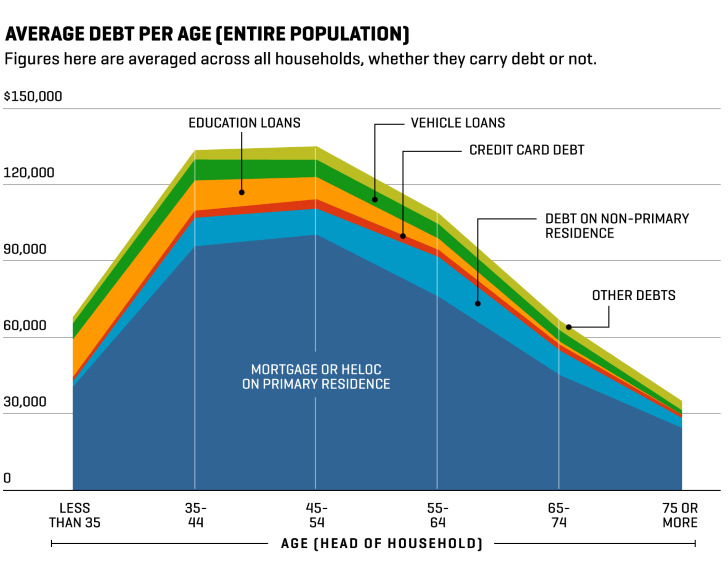
As it turns out, people’s peak earning years also appear to be their peak debt years. People between the ages of 45 and 54 reported the highest levels of debt overall, totaling $134,600. Those in the 35-44 age bracket carry the second-largest amount, at $133,100.
Here’s how much Americans owe overall, broken down by age group:
Under 35: $67,400
35–44: $133,100
45–54: $134,600
55–64: $108,300
65–74: $66,000
75 and up: $34,500
That’s to be expected, says John D. Salter, professor of financial planning at Texas Tech University. “The trend tends to follow when people have children and those kids’ needs. We see that rise in debt at the time most people are looking for bigger homes to get more space for their family, buying cars for their children, or paying college tuition for them.”
People may also feel more comfortable taking on debt in these years, Salter speculates: This stage of life is also typically when people feel established in their careers, a time when they seek out promotions and raises and therefore experience higher earnings.
The following chart, based on Fed data, breaks down average 2016 debt levels and types for all U.S. consumers.
It has, to some extent, an element of symmetry. For those just starting out, the under-35 group, the total average debt was $67,400. That’s pretty close to the $66,000 average debt for those between the ages of 65 and 74. Both groups are sitting just outside those peak earning years, and are less likely to have child-related expenses to contend with. (We’ll get to the 75+ cohort in a minute.)
Yet the types of debt held by the two groups were vastly different.
Households run by those under age 35 carry the most education debt—a function of their age as well as recent surges in education expenses and financing, something that older generations were less likely to face. The average millennial household owes $14,800 in student loans.
For those in the 65-74 category, on the other hand, the second-largest source of debt was tied to real estate that was not a primary residence—presumably vacation homes or investment properties.
Debt levels drop off sharply for those 75 and older, who owe less than $35,000 on average—most of that in the form of a mortgage. Even so, some experts note, that five-figure debt level is still jarring.
“We’re seeing people carrying much more debt than previous generations into retirement,” says Ron Rhoades, professor of finance at Western Kentucky University. “Before, most people would have already paid off their 30-year mortgage before retiring—but those generations also weren’t taking advantage of home equity lines of credit and refinancing options. Paying off such a loan really aids cash flow in retirement and makes your financial situation less precarious.”
Some fretted that younger families will be carrying even more debt as they age, compared with today’s 60- and 70somethings.
“Younger people are taking on debt at a higher rate and paying it off at a lower rate,” says Lucia Dunn, an economics professor at Ohio State University who has studied consumer debt. “When they reach age 75, the debt picture for them will look a lot different than what we currently see. When you project out these trends, it is not so optimistic.”
The above data considers debt levels across all Americans—mixing in both borrowers and non-borrowers, and averaging out the debt levels across the whole group."
Source: cnbc
Trust me everyone is experiencing the burden of debt, student debt is a killer especially when society norms version of security in todays economy is going to college, getting a degree, getting a stable career but i believe this is why "everyone is in debt" & cryptocurrency will be one of the factors of me rising from this overwhelming amount of debt due to college...
I am proud of you for pursuing your education and investing in yourself. I wish that you did not have the burden of student debt and could focus on earning money and sharing your talents.
That is so true, younger people of this generation owes more debt than those in the past
I believe that education should be free especially for academically focused students. It is good for our citizens, country, and overall future.
Studies have shown that debt and debt crises has become a global challenge in today's world. In that case, Which of the following debt categories stated above can be justify?
They can all be justified, after all, it is literally the American way! I believe that basic essentials such as education, housing, and medical care should be free because it is an enormous investment that will return tenfold.
Americans have fallen back in love with debt. - Really? They have no choice as the monetary system is debt based and requires the money supply to be continually expanded, which ties into the economy that is consumption based economy and continually needs to expand as well. Those systems needs to end!
thanks for sharing such type of informative post dear..
@resteem done
thanks for the information
To listen to the audio version of this article click on the play image.

Brought to you by @tts. If you find it useful please consider upvote this reply.
So did time.com steal the article from you or did you steal it from time.com?
I guess that is a way of life over there. A huge percentage of adults still fall back on debt. It's much more comfortable for them because they are in an economy that appreciates credit loan to people for an increment in economic, social activities for the overall betterment of the country. In my country, Nigeria, owing is like a massive burden that has caused a lot of assainations, suicide and many others. In my opinion, I guess this credit loan given is for a positive motive but becomes negative when repayment becomes difficult. Credit loan will create incentives for people to have a much more comfortable life and increase the standard of living.