What Is GEO, and How Is It Reshaping SEO?
For twenty-five years, search optimization meant one thing: getting a blue link on Google's results page. You picked keywords, built backlinks, structured your pages, and waited for rankings to climb. That playbook still matters, but a second front has opened up alongside it — and it plays by different rules.
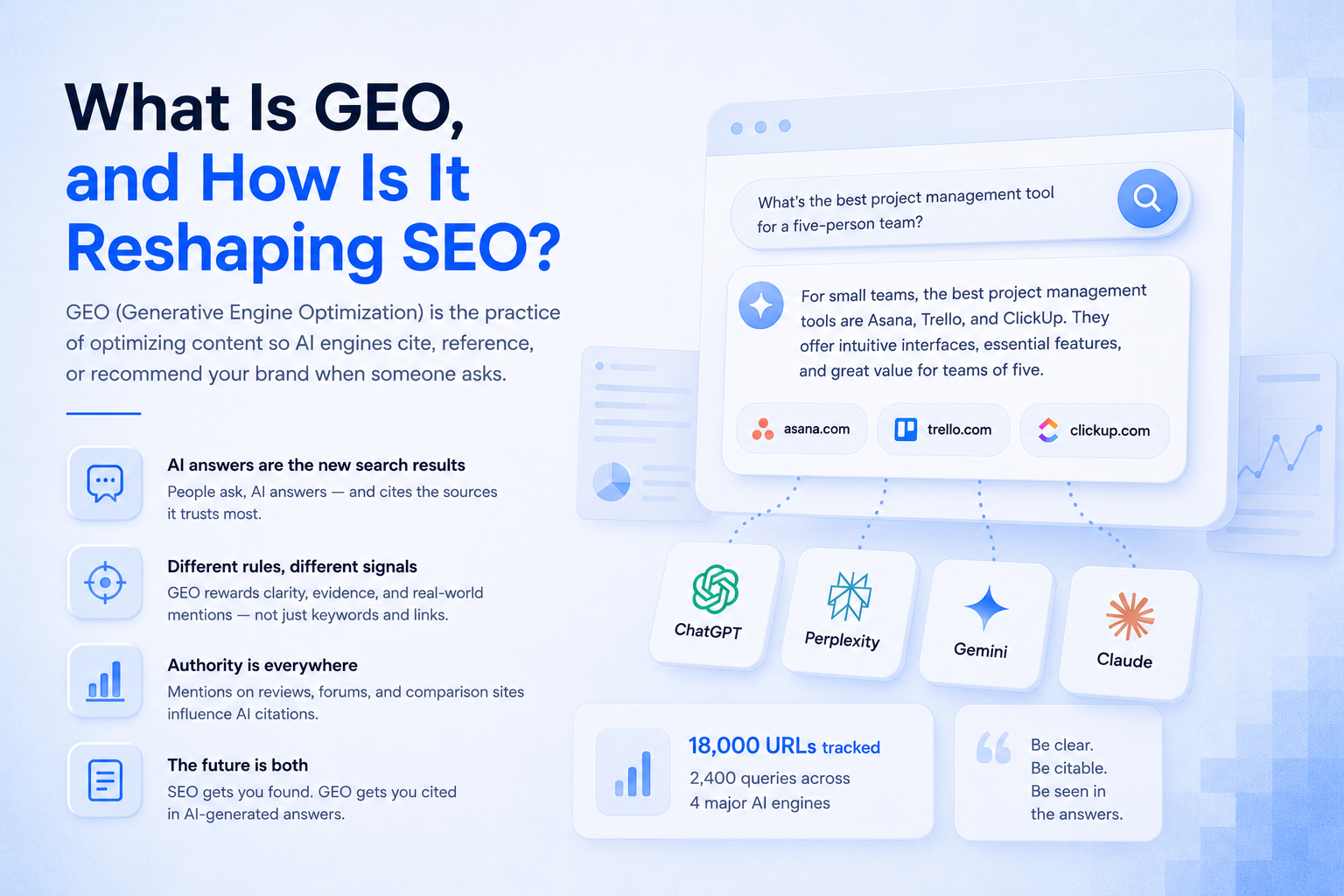
That second front is GEO: Generative Engine Optimization. It's the practice of optimizing content so AI systems like ChatGPT, Perplexity, Gemini, and Claude cite, reference, or recommend your brand when someone asks a question. Instead of competing for a position on a results page, you're competing to be the source an AI model pulls from when it writes its answer.
Why GEO Exists
The shift didn't happen because SEO stopped working — it happened because search behavior changed. A growing share of people now ask questions directly to AI chat interfaces instead of typing a query into Google and clicking through ten blue links. When someone asks ChatGPT "what's the best project management tool for a five-person team," the AI doesn't show a list of links. It gives a direct answer, often naming two or three brands by name, sometimes with a short explanation of why.
If your brand isn't one of the names mentioned, you don't just rank lower — you're invisible for that entire interaction. There's no page two to fall back on. That's the core problem GEO exists to solve.
How GEO Differs From Traditional SEO
Traditional SEO optimizes for a ranking algorithm that returns a list of links. GEO optimizes for a language model that synthesizes an answer and decides which sources are worth citing. That distinction changes almost everything about how content should be built.
A few of the biggest differences:
Matching versus synthesis. SEO rewards content that matches a query closely. GEO rewards content that an AI model can pull apart, understand, and reuse as a building block inside its own generated answer.
Keyword density stops mattering. Traditional SEO still cares about where and how often a keyword appears. GEO cares about whether the underlying facts, comparisons, and explanations in your content are clear enough for a model to extract and restate accurately.
Citations replace backlinks. Backlinks are still valuable, but AI answer engines also pull heavily from being mentioned, quoted, or referenced across third-party sites — review platforms, forums like Reddit, comparison articles, and community discussions. A brand that shows up organically in conversations across the web has a real advantage.
Structure for extraction, not just readability. Clear headers, direct answers near the top of a section, and well-defined comparisons make it far easier for a language model to lift a clean, accurate fact out of your page.
There's no fixed "page one." In traditional search, ten spots exist and you're fighting for them. In an AI-generated answer, the model might mention one brand, three brands, or none — the competitive shape is entirely different.
What the Data Actually Shows
To understand how AI models were actually choosing sources, we ran a study tracking 18,000 URLs over 60 days, covering 2,400 queries across ChatGPT, Claude, Perplexity, and Gemini. A few patterns stood out clearly.
Content that got cited repeatedly tended to be direct and specific — pages that answered a question plainly in the first few sentences, rather than building up to the point through a long introduction. Pages with clear comparisons, numbers, and named specifics were pulled far more often than vague, marketing-heavy copy. And critically, being cited on third-party platforms — not just ranking on your own site — had a strong correlation with how often a brand appeared in AI-generated answers. Authority, in the GEO world, is distributed across the web rather than concentrated on your own domain.
Does This Mean SEO Is Dying?
No — and this is the part people get wrong. Traditional SEO remains the foundation GEO is built on top of. AI models still rely heavily on the same signals search engines have used for years: crawlable, well-structured content, technical site health, and genuine topical authority. A site with poor SEO fundamentals rarely performs well in AI search either, because the underlying content simply isn't strong enough to be worth citing.
The more accurate way to think about it: SEO gets you found by search engines. GEO determines whether, once found, your content is trustworthy and clear enough to be quoted by an AI model synthesizing an answer for someone else. They're two layers of the same discipline, not competing strategies.
What Small and Mid-Sized Businesses Should Actually Do
For most businesses, the practical shift looks like this:
Answer questions directly. Structure content so the core answer appears early and plainly, not buried under a long preamble.
Build genuine topical depth. Thin, scattered pages perform worse in GEO than a smaller number of pages that cover a subject thoroughly.
Get mentioned beyond your own site. Reviews, comparison articles, forum threads, and community discussions all feed into how often AI models cite a brand.
Use structured data and FAQs. These make it easier for AI crawlers to parse exactly what your page is claiming.
Track your actual visibility. Traditional rank trackers don't show whether you're being cited inside AI answers — that requires dedicated monitoring.
On that last point, tools have emerged specifically to track AI citation visibility, since it isn't something Google Search Console or standard rank trackers can measure. Vista AI is one of these — it monitors how often and where a brand gets cited across AI answer engines like ChatGPT, Perplexity, and Gemini, giving businesses visibility into a channel that was previously a black box.
The Bottom Line
GEO isn't a replacement for SEO — it's an extension of it, built for a search landscape where the destination isn't always a webpage anymore. The businesses that adapt early, by writing clearer, more citable content and building presence across the wider web rather than just their own domain, are the ones showing up when AI tools answer questions on their behalf. The ones that don't adapt won't lose rankings — they'll simply stop existing in the conversation.