Struggling With Delivery Performance? How Logistics Delivery Management Software Can Save You
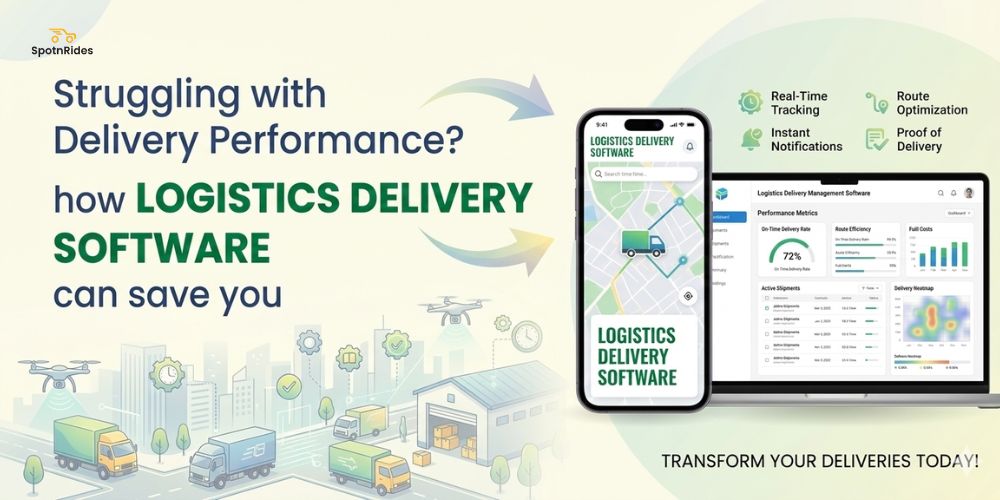
Lagging in delivery performance will leave a hefty damage to your logistics service business if not dealt with in the right time. Across the supply chains, this drawback lowers efficiency and deters last-mile delivery progress. Technology pioneers found a way to limit disruptions for fleet managers, retailers, and entrepreneurs with the advent of logistics delivery management software.
Real-time tracking, dispatch management, and performance analytics are the notable perks of the software that scales up revenue. This blog gives you a big picture of how businesses can manage shippers and carriers and the last mile delivery process, the complex part of the supply chain, using the software.
What Is A Logistics Delivery Management Software
A logistics delivery management software is a digital tool to optimize the supply chain operations, from workflow automation to real-time tracking facility. The use of logistics delivery software helps manage transport of goods from the distributor hub to customers.
Not just the forward logistics, the software brings efficiency into handling order returns. You can gain better visibility into every part of the operation from storing these products and transporting them to the customer doorstep.
The types of logistics delivery management software includes:
Transportation Management Systems
Last Mile Delivery Software
Fleet Management Software
Warehouse Management Systems
Freight Management Software
Order Management System
The software benefits courier services, e-commerce businesses, retailers, fleet managers, and manufacturers. Accuracy in every delivery update creates a transparent atmosphere for businesses to boost operational visibility and control.
Essential Features A Logistics Delivery Management Software Should Have
Features form the vital segment of developing a logistics delivery management software. Core features of the software help you resolve the existing challenges in the logistics delivery business. The digital transformation elevates clarity and streamlines operations across industries that rely on the delivery management software.
Real-Time Visibility & Tracking
Businesses need to be aware of the status of the order and every stage of the supply chain operations. The updates on delivery statuses help the logistics delivery businesses meet the customer requirements. Customers can track their orders and improve their satisfaction levels.
Transparency in delivery estimates
Accountability for delivery partners
Proactive monitoring of the supply chain
Order Management & Fulfillment
The order-to-delivery process can be undertaken to optimize resource allocation and utilization. The reliable system creates efficiency in order entry, processing, and dispatching. It eliminates errors in shipments, automates workflows, and drives measurable outcomes.
Allocates delivery partners automatically
Processes orders from multiple channels
Maintain stock levels and update inventory
Effective Route Planning
Deliveries have to be made to the correct addresses. For these processes, businesses should optimize routes, mainly in tier 1 and tier 2 cities. The last-mile delivery software leverages AI capabilities to suggest shorter routes to increase delivery times.
Reduce transit times and optimize fuel usage
Monitors vehicles to remove hurdles during transit
Sends instant alerts to customers on delivery updates
Reporting & Business Analytics
In-depth analytics drive logistics businesses to stay in control of the entire supply chain. Particularly in end-to-end transportation, the analytics feature helps implement strategies on fleet performance, user behaviour, and plan loads effectively.
Forecast challenges to prepare for a smooth transit
Adjust to evolving demands without falling behind
Automates choosing carriers for every order delivery
Automated Billing & Payments
The manual billing processes take a long time and give way to inaccuracies that can impede profits for businesses. The logistics delivery management software calculates pricing for every delivery and automatically displays billing.
Fosters electronic invoicing that happens in a flash
Accelerates the payment process in a secure way
Builds trust through transparency
Trends In the Logistics Delivery Management Software
Fluctuations in the logistics delivery market are visible. The trends that have potential impact in the logistics delivery management space include:
AI and Machine Learning Integration: Detects risks and drives smart decisions
IoT and Blockchain: Transparency in communication and extended visibility
Cloud-based and SaaS solutions: Lower upfront costs, but accessibility from anywhere
Key Takeaways
The logistics delivery business space transitioned into a lucrative environment for startups and enterprises that acquire a scalable logistics delivery management software. They can manage every nook and corner of the operations using a reliable system that offers real-time visibility, live shipment tracking, automated processes, and seamless integrations.
The year 2026 looks promising for businesses that can address the existing challenges and improve delivery times. You can share your requirements and obtain a logistics delivery management software that aligns with your needs from SpotnRides.
For more details - https://www.spotnrides.com/logistics-delivery-management-software