The Lumy Ecosystem Explained: Why Web3 Needs Decentralized Intelligence
Web3 has done a great job decentralizing money, art, and data storage. But there's one critical resource still locked inside corporate vaults: artificial intelligence.
Today I want to break down an infrastructure project tackling this problem head-on — Lumy AI — along with how its node network and native token ($LUMY) fit together.
The Problem: AI Is Still Centralized
Right now, a handful of tech giants control the server farms needed to train and run AI models. That means:
Exorbitant pricing that shuts out independent developers
Throttled speeds tied to subscription tiers
Sensitive data uploaded into centralized black boxes
This runs against everything Web3 stands for — permissionless access, privacy, and community ownership. If blockchain apps still have to rely on centralized AI APIs, decentralization is only half-finished.
The Solution: Lumy AI
Instead of building one massive data center, Lumy AI taps into the collective computing power of thousands of independent machines around the world.
When a dApp needs AI processing — market analysis, procedural game assets, trading automation — the task gets fragmented with cryptography, encrypted, and distributed across the network. No single node can see the full data. Once processed, outputs are verified and reassembled for the user.
Result: a trustless setup for machine learning that's censorship-resistant and cheaper to run than centralized alternatives.
The Hardware Layer: Lumy Nodes
None of this works without physical compute, and that's where the community comes in.
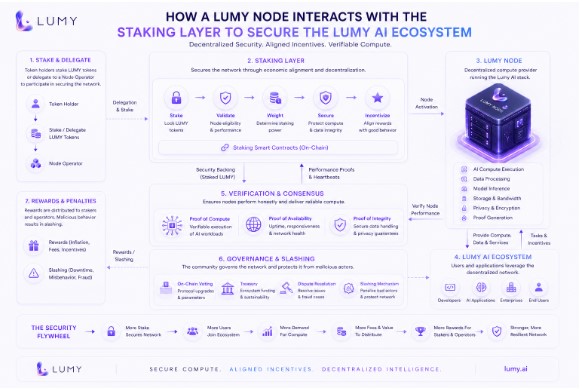
A Lumy node is lightweight software that lets anyone contribute idle processing power to the network. The team built it to be accessible — no mining rig or coding background required, just a standard computer and a stable connection.
Operators aren't donating compute for free — they earn ongoing rewards for keeping their hardware online and processing requests accurately. More demand → more rewards → more operators join → network capacity and security grow. It's designed as a self-reinforcing loop.
The Token: $LUMY
$LUMY sits at the center of the ecosystem's economy:
Payment — developers and businesses pay network fees in $LUMY to use Lumy AI
Rewards — node operators are compensated in $LUMY for their compute
Collateral — operators must lock tokens to run a node, discouraging bad behavior and reducing circulating supply as the network grows
More locked supply + growing commercial demand is the core thesis behind the token's long-term value case.
Why Now?
The blockchain narrative has shifted from NFTs and basic DeFi toward DePIN (decentralized physical infrastructure networks) and real-world utility. Two sectors stand out:
Web3 gaming — smart NPCs and dynamic in-game economies need real intelligence, not just static logic
Enterprise — companies want cheaper compute without handing proprietary data to third-party clouds
Lumy AI is positioned to serve both.
Get Involved
🌐 Project portal & whitepaper: https://www.lmos.info
🐦 X (Twitter): https://x.com/lumyinfo
📢 Announcements: https://t.me/LUMY_Announce
💬 Community chat: https://t.me/LUMYCommunity
Disclosure: this post covers a crypto project's own claims about its technology and tokenomics — none of it is independently verified here. Not financial advice; do your own research before running a node or acquiring any token.