Miradex Combines Privacy, Security, and Efficiency in Cross-Chain Trading
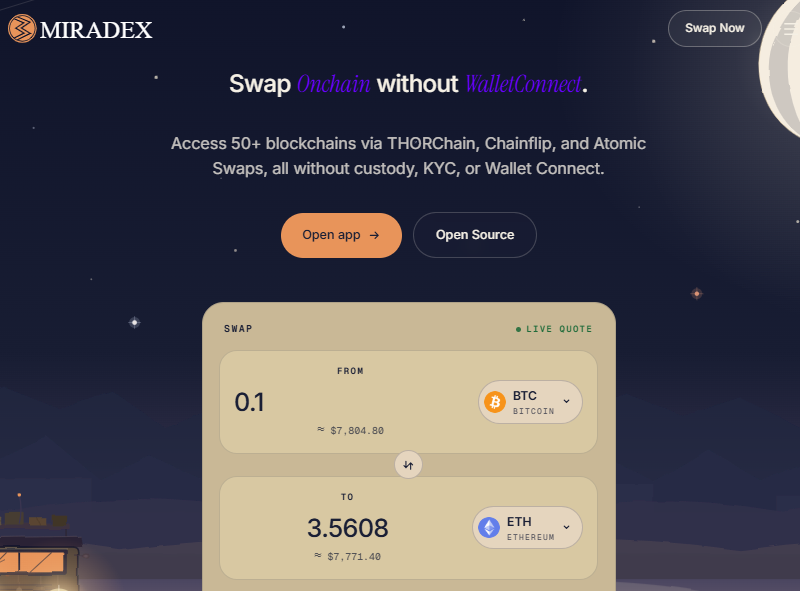
For a long time, the decentralized finance (DeFi) space has felt like a collection of walled gardens. If you wanted to move value from Bitcoin to Ethereum, or from Solana to Monero, you were often forced to jump through a series of complex hoops. You might have had to use a centralized exchange, deal with custodial "wrapped" tokens, or navigate the murky waters of insecure bridges. The friction wasn't just annoying; it was a barrier to true financial sovereignty.
Fortunately, the landscape is shifting toward a more unified experience. Imagine a platform that lets you swap assets across over 50 different blockchains without ever asking for your name, your email, or even access to your wallet via a browser extension. This isn't a hypothetical future—it is exactly what is being built right now by a team focused on transparency and user control.
About the Miradex Ecosystem
At its heart, Miradex is an open-source, non-custodial DEX aggregator. It doesn't hold your funds, and it doesn't act as a middleman in the traditional sense. Instead, it serves as a sophisticated intelligence layer that sits on top of several high-liquidity decentralized protocols. By pulling real-time data and liquidity from sources like THORChain, Chainflip, and NEAR Intents, it provides users with a single entry point to the entire cross-chain universe.
One of the most refreshing aspects of the project is its commitment to the open-source ethos. In an industry where "trust me" is all too common, being able to verify the code behind the routing logic is a massive win for security-conscious traders. It functions as a verification layer that ensures you are interacting with authentic protocol endpoints, effectively neutralizing many of the common phishing attacks that plague the DeFi world.
The "No Wallet Connect" Philosophy
The most striking feature you will notice when you visit the Miradex is the lack of a "Connect Wallet" button. In a world where every DApp begs for permission to see your balance and sign transactions, this feels radical. However, it is a deliberate security choice.
- Zero Permissions: You never have to grant a smart contract permission to spend your tokens. This eliminates the risk of "infinite approval" exploits.
- Environment Agnostic: Because there is no dependency on browser extensions like MetaMask or Phantom, you can use the platform from any secure browser, even on mobile devices or hardened operating systems.
- Privacy Preservation: Connecting a wallet often links your various on-chain activities to a single session. By manually sending funds, you maintain a higher degree of anonymity.
A Unified Liquidity Hub for 50+ Blockchains
Miradex isn't just a simple swap tool; it is a titan of interoperability. By aggregating multiple protocols, it provides access to native assets across dozens of chains. This means you aren't trading "Wrapped BTC" on Ethereum; you are trading actual, native Bitcoin for native assets on other chains. This reduces the systemic risk associated with bridge-backed assets, which have historically been a major point of failure in the crypto ecosystem.
The Architecture of a Multi-Protocol Aggregator
How does Miradex actually move value across these disparate networks? It doesn't rely on a single mechanism. Instead, it uses a multi-tiered routing system that picks the best tool for the job based on your specific needs.
THORChain: The Native Swap Driving Force
THORChain is perhaps the most well-known decentralized liquidity network for native assets. Miradex taps into this deep liquidity to allow for swaps between major assets like BTC, ETH, BNB, and LTC. Because THORChain uses a continuous liquidity pool model, it can handle significant volume while ensuring that users always receive native coins rather than synthetic representations.
Chainflip: Optimizing for Speed and Price
When efficiency is the priority, the system often routes through Chainflip. This protocol uses a validator-based system that is highly optimized for cross-chain settlement. It is particularly effective for users who want fast execution without sacrificing the decentralized nature of the trade. Miradex monitors Chainflip’s state in real-time to offer it as a primary route whenever the pricing or speed beats out other providers.
NEAR Intents: Expressive Transaction Execution
A newer addition to the cross-chain toolkit is NEAR Intents. This technology allows users to express a "desired outcome" (e.g., "I want 1 ETH for this much BTC") rather than having to manually execute every step of a bridge or swap. Miradex leverages this to simplify complex routing, making the experience feel as smooth as a traditional banking app while keeping the decentralization intact under the hood.
Privacy-First BTC to XMR Atomic Swaps
For the privacy advocates, the inclusion of Bitcoin to Monero (XMR) atomic swaps is a game-changer. These swaps are purely peer-to-peer and mathematically guaranteed. There is no intermediary, no "operator," and no way for a third party to link the identities of the participants. This is the gold standard of financial privacy in the crypto space, and having it integrated into a broader DEX aggregator is a significant step forward for user autonomy.
Trust Through Transparency: The Verification Layer
One of the hidden gems of this platform is the browser-side verification system. In many DeFi interfaces, you are at the mercy of the frontend developer. If their server is compromised, they could show you a fraudulent deposit address. Miradex combats this by running a dynamic verification layer directly in your browser.
- The interface pulls the deposit address from the provider (like THORChain or Chainflip).
- The verification system checks this address against known, cryptographically verifiable protocol parameters.
- If the address cannot be confirmed as belonging to the actual protocol, the route is hidden from the user.
This "Verify, Don't Trust" approach ensures that even if the UI were somehow manipulated, the system would refuse to present a dangerous route to the user. It is a proactive stance on security that few other aggregators have adopted.
Navigating Your First Swap: A Practical Tutorial
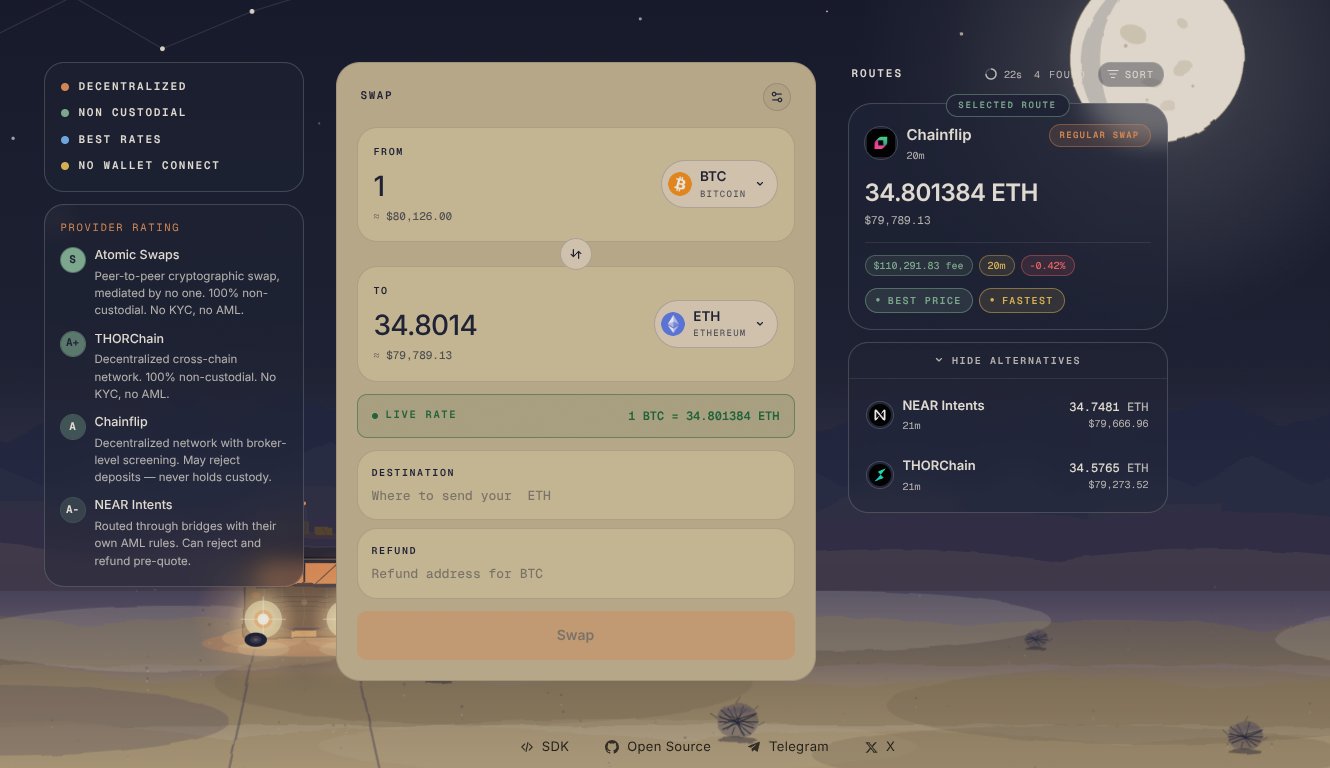
If you are ready to move away from centralized exchanges and "Connect Wallet" prompts, the process on Miradex is remarkably straightforward. Here is how you can perform a native cross-chain swap in just a few minutes.
Selecting Your Trading Pair
Start by heading to the official swap interface. You will see a "From" section and a "To" section. Choose the asset you currently hold—let’s say Bitcoin (BTC)—and the asset you wish to acquire, such as Ethereum (ETH). Enter the amount you wish to swap. Immediately, the aggregator will begin scanning its various providers to find you the best possible deal.
Comparing the Best Routes
Miradex doesn't just give you one price. It shows you a variety of options. You might see a route via THORChain that offers the most ETH, or a route via Chainflip that is five minutes faster. Each route comes with a breakdown of:
- The estimated amount you will receive.
- The expected time for the swap to complete (usually between 10 and 25 minutes).
- A "Grade" or rating for the provider.
Take a moment to review these. If you are in a rush, pick the "Fastest" route. If you want every last Satoshi, pick the "Best Price."
Inputting Wallet Addresses
Since you aren't connecting a wallet, you need to tell the system where to send your funds. You will need to provide two addresses:
1. The Destination Address
This is where your new tokens will be sent. If you are swapping for ETH, this must be your Ethereum wallet address. Always double-check this; a single typo in a crypto address can result in the permanent loss of funds.
2. The Refund Address
This is a safety net. If the market shifts wildly and the swap cannot be completed, or if a provider experiences a temporary issue, your original funds (in this case, BTC) will be sent back to this address. Using a refund address ensures you never lose custody of your value, even if a transaction fails to execute.
Initiating the Transfer
Once you click the "Swap" button, Miradex will generate a unique deposit address for that specific transaction. You will see clear instructions on exactly how much to send and where to send it. Open your own wallet (whether it's a hardware wallet, a mobile app, or a desktop client) and send the funds to that address. Once the transaction hits the blockchain, the Miradex server watches the chains and triggers the swap logic automatically.
The Vision of Miradex: A Future Without Barriers
The team behind Miradex envisions a financial world where blockchains are essentially back-end infrastructure that the user doesn't need to struggle with. In their view, moving value from one chain to another should be as simple as sending an email. By removing the need for KYC, account registration, and complex wallet connections, they are paving the way for a more inclusive DeFi landscape.
This vision is about more than just convenience; it is about resilience. When liquidity is native and decentralized, it is much harder for any single point of failure to take down the system. By aggregating the world's most robust cross-chain protocols, Miradex is building a financial layer that is as open and borderless as the internet itself.
Staying Secure While Trading in Miradex
While Miradex provides the tools for a secure swap, user habits remain the most important factor. Always perform a small test swap if you are using a new wallet or a new chain for the first time. Verify your network fees, as some chains (like Ethereum) can be expensive during times of high congestion. Most importantly, keep your refund addresses handy; they are your insurance policy in the world of decentralized finance.
Final Thoughts
Miradex stands out because it respects the user. It respects your privacy by not demanding data. It respects your security by not asking for wallet permissions. And it respects your time by aggregating 50+ blockchains into a single, clean interface. Whether you are a privacy-seeking Monero enthusiast or a Bitcoin holder looking to explore the world of DeFi, this platform provides a professional-grade toolkit for the modern age of crypto.
To learn more or start your first swap, check out these official resources:
- Website: https://miradex.io/
- Telegram: https://t.me/MiraDexIO
- Twitter: https://x.com/MiraDex
Author:
Username: Helen Barton
Profile link: https://bitcointalk.org/index.php?action=profile;u=3425754
Wallet: 0x7dBD01B141c00D6E39135dce32689C1E8302Da1b