How MLM Software Automates Network Marketing Operations
How MLM Software Automates Network Marketing Operations
Running a network marketing business involves much more than recruiting distributors and tracking sales. As a network grows, businesses need to manage members, genealogy structures, commissions, payments, reports, and other daily operations.
Handling all of this manually can become time-consuming and difficult to scale.
This is where MLM software can help.
MLM software brings essential network marketing operations into one centralized platform and can automate repetitive processes such as commission calculations, distributor management, genealogy tracking, payouts, and reporting.
What Is MLM Software?
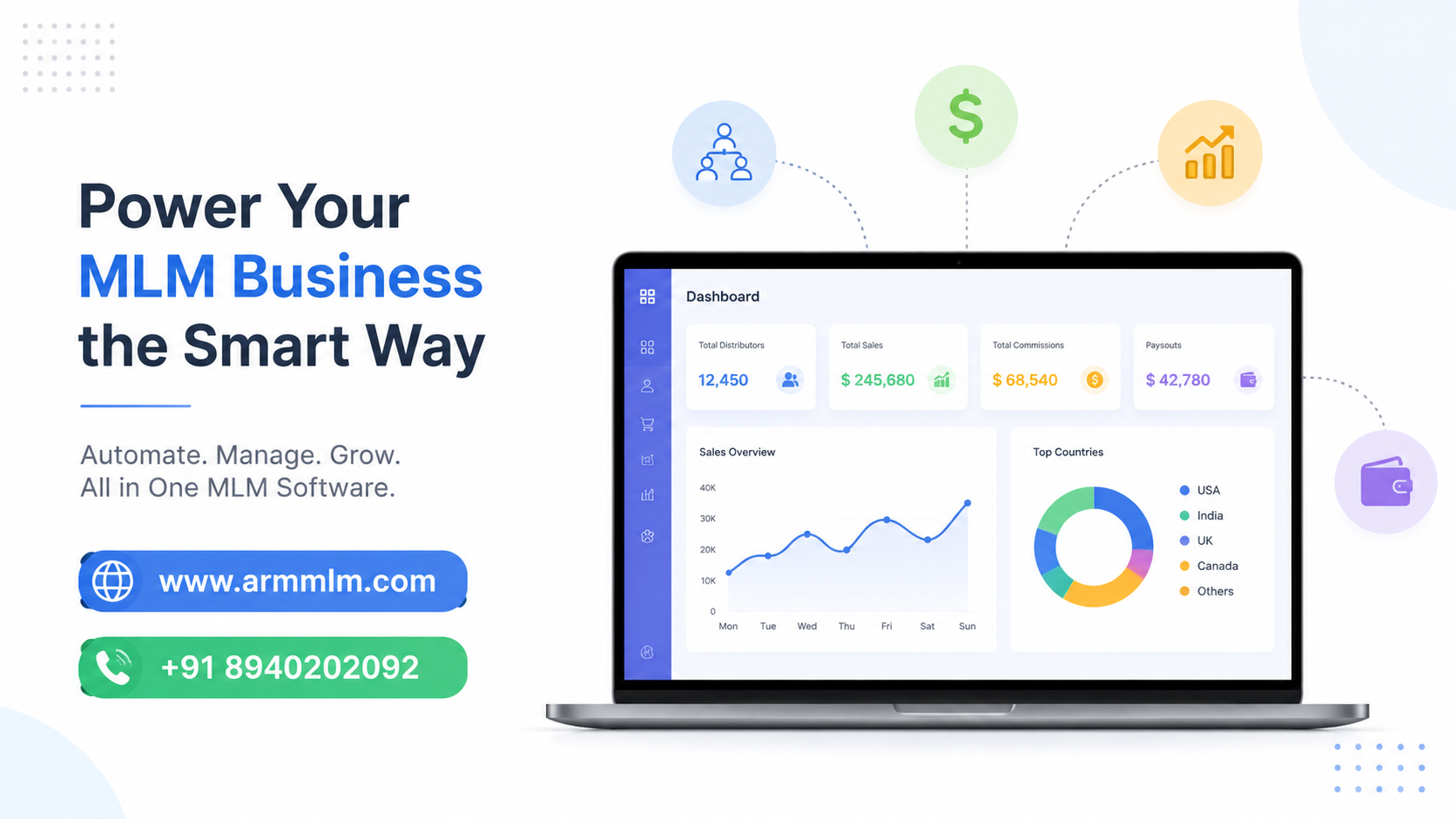
MLM software is a business management platform designed to help network marketing companies manage distributors, sales, compensation plans, and downline structures.
Depending on the platform, it may include distributor management, genealogy tracking, commission processing, eWallets, replicated websites, payment integrations, reporting, mobile access, and automation.
The right combination of features depends on the business model and how the network operates.
For a broader overview, MLM software can be understood as the technology layer that connects many of these day-to-day processes.
Why Does Automation Matter in Network Marketing?
Manual processes can become harder to manage as a network grows.
A business may need to update distributor information, calculate commissions, monitor team activity, process payouts, and prepare reports regularly. Managing these activities across spreadsheets or disconnected systems can increase administrative work.
Automation provides a more structured way to handle repetitive tasks.
Instead of manually processing every transaction or updating every distributor record, the software can perform configured actions based on business rules.
This allows administrators to spend more time monitoring the business and supporting growth rather than managing repetitive data entry.
1. Automating Distributor Management
Distributor management is one of the most important functions of an MLM business.
A centralized platform can store distributor profiles, referral information, account status, joining details, transactions, and other relevant data.
Administrators can access this information through a central dashboard, while distributors can view information related to their own accounts.
This creates a more organized way to manage a growing network without maintaining multiple records manually.
2. Simplifying Genealogy Management
Genealogy is another area where automation becomes valuable.
As distributors build teams, the network can quickly become difficult to track manually. A software platform can automatically maintain relationships between members and display the structure through genealogy or tree views.
This becomes especially important when the compensation plan depends on distributor placement or downline activity.
For example, Binary MLM businesses have specific placement and commission requirements that need to be reflected accurately within the software.
Businesses can learn more about how this structure works through this guide to the Binary MLM compensation plan.
3. Automating Commission Calculations
Commission management is one of the biggest opportunities for automation.
Different MLM businesses use different compensation structures, and each plan can have its own rules for calculating earnings.
The software can process eligible transactions according to the configured compensation plan and calculate the applicable commissions.
This can reduce repetitive calculations and provide distributors with greater visibility into their earnings.
The important point is that the software should support the specific compensation structure used by the business rather than forcing the business to change its model around the software.
4. Managing eWallets and Payouts
An integrated eWallet can give distributors a centralized view of their earnings and transactions.
Depending on the platform, users may be able to see wallet balances, credits, withdrawals, transfers, and transaction history.
Once commissions are calculated, businesses can also use configured payout workflows to manage distributor withdrawals.
Automating these processes can reduce manual administrative work while providing a clearer record of transactions.
5. Connecting Payment Gateways
Payments are an important part of many network marketing businesses.
An MLM platform can integrate supported payment gateways to connect transactions with the broader distributor management and compensation system.
For example, payment integrations may support activities such as registration payments, product purchases, wallet funding, or other transactions depending on the business model.
Businesses evaluating this capability can consider MLM software with payment gateway integration as part of their software requirements.
The available payment methods will depend on factors such as the provider, gateway, country, currency, and business requirements.
6. Making Reports Easier to Manage
Reports help administrators understand what is happening across the network.
Instead of collecting information from multiple spreadsheets, an MLM platform can centralize important business data.
Reports may cover areas such as:
- Distributor activity
- Sales
- Commissions
- Payouts
- New registrations
- Rankings
- Network performance
- Transactions
Having this information in one place can make routine monitoring easier and give administrators a clearer view of business activity.
7. Providing Mobile Access
Network marketing distributors may not always manage their business from a desktop computer.
A mobile app can give distributors access to important information while they are away from their desks.
Depending on the software, mobile functionality may include dashboards, commissions, wallet information, team activity, reports, and notifications.
This can make the distributor experience more convenient and provide faster access to important account information.
8. Supporting Different Compensation Plans
Every MLM business does not use the same compensation structure.
Some businesses use Binary or Unilevel plans, while others may use Matrix, Board, Hybrid, or customized structures.
This means compensation-plan support should be considered before selecting software.
For example, a Unilevel structure has different characteristics from a Matrix structure, particularly in how levels and network positions are organized.
Businesses comparing different models can review resources such as Unilevel vs. Matrix MLM plans to understand the differences before defining their software requirements.
9. Using AI for Smarter Automation
AI is becoming increasingly common in business software, and MLM platforms are also beginning to incorporate AI-powered capabilities.
Depending on the implementation, AI can assist with knowledge management, support, analytics, business insights, and selected automation workflows.
For example, an AI-powered knowledge system can help users find information from business documentation, training materials, or other approved sources.
AI can also help analyze business data and highlight patterns that may require attention.
However, AI should work alongside established business processes and appropriate human oversight, particularly when financial or compliance-related decisions are involved.
What Should You Look for in MLM Software?
Choosing MLM software should start with your business requirements rather than the feature list alone.
Consider your compensation plan, number of distributors, target markets, payment requirements, reporting needs, mobile requirements, integrations, and expected growth.
Then evaluate whether the platform can support those requirements today and as the business expands.
A practical evaluation should consider:
Features + scalability + security + usability + integrations + support
It is also important to understand what is included in the software package and whether customization or additional integrations will involve extra costs.
How Much Does MLM Software Cost?
There is no single price for MLM software.
The cost can depend on factors such as the compensation plan, features, customization, integrations, mobile applications, hosting, support, and overall project requirements.
Instead of comparing only the starting price, businesses should look at the complete package and understand what they are receiving for the investment.
You can explore the different factors involved in MLM software pricing before comparing available solutions.
ARM MLM for Network Marketing Automation
ARM MLM provides MLM software designed to support different network marketing business requirements.
The platform includes tools for distributor management, genealogy, commission processing, eWallets, replicated websites, mobile applications, payment integrations, reporting, and KYC/AML workflows.
It also supports different compensation plan structures and provides AI-powered capabilities for businesses looking to introduce more automation into their operations.
Learn more about ARM MLM:
Final Thoughts
Automation can make network marketing operations easier to manage as a business grows.
From distributor management and genealogy tracking to commission calculations, payments, reporting, and mobile access, MLM software can bring multiple processes into one centralized system.
The objective is not simply to automate every possible task.
It is to reduce repetitive work, improve access to information, create consistent processes, and give the business a stronger operational foundation.
Before choosing a platform, understand your business model first. Then select software that fits those requirements and can continue supporting the network as it grows.
Frequently Asked Questions
What does MLM software automate?
MLM software can automate distributor management, genealogy tracking, commission calculations, eWallet transactions, payouts, reporting, and selected payment and verification workflows.
Can MLM software support different compensation plans?
Yes. Many platforms support compensation structures such as Binary, Unilevel, Matrix, Board, Monoline, Gift, and Hybrid plans. The available options vary between providers.
Can MLM software integrate with payment gateways?
Yes. Many MLM platforms support payment gateway integrations. The available gateways depend on the provider, payment service, region, currency, and business requirements.
Does MLM software include mobile apps?
Some platforms provide mobile applications for distributors and administrators. Depending on the implementation, users may be able to access commissions, wallet information, team activity, reports, and notifications.
Can AI be used in MLM software?
Yes. AI can support areas such as knowledge management, analytics, insights, support, and selected automation workflows, depending on the platform.
How do I choose MLM software?
Start by defining your compensation plan, required features, payment methods, integrations, distributor volume, target markets, mobile requirements, and future growth. Then compare platforms based on functionality, scalability, security, support, customization, and overall cost.