Stop! Run This Final Code Review and Mobile App Security Audit Before Launch
The Finish Line is a Trap: Why Your Final Code Review Matters
You’re there. The late nights are over, the features are blinking green in your testing environment, and the coffee grounds are finally being swept away. Your mobile app development project is ready to go live. You’re dreaming of App Store rankings and user downloads.
But hold on. That excitement? That feeling of "It works!"? That's exactly when you need to slow down and execute the single most critical step that separates robust, successful apps from those that crash and burn: a non-negotiable, deep-dive code review.
A final audit isn't just about catching that last typo. It’s a systemic approach to risk management. It’s about ensuring that the application you’re about to release to millions of people is not only functional but also secure, stable, and ready to scale. Skipping this step is how you end up paying exponentially more later.
The Cost of Shortcuts: Stats That Demand an Audit
If you think a code review takes too long, just look at the data on the cost of fixing bugs later. The IBM Systems Sciences Institute famously found that the cost to fix a bug found after a product is released can be up to 100 times more than if it was found during the design or coding phase. Think about that: a one-hour fix during development could become a 100-hour nightmare, complete with PR disasters and lost user trust, if it goes live.
Furthermore, the threats are growing. Recent statistics from 2024 highlight the urgency: over 75% of all published mobile apps have at least one security vulnerability. You do not want your app to be one of the three-quarters of the market that is an easy target.
Phase 1: The Non-Negotiable Mobile App Security Audit
Security isn't an add-on; it’s the bedrock of trust. Your final audit must include a stringent mobile app security audit. This goes beyond simple password checks. You need to verify how your code handles the biggest vulnerabilities.
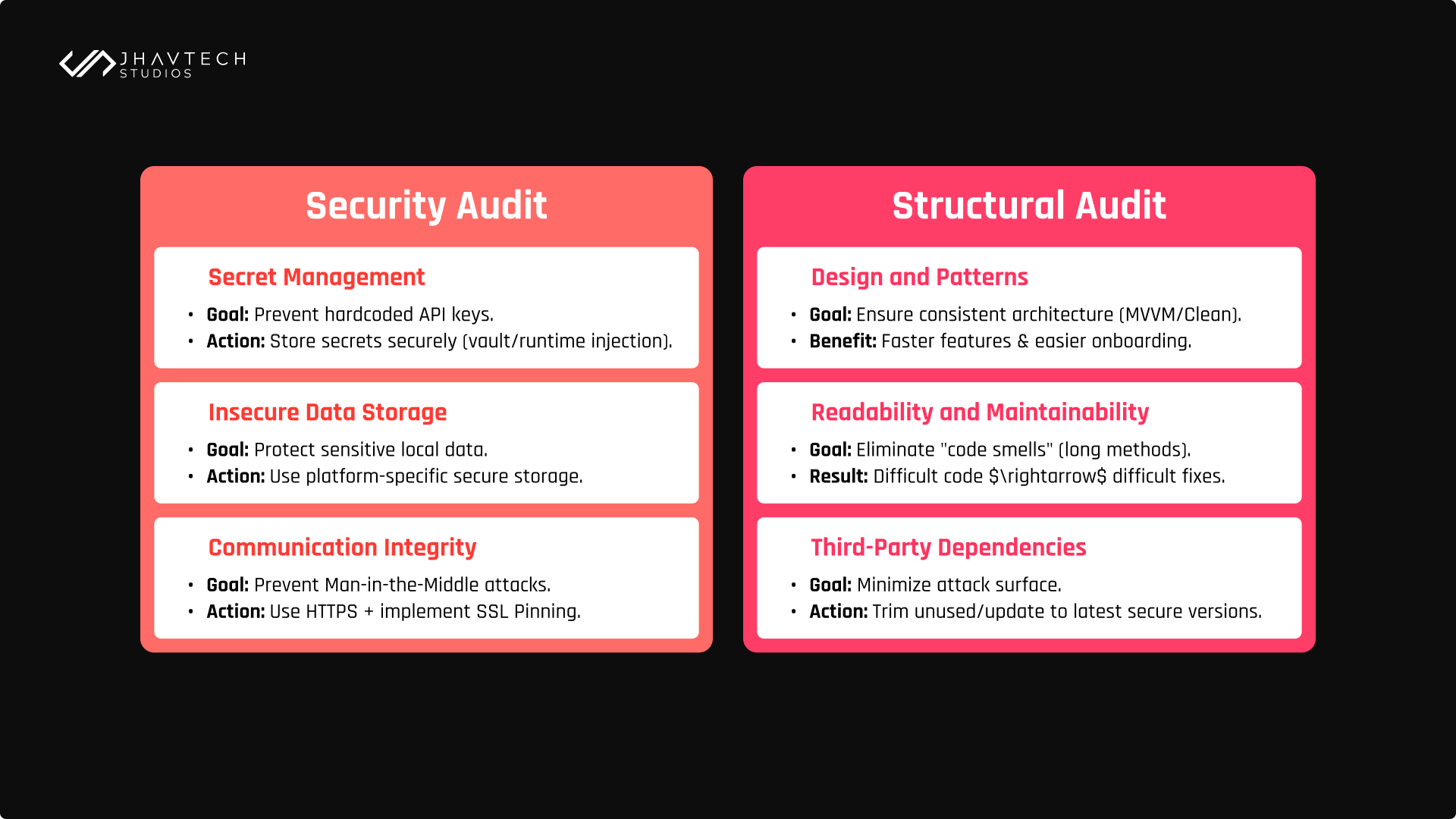
Secret Management: Have you hardcoded any API keys, database passwords, or third-party service credentials directly into the source code? This is hacker gold. Secrets must be stored securely, often injected at runtime or fetched from a secure server vault.
Insecure Data Storage: Are you storing sensitive user data locally on the device, maybe an authentication token or user preferences? Ensure this data is protected using platform-specific secure storage mechanisms (like the iOS Keychain or Android Keystore), not simple plaintext files.
Communication Integrity: Your review must verify that all network traffic uses HTTPS and, ideally, implements SSL Pinning. This prevents Man-in-the-Middle attacks by ensuring your app only talks to a server with a specific, trusted certificate.
Phase 2: Structural Soundness and Futureproofing
A great app can’t just be secure; it has to be a pleasure to maintain. This part of the code review focuses on the inner architecture.
Design and Patterns:Is the code following established design patterns (like MVVM, MVC, or clean architecture)? Consistent structure makes it easier for new developers to join the team and faster to add new features without introducing regressions.
Readability and Maintainability: Look for "code smells" like overly long methods or high cyclomatic complexity. These are red flags that scream "bug magnet." If the code is difficult to read, it's difficult to fix.
Third-Party Dependencies: Check your list of external libraries. Are they all necessary? Are they the latest, most secure versions? Every library you include expands your attack surface, so be ruthless in trimming any unused or outdated ones.
The Final App Launch Checklist: From Code to Consumer
A great codebase is pointless if the deployment environment is misconfigured. Your final app launch checklist connects your code quality to your business readiness.
Production Environment Variables: Seriously, double-check that you are pointing to your live APIs, databases, and authentication services, not the staging server you’ve been using for months. This is a simple, common error that brings down high-profile launches.
Performance Metrics: The modern user expects speed. Your code review must audit for performance bottlenecks. Look at network call overhead, inefficient database queries (like queries inside a loop), and image loading. Slow performance leads to poor user retention.
Error Reporting and Logging: Is your crash reporting (like Sentry or Firebase Crashlytics) properly installed and configured for the production build? You need to know immediately when a user encounters an issue, not wait for an angry email.
Don't Let Poor Code Force a Software Project Rescue
If you launch an app with foundational problems such as major security holes, severe performance issues, or an impossible architecture, you're not building a product, you’re creating an emergency. The inevitable result is a costly engagement known as a software project rescue, where an expert team has to step in to untangle a catastrophic mess of code. It is far cheaper, faster, and less stressful to get a professional code review done before launch.
Targeting Visibility: The Technical SEO Audit Checklist for App Launch
Even technical developers need to think like marketers. Your code review should have a component focused on visibility. This is where you run a technical SEO audit checklist for app launch. This means checking:
Deep Linking: Are your deep links and Universal Links correctly set up? These links allow search engines to index the content within your app, which is crucial for discovery. If they’re broken, users can’t jump directly to a product page or specific piece of content from a web search.
Load Times: As mentioned, speed is critical. Faster loading code gets rewarded in every search algorithm, whether it’s for app indexing or web content.
Ready to Launch? Get an Expert Second Opinion
It is impossible to be completely objective about your own code. You wrote it, you know how it should work, and your brain often glosses over obvious mistakes. This is why a third-party code review is so valuable.
If you're unsure if your code is truly production-ready, or if you need an expert to check for the sophisticated security and performance issues that automated tools often miss, consider reaching out to a specialist. For instance, Jhavtech Studios offers a completely free code review service. They’ll give you an objective X-ray of your software’s architecture, providing clear guidance on how to fix common flaws like security vulnerabilities and performance bottlenecks, ultimately giving you the confidence to launch strong.
Don't let a hasty decision sink your venture. The small delay for a final, comprehensive code audit is the best insurance policy you can buy.