The Hidden Tech Behind Swipe, Match & Chat Apps
Have you ever stopped to wonder, while you are mindlessly swiping left or right on a Tuesday night, what is actually happening under the hood of your smartphone? It feels like magic, or perhaps fate, when that "It’s a Match!" screen pops up. But in reality, there is no cupid in the cloud. Instead, there is a complex web of data points, server clusters, and mathematical equations working tirelessly to predict your romantic future. The world of digital romance is governed by dating app algorithms that are far more sophisticated than most users realize.
For anyone curious about the intersection of human emotion and cold, hard data, the "hidden" side of these apps is a masterclass in modern engineering. From the way a profile is prioritized to the millisecond-fast delivery of a "Hey" notification, every action is a calculated move.
The Math of Attraction: Understanding Dating App Algorithms
At the center of the experience are the uncanny algorithms. In the early days, these systems were relatively primitive, often relying on simple Elo scores borrowed from the world of competitive chess. If "desirable" people swiped right on you, your "score" went up, and you were shown to other high scorers. However, the industry has moved far beyond such binary rankings. Today, the focus has shifted toward collaborative filtering and deep learning.
Modern dating app algorithms look at your behavior rather than just your stated preferences. You might say you want a tall doctor who loves hiking, but if you consistently swipe right on short musicians who love gaming, the system will prioritize the latter. This behavioral analysis ensures that the "Discovery" deck remains addictive and relevant. Companies specializing in dating app development have realized that the key to retention is not just finding a match, but finding a "satisfying" match that keeps the user engaged with the interface.
The Role of Artificial Intelligence and Machine Learning
As we look at the rapid pace of innovation, it is clear that how AI is changing online dating in 2026 involves a shift from simple recommendation engines to fully autonomous "dating agents" that can pre-screen matches for you. We aren't just talking about chatbots; we are talking about neural networks that can analyze the content of your photos to identify common interests or even suggest opening lines based on the shared context of two users' profiles.
AI matchmaking technology has become the gold standard for high-end platforms. This tech doesn't just look at who you like; it looks at who likes people like you. By analyzing millions of data points across the entire user base, the system can predict compatibility with startling accuracy. According to recent industry reports, AI-driven platforms have seen a 27 percent increase in "meaningful conversations" compared to traditional filter-based apps.
The Invisible Infrastructure: Speed, Security, and Scale
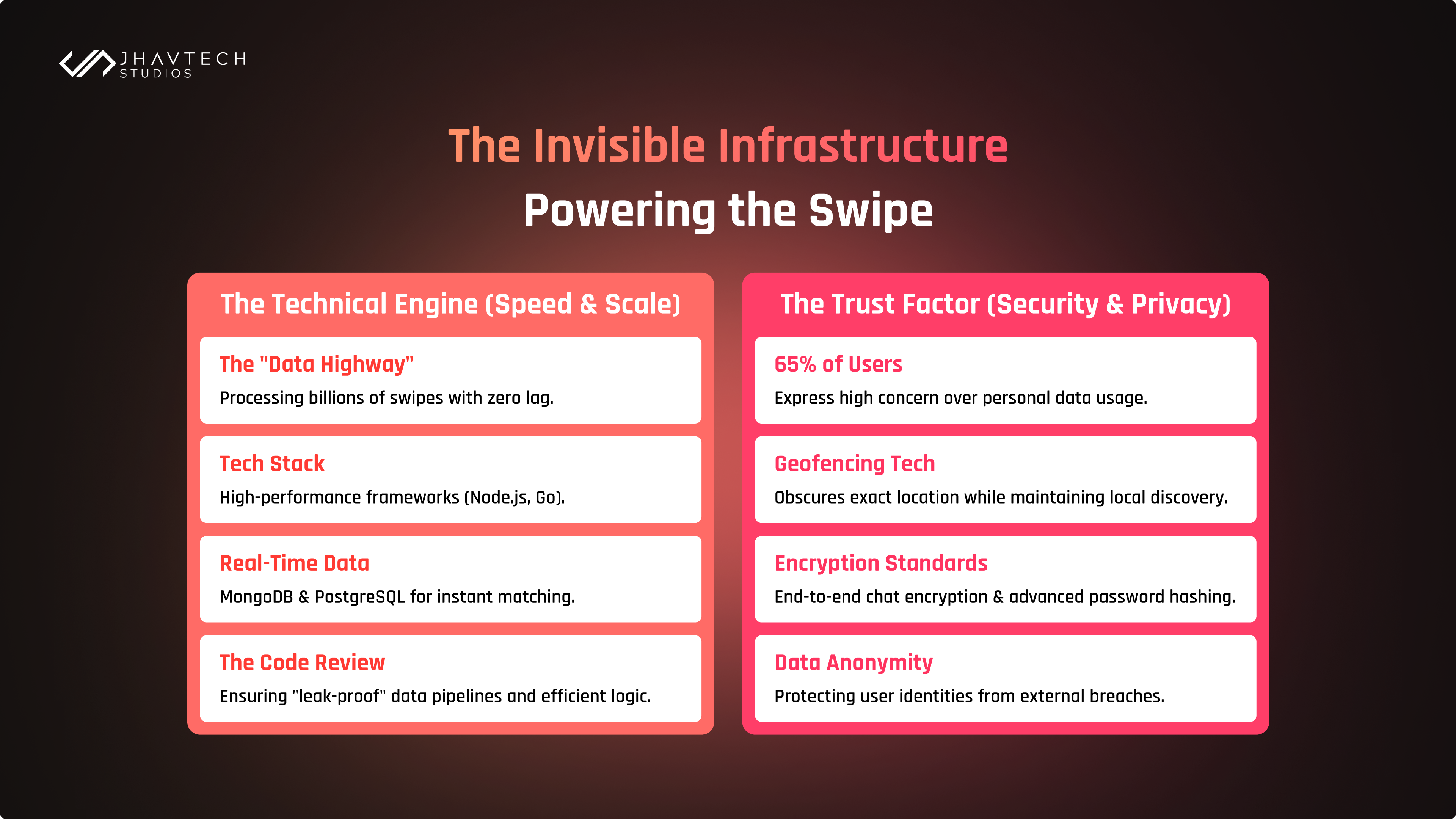
While the front end of an app looks simple and clean, the back end is a chaotic highway of data. When you swipe right, that data must be processed, compared against the other person's database entry, and, if a match occurs, a push notification must be triggered instantly. This requires a robust dating app tech stack that usually involves high-performance frameworks like Node.js or Go, coupled with real-time database management systems like MongoDB or PostgreSQL.
A critical but often overlooked part of the development process is the code review. This phase ensures that the logic governing the matches is efficient and that there are no leaks in the data pipeline. When you consider that a major app might handle 2 billion swipes per day globally, even a tiny inefficiency in the code can lead to massive server lag or crashes.
Privacy and the Trust Factor
As we share more of our lives online, the "hidden" tech must also act as a shield. Privacy and data security in swipe-based apps is a top priority for developers today. It isn't just about hiding your email address; it involves sophisticated geofencing tech that obscures your exact location while still allowing you to find people nearby.
Recent studies show that 65 percent of users are "highly concerned" about how their personal data is used by romantic platforms. To combat this, modern apps use end-to-end encryption for chats and advanced hashing for passwords. Developers often look at successful case studies from reputable firms to understand how to balance high-level functionality with stringent data protection protocols. They ensure that while the dating app algorithms have enough data to work with, that data remains anonymous and protected from external breaches.
Why UI/UX Design Dictates Your Love Life
We often think we are making conscious choices about who we like, but the UI/UX design of an app heavily influences our behavior. The "swipe" itself is a stroke of psychological genius. It turns the search for a partner into a gamified experience, triggering dopamine hits with every match. The placement of buttons, the speed of the transitions, and even the color palette are all chosen to keep you in a "flow state."
If the interface is too cluttered, users feel overwhelmed. If it is too simple, it feels hollow. The goal is to create a frictionless environment where the technology disappears, leaving only the human connection. This design philosophy extends to the "onboarding" process, where the app asks you questions to feed the dating app algorithms without making it feel like a boring survey.
The Ethics of the Swipe
There is an ongoing debate about the ethics of dating app algorithms. Critics argue that by prioritizing certain profiles, these systems can inadvertently reinforce social biases or create "beauty hierarchies." For example, a study by Cornell University found that algorithmic sorting can sometimes limit the visibility of minority groups if not properly calibrated for diversity.
Because of this, many developers are now implementing "anti-bias" layers into their code. This involves periodically refreshing the deck with "low-score" profiles to ensure everyone gets a fair chance at visibility. The goal is to move away from a "winner takes all" system toward a more inclusive digital ecosystem.
The Evolution of Communication
Once the match is made, the tech doesn't stop. The chat interface is another arena of intense innovation. Real-time communication relies on WebSockets to ensure that there is zero latency between sending and receiving a message. Some apps are even experimenting with "sentiment analysis" tools that can nudge a user if they are being too aggressive or if a conversation has gone cold.
This level of detail is why the dating app algorithms are so vital. They don't just stop at the match; they track whether the match actually led to a conversation. If two people match but never speak, the algorithm learns that the match was a "false positive" and adjusts your future deck accordingly. It is a constant, living loop of feedback and optimization.
Conclusion: The Future of Digital Connection
As we look toward the future, the integration of technology into our romantic lives will only deepen. We are moving toward a world where augmented reality and biometrics might play a role in how we meet. Imagine walking through a coffee shop and receiving a subtle haptic nudge on your watch because someone with a 90 percent compatibility score is sitting ten feet away.
The complexity of dating app algorithms continues to grow, becoming more human-centric and less robotic. While the idea of a machine choosing our partners can feel cold, the reality is that these tools are simply expanding our reach, allowing us to meet people we never would have crossed paths with in the physical world.
Whether you are a developer interested in the latest trends or a user just looking for love, understanding the tech behind the screen changes your perspective. It is a fascinating blend of sociology, mathematics, and high-level engineering. The next time you find yourself scrolling through profiles, remember that there are millions of lines of code working behind the scenes, all designed to help you find that one perfect person. In the end, the tech is just the bridge; the journey across it is still entirely up to you.
The evolution of this industry is a testament to how far we have come. With the right dating app algorithms and a commitment to user safety and experience, the "hidden" tech of the swipe-and-match world will continue to redefine how we connect, one match at a time.