Multi-Wallet Meteora Farming on Solana: Full Browser and Proxy Stack
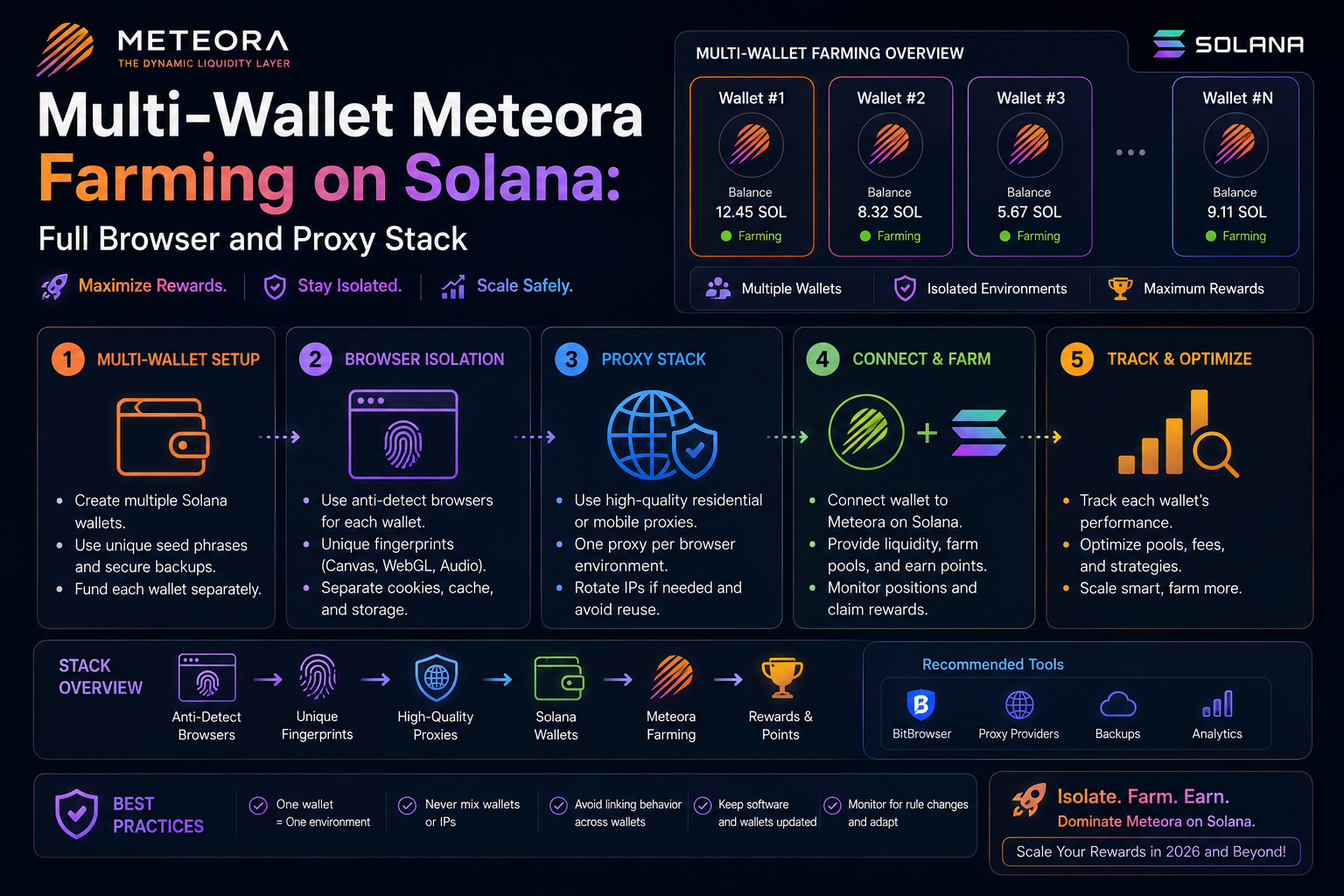
I started farming Meteora seriously in February 2026, right after their DLMM volume crossed $2B in a single week. Nine months later I run 22 wallets on Meteora across DLMM pools, Dynamic Vaults, and Alpha Vault positions. Zero flagged so far, zero cross-linked, and I want to walk you through the exact stack I use.
If you are still farming Meteora from one browser with one IP and hoping for the best, you are already on Jupiter's shared Sybil lists. Solana's on-chain graph is public, and every serious airdrop team now runs off-chain clustering on top of it. The browser fingerprint you leak matters as much as the wallet address you sign with.
This is the stack I run in August 2026, updated after the Solana ecosystem tightened Sybil filters post-JUP Season 3.
Why Meteora is worth the setup work
Meteora is the concentrated liquidity DEX on Solana that has been quietly eating market share from Raydium and Orca since late 2025. Their MET token launch is still pending as of this writing, and the point system (M3M3 stakers, LP incentives, referral tiers) is one of the most generous on Solana right now.
The catch: their team has openly said they will filter Sybil clusters using both on-chain patterns and off-chain signals shared with partner projects. That last part is the one most farmers miss. Meteora reads the same clustering data that Jupiter, Kamino, and Drift use. Get flagged on one, you are on the list for all of them.
So the browser and proxy layer has to be right from wallet #1, not retrofitted at wallet #15.
The three things that actually get you clustered
I've seen wallets get filtered for three reasons, in this order of frequency.
- Shared IP across wallets. Even one login from the wrong IP links a wallet forever. Cluster analysis doesn't care that you fixed it later.
- Identical browser fingerprint. Canvas hash, WebGL vendor, audio context, font list, timezone offset. If two wallets share more than four of these values, they get bucketed together.
- Behavioral rhythm. Same click cadence, same transaction sizes rounded to the same decimals, same 30-minute session length. Behavioral models catch this even when fingerprints are clean.
Proxies fix #1. An antidetect browser fixes #2. Discipline fixes #3, plus real cloud phones for the mobile-native protocols.
Layer 1: Browser isolation with BitBrowser
I use BitBrowser for every desktop wallet session. One profile per wallet, no exceptions. Each profile carries its own Canvas, WebGL, WebRTC, timezone, and font fingerprint, and none of them share cookies or local storage.
The setup that works for Meteora specifically:
- Fingerprint template: Chrome 128 or newer, since Solana dApps often break on older kernels. Mix Windows 11 and macOS Sonoma templates across your wallets. Don't use Linux templates for retail wallets, they stick out.
- WebRTC: set to "Replace" mode with the proxy IP. Leaked local IPs are the number one silent linkage vector.
- Canvas noise: enabled per profile. Meteora's frontend doesn't run canvas fingerprinting directly, but the widgets they embed do.
- Timezone and geolocation: must match the proxy country. A US proxy with an Asia/Ho_Chi_Minh timezone is a red flag even if the IP is clean.
I covered the exact BitBrowser build I run in my earlier post on my anti-Sybil browser stack, so I won't repeat all of it here. The Meteora-specific tweak is that Phantom and Backpack both check for canvas noise consistency across sessions, so I keep the noise seed fixed per profile instead of regenerating it on every launch.
If you are picking your first antidetect browser, BitBrowser has a free tier of 10 profiles, which is enough to test a real setup before you pay for anything. AdsPower and Multilogin both charge from wallet 1.
Layer 2: Proxies that actually match
Every profile gets its own residential IP. Sticky session, not rotating. Rotating IPs during a farming session is how you get soft-banned on Jupiter and get your JUP allocation halved.
My current proxy split for 22 Meteora wallets:
- 12 US residential (Proxy-Seller, one ISP per wallet, sticky for 24 hours)
- 6 EU residential (IPRoyal, mix of DE/NL/FR)
- 4 Asia residential (NetNut, JP/SG/HK)
I keep the geographic split because Meteora's DAU chart shows Solana activity is genuinely global, so a cluster of 22 US-only wallets looks statistically suspicious. Real users are spread out.
The rule I follow: one IP, one wallet, one BitBrowser profile, for the life of the wallet. If a proxy dies, I retire the wallet. It sounds harsh, but I tried to migrate wallets to new IPs early in 2026 and got two of them flagged. Not worth the risk.
Layer 3: Mobile sessions with cloud phones
Meteora added their mobile app in April 2026, and their point system now rewards mobile-native swaps at 1.3x the desktop rate. If you are ignoring mobile, you are leaving 30% of your points on the table.
But you cannot install 22 wallet apps on one Android phone. Every Solana wallet app reads IMEI, device ID, Android ID, boot count, and installed app list. Two wallets on the same physical device get linked in about four sessions.
For Android I use BitCloudPhone. Each cloud phone runs a fresh Android 13 instance with its own IMEI, GPS, sensor data, and SIM identifiers. I pair each cloud phone with the same proxy assigned to its desktop twin, so the wallet sees a consistent environment whether I open Phantom on desktop or the Phantom mobile app.
For iOS-specific dApps, BitCloudPhone iOS is currently the only cloud iPhone service that actually works. Backpack has an iOS-first update rolling out for their perps interface, and Solflare's iOS app has features their Android version doesn't. If you want those points, you need real cloud iOS. Emulators get caught immediately.
The BitCloudPhone iOS pricing is higher than Android, but for 4-5 flagship wallets it's worth it. I run 5 iOS instances and 17 Android instances. The iOS ones are for my highest-value wallets, the ones I don't want to lose.
Wallet and behavioral hygiene
The stack above is 80% of the work. The last 20% is behavior.
Rules I follow, every wallet, every session:
- No round-number swaps. 100 USDC, 500 USDC, 1000 USDC are all Sybil signals. I use 87.43, 213.19, whatever hits Jupiter's slippage tolerance naturally.
- Vary session length. Some wallets open Meteora for 8 minutes. Others stay logged in for 3 hours. Never the same block per wallet.
- Different pool preferences. Wallet A farms SOL-USDC. Wallet B farms JUP-USDC. Wallet C farms JitoSOL-SOL. Don't run 22 wallets in the same three pools.
- Stagger over weeks, not hours. I opened these wallets between February and June 2026, not in one weekend. Cluster analysis loves same-day cohorts.
- Never fund from the same source. I fund from 6 different CEXs (Bybit, MEXC, Kucoin, Bitget, Gate, Coinbase International) rotating across wallets.
I wrote a longer breakdown of the funding and behavioral rules in my post on DeFi yield farming across 20 wallets and what changed with 2026 detection. The Meteora-specific note is that their team is watching for M3M3 staking patterns too. If all your wallets stake the same amount on the same day, you get bucketed. Vary it.
What I'd do differently if starting today
Two things.
First, I would run more iOS instances. When I set this stack up in Q1 2026, cloud iOS was expensive and Android was fine. That's changed. Solana wallets increasingly ship iOS-first features and iOS device fingerprints are harder to fake, which means an iOS wallet gets more implicit trust from the anti-Sybil layer. If I were starting today, I'd run 10 iOS wallets and 12 Android.
Second, I would have set up per-wallet EVM identities from day one. Meteora hasn't announced cross-chain plans yet, but Jupiter did, and my Hyperliquid wallets were a mess to isolate when HIP-3 launched because I hadn't planned for it. I covered that painful migration in my Hyperliquid HIP-3 farming post if you want the details.
Full stack summary
- BitBrowser, one profile per wallet, canvas noise fixed per profile
- Residential proxies, sticky sessions, one IP per profile for the life of the wallet
- Geographic split across US, EU, Asia to look statistically normal
- BitCloudPhone Android for standard mobile sessions
- BitCloudPhone iOS for high-value wallets and iOS-native dApp features
- CEX funding rotated across 6+ exchanges
- Wallet creation staggered over months, not days
- Behavior varied per wallet: pool choice, session length, swap size
That is the setup running 22 clean Meteora wallets right now. When MET launches, I'll post a follow-up with allocation results.
Until then, stay clean off-chain. The on-chain graph is public, but the off-chain graph is what actually gets you filtered.