From Content Creator to Builder: Why I Decided to Create NanoMaker AI
Living in San Francisco as a Chinese immigrant has taught me one thing: nothing stays stable for long.
A few years ago, I was working as a website editor. My job was to produce visuals — banners, thumbnails, promotional graphics, blog images. It was steady work, but it was also repetitive. I spent hours adjusting colors, fixing lighting, resizing layouts, polishing details that most people would scroll past in seconds.
When AI image tools started becoming popular, I felt curious but skeptical. Still, I decided to try one — Nano Banana. I subscribed to a $49.9 monthly plan to see if it could speed up my workflow.
It did more than that.
Tasks that once took half a day were done in minutes. Instead of shooting photos and retouching them endlessly, I could generate visuals directly from prompts. It wasn’t perfect, but it dramatically reduced the mechanical part of my work.
For the first time in a while, I felt like technology was working for me instead of exhausting me.
Then life shifted again.
During a company restructuring, I lost my job. It wasn’t dramatic. No conflict. Just a quiet ending.
I decided to use the opportunity to try something different. I started building my own content channels on TikTok and YouTube. If I had to rebuild from scratch, I wanted to build something that belonged to me.
But creating content independently exposed a new challenge.
Images were no longer enough. I needed video.
So I subscribed to an AI video generation platform — another $99 per month. Now I was using AI images as the foundation and turning them into short videos.
It worked. But something was missing.
Music.
Background music matters more than most people realize. The right track changes the emotional tone of a video completely. So I searched again and subscribed to an AI music generation tool. Another $99 per month.
Without fully noticing it, I was now spending roughly $250 every month across different AI platforms.
The frustrating part wasn’t just the cost. It was the fragmentation.
Each platform had separate accounts, separate dashboards, separate credit systems. I was constantly downloading files from one service and uploading them to another. Managing subscriptions became part of my workflow.
And honestly, I wasn’t fully using any of them. As an individual creator, I didn’t need massive quotas. I needed flexibility and integration.
One evening, while reviewing my expenses, I asked myself a simple question:
Why am I stacking subscriptions instead of simplifying them?
I assumed someone had already built an all-in-one AI platform that combined top image, video, and music models under one plan. I searched for it. I tested a few tools.
Nothing felt complete.
Most platforms specialized in one category. Others tried to do everything but lacked depth or quality. The experience remained scattered.
That’s when the idea formed quietly:
What if I built the tool I was looking for?
I’m not a formally trained engineer. But modern AI coding tools have lowered the barrier dramatically. With tools like Cursor, documentation, and persistent trial and error, I began experimenting.
At first, progress was slow. Integrating APIs wasn’t as simple as it looked. Payment systems required careful handling. Usage tracking had to be accurate. Every small detail mattered.
There were moments of doubt. It would have been easier to just continue paying for separate subscriptions.
But I kept thinking about the core problem: creators shouldn’t need three or four platforms just to produce one cohesive piece of content.
That idea became the foundation of NanoMaker AI.
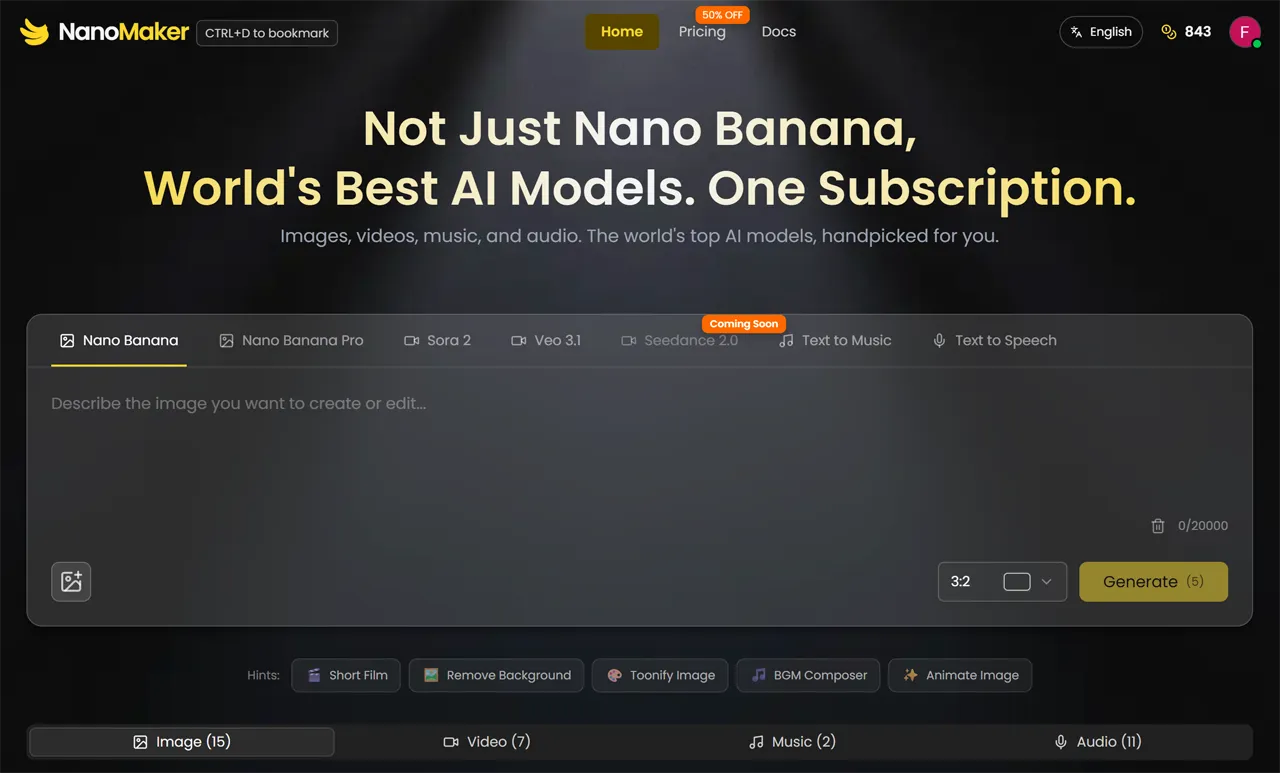
The concept was straightforward — bring powerful AI models for image, video, music, and audio into a unified environment with a simpler structure.
No constant tab switching.
No subscription stacking.
No wasted quotas.
Building it taught me something unexpected.
Entrepreneurship doesn’t always start with ambition or market opportunity. Sometimes it begins with personal friction. A recurring inconvenience. A small frustration that slowly grows until you decide to fix it yourself.
NanoMaker AI didn’t come from a grand vision of building a tech empire.
It came from a content creator trying to reduce complexity.
And maybe that’s enough.
Because sometimes, solving your own problem is the most honest place to begin.