Nature of Science
Think of your favorite science fiction movie. What is it about? Maybe it’s about spaceships going to distant planets, or people being cloned in laboratories, or undersea civilizations, or robots that walk among us. These entertaining imaginings are make-believe fantasies, that’s why they’re called science “fiction.” They are not real. But why are they called “science” fiction?
The answer is that science uses a disciplined process to answer questions. In science, "disciplined" does not mean well-behaved. It means following orderly steps in order to come up with the best answers. Science involves observing, wondering, categorizing, communicating, calculating, analyzing, and much more. In order to convert creativity into reality, we need science. In order to travel beyond where anyone has gone before, we need science. In order to understand the world, make sense of it, and conserve it, we need science. In order to confirm our best guesses about the universe and the things in it, we need science. Science fiction stories extend and expand on all the ideas of science and technology in creative ways.
Lesson Objectives
Explain the importance of asking questions.
State the steps of the scientific method.
Describe the three major types of scientific models.
Use appropriate safety precautions inside and outside the science laboratory.
Asking Questions
Why is the sky blue?
How tall will this tree grow?
Why does the wind blow so hard?
Will it be cold tonight?
How many stars are out there?
Are there planets like Earth that orbit about some of those stars?
How did this rock get holes in it?
Why are some rocks sharp and jagged, while others are round?
You probably ask yourself a thousand questions a day, many of which you never ask anyone else. For many of the questions you do ask, you never even get an answer. But your brain keeps churning with questions and curiosity. We can't help but want to know.
The list of questions above are some of the same questions that scientists ask. Science has developed over centuries and centuries, and our ability to measure the tiniest trait has increased immensely. So although there is no wrong question, there are questions that lend themselves more to the scientific process than others. In other words, some questions can be investigated using the scientific method while others rely on pure faith or opinion.
Scientific Methods
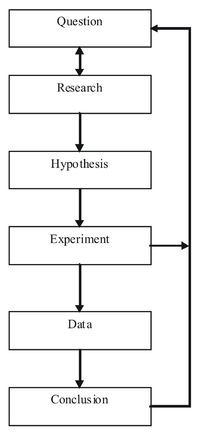
The scientific method is not a list of instructions but a series of steps that help to investigate a question. By using the scientific method, we can have greater confidence in how we evaluate that question. Sometimes, the order of the steps in the scientific method can change, because more questions arise from observations or data that we collect. The basic sequence followed in the scientific method is illustrated in Figure 1.1.
Question
The scientific method almost always begins with a question that helps to focus the investigation. What are we studying? What do we want to know? What is the problem we want to solve? The best questions for scientific investigation are specific as opposed to general; they imply what factors may be observed or manipulated.
Example: A farmer has heard of a farming method called “no-till farming.” In this method, certain techniques in planting and fertilizing eliminate the need for tilling (or plowing) the land. Will no-till farming reduce the erosion of the farmland (

Research
Before we go any further, it is important to find out what is already known about the topic. You can research a topic by looking up books and magazines in the library, searching on the Internet, and even talking to people who are experts in the area. By learning about your topic, you’ll be able to make thoughtful predictions. Your experimental design might be influenced by what you have researched. Or you might even find that your question has been researched thoroughly. Although repeating experiments is valid and important in science, you may choose to introduce new ideas into your investigation, or you may change your initial question.
Example: The farmer decides to research the topic of no-till farming (Figure 1.3). She finds sources on the Internet, at the library, and at the local farming supply store that discuss what type of fertilizer might be used and what the best spacing for her crop would be. She even finds out that no-till farming can be a way to reduce carbon dioxide emissions into the atmosphere, which helps in the fight against global warming.

Hypothesis
Now that you have researched the topic, you can make an educated guess or explanation to the question. This is your hypothesis. The best hypothesis is directly related to the question and is testable, so that you can do experiments to determine whether your hypothesis is correct.
Example: The farmer has researched her question and developed the following hypothesis:
No-till farming will decrease the soil loss on hills of similar steepness as compared to the traditional farming technique because there will be less disturbance to the soil.
A hypothesis can be either proved or disproved by testing. If a hypothesis is repeatedly tested and proven to be true, then scientists will no longer call it a hypothesis. A scientific theory has a great deal of supporting evidence that backs it up.
Experiment
Not all questions can be tested by experimentation. However, many questions present us with ways to test them that give us the clearest conclusions. When we design experiments, we select the factor that will be manipulated or changed. This is the independent variable. We will also choose all of the factors that must remain the same. These are the experimental controls. Finally, we will choose the factor that we are measuring, as we change the independent variable. This is the dependent variable. We might say that the dependent variable “depends” on the independent variable. How much soil is eroded depends on the type of farming technique that we choose.
Example: The farmer will conduct an experiment on two separate hills with similar slopes or steepnesses (Figure 1.4). On one hill, he will use a traditional farming technique which includes plowing to stir up the nutrients in the soil. On the other hill, he will use a no-till technique by spacing plants further apart and using specialized equipment that plants the plants without tilling. He will give both sets of plants identical amounts of water and fertilizer.
Conceptual Models
Figure 1.6: A collision showing a meteor striking the Earth.
A conceptual model is not a physical model, but rather a mental explanation that ties together many ideas to attempt to explain something. A conceptual model tries to combine knowledge and must incorporate new knowledge that may change it as knowledge is acquired. The origin of the moon, for example, is explained by some as a Mars sized planet that hit the Earth and formed a great cloud of debris and gas (Figure 1.6). This debris and gas eventually formed a single spherical body called the Moon. This is a useful model of an event that probably occurred billions of years ago. It incorporates many ideas about the craters and volcanoes on the Moon, and the similarity of some elements on both the moon and the Earth. Not all data may fit this model, however, and there may be much information that we simply don’t know. Some people think that the Moon was initially an asteroid out in space which was captured in orbit by the gravity of the Earth. This may be a competing conceptual model which has its own arguments and weaknesses. As with physical models, all conceptual models have limitations.
Mathematical Models
A third type of model is the mathematical model. These models are created through a great deal of consideration and analysis of data. A mathematical model is an equation or formula that takes many factors or variables into account. These models may help predict complex events like tornadoes and climate change. In order to predict climate change, for example, a mathematical model may take into account factors such as temperature readings, ice density, snow fall, and humidity. These data may be plugged into equations to give a prediction. As with other models, not all factors can be accounted for, so that the mathematical model may not work perfectly. This may yield false alarms or prediction failures. No model is without its limitations.
Models are a useful tool in science. They allow us to efficiently demonstrate ideas and create hypotheses. They give us visual or conceptual manners for thinking about things. They allow us to make predictions and conduct experiments without all of the difficulties of real-life objects. Could you imagine trying to explain a plant cell by only using a real plant cell or trying to predict the next alignment of planets by only looking at them? In general, models have limitat ions that should be taken into consideration before any prediction is believed or any conclusion seen as fact.
Source: https://en.wikibooks.org/wiki/High_School_Earth_Science/Nature_of_Science
Not indicating that the content you copy/paste is not your original work could be seen as plagiarism.
Some tips to share content and add value:
Repeated plagiarized posts are considered spam. Spam is discouraged by the community, and may result in action from the cheetah bot.
Creative Commons: If you are posting content under a Creative Commons license, please attribute and link according to the specific license. If you are posting content under CC0 or Public Domain please consider noting that at the end of your post.
If you are actually the original author, please do reply to let us know!
Thank You!
Hi! I am a robot. I just upvoted you! I found similar content that readers might be interested in:
https://en.wikibooks.org/wiki/High_School_Earth_Science/Nature_of_Science
Congratulations @adeelahasnain05! You received a personal award!
Click here to view your Board of Honor
Congratulations @adeelahasnain05! You received a personal award!
You can view your badges on your Steem Board and compare to others on the Steem Ranking
Vote for @Steemitboard as a witness to get one more award and increased upvotes!