Solana Turns Its X Profile Picture Into a Billboard for Nepal Flood Relief
The Solana Foundation is auctioning nine advertising zones on its official X profile picture and pinned post, converting one of crypto’s most visible brand assets into a week-long fundraiser for victims of Nepal’s catastrophic August 26 flash floods. One hundred percent of the bids are earmarked for the Government of Nepal’s Prime Minister’s Disaster Relief Fund.
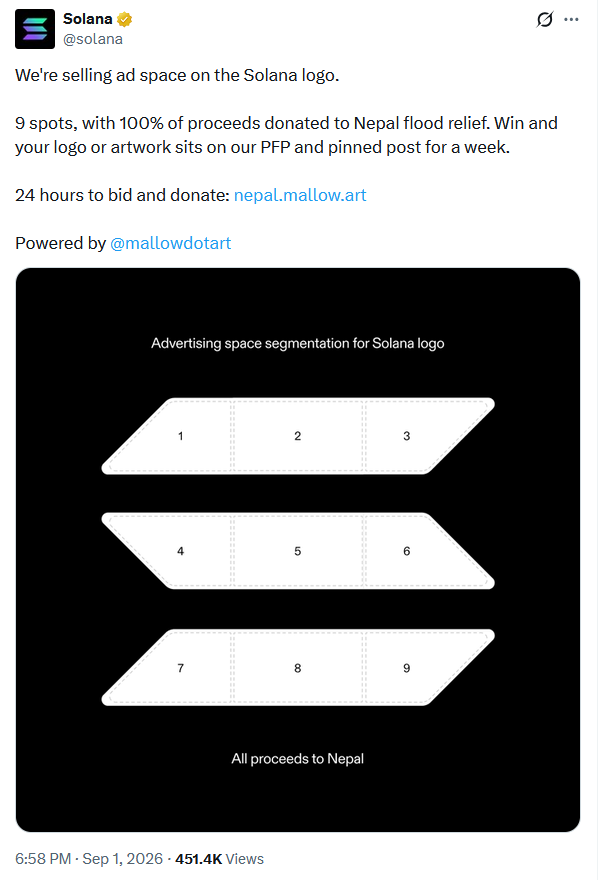
The live auction is hosted at https://nepal.mallow.art and powered by the Solana art marketplace mallow. By September 1 it had drawn more than $158,000 in USDC bids, with crypto betting platform Rollbit holding the center slot at $50,000. Other prominent bids included Solami, PreStocks, SolARBa, SOLCAT and Addog. The auction uses anti-sniping rules and was scheduled to close later on September 1 or early September 2, depending on last-minute bidding.
Winners get their logos displayed on the official Solana X account’s profile picture and pinned tweet for one week. Bids are in USDC, binding once they win, and artwork must meet content rules (no NSFW, violent or hateful imagery).
A glacier collapse, then a wall of water
On the morning of August 26, 2026, a glacier gave way above the Trishuli River system on the Nepal–Tibet border. An ice-and-rock avalanche temporarily blocked a tributary, then released a sudden surge of water, mud and debris down the Bhotekoshi–Trishuli corridor. The torrent tore through Rasuwa, Nuwakot and Dhading districts, destroying homes, roads, bridges and hydropower sites.
By September 1, Nepal’s death toll had passed 1,000, with thousands still missing, including hundreds of foreign nationals and workers trapped at damaged hydropower projects. More than 11,000 people had been rescued. Debris estimates ran into the millions of tons. Entire stretches of the highway toward the China border were gone. Prime Minister Balendra Shah described communities that had lost homes, families and livelihoods in hours.
The disaster is one of the deadliest Himalayan flood events in recent years and has been linked by scientists to glacial instability in a warming mountain range. Secondary flood risk from debris-dammed lakes remained a concern days later.
How the money actually moves
The auction page is explicit: every cent of winning bids goes to the Prime Minister’s Disaster Relief Fund. The path is not a direct on-chain transfer to Kathmandu.
Proceeds sit in escrow. Mallow then converts them to USDC on Ethereum and sends them to Engage Nepal, a U.S. 501(c)(3) charity. Engage Nepal forwards the funds to the official government fund. Solana Foundation and mallow say they will publish the donation transaction from their X accounts.
That two-step structure is common when crypto projects want a tax-recognized U.S. nonprofit intermediary and a legally recognized destination inside Nepal’s “one-door” relief system.
Engage Nepal: the U.S. bridge
Engage Nepal is a Virginia-based public charity (EIN 47-3883147) that describes itself as a philanthropic bridge between global donors and grassroots Nepali organizations.
It was created in 2015 with a focus on disaster risk reduction after Nepal’s earthquakes. On his first day of retirement from a 35-year diplomatic career, former U.S. Ambassador to Nepal Scott DeLisi, who served under President Obama, took the helm. The organization says it has no large staff of its own. It funds and partners with more than 14 Nepali nonprofits working in health, education, livelihoods and environment/climate resilience. It reports 100-plus completed projects and more than 10,000 lives directly impacted over a decade.
DeLisi’s background in Nepal and the group’s earlier flood-response work, including medical camps after prior monsoon disasters, made it a natural conduit for a crypto-to-government transfer. Engage Nepal is not the final spender of the Solana auction money. It is the legally recognized U.S. recipient that then passes funds to the official Nepali account.
Website: https://engagenepal.org
The Prime Minister’s Disaster Relief Fund: Nepal’s official “one door”
The actual destination is the Prime Minister’s Disaster Relief Fund (PMDRF), known in Nepali as प्रधानमन्त्री दैवी प्रकोप उद्धार कोष.
It is a government fund, not an NGO. By regulation it is restricted to rescue, medical treatment, relief, rehabilitation and restoration of damaged infrastructure. The Ministry of Finance is the focal ministry for collecting contributions. Accounts exist at multiple commercial banks, all under the name “PRIME MINISTER DISASTER RELIEF FUND.” International donors can give by card or QR at https://pmdrf.nchl.com.np (operated with Nepal Clearing House) or via a Himalayan Bank gateway, or by SWIFT.
After the August 26 floods, the government imposed a one-door policy: cash and in-kind aid are supposed to flow through this official channel and designated collection hubs, not through unauthorized private drives. The Prime Minister’s Office publicly warned against fake QR codes and newly created social-media “relief” pages, a problem that appeared within days of the disaster.
The fund already held a pre-disaster balance and then received a flood of domestic pledges. Within days, reported inflows exceeded NPR 2 billion, and the overall balance was cited above NPR 4 billion as companies, banks, insurers and individuals contributed. The cabinet decided that the prime minister and ministers would donate one month’s salary. Finance Minister Swarnim Wagle personally received large institutional checks.
Critics of government-run disaster funds anywhere in the world often ask about speed, leakage and political allocation. Nepal’s rules require the money to be used for disaster purposes, and accounts are subject to audit. Independent guides have pointed donors to the official portal precisely because it is the legally designated channel and because scams multiplied on Instagram and Facebook. Whether the Solana proceeds move quickly from Engage Nepal into field operations will depend on how the Finance Ministry and disaster agencies disburse the larger pool.
Why a logo auction?
Solana’s official X account is one of the most-followed profiles in crypto. Selling slices of that profile picture is a way to monetize attention without dipping into foundation treasury grants. Bids in USDC keep the donation value stable between bid and settlement.
The campaign sits alongside other crypto responses. Ripple pledged $300,000 to World Central Kitchen and Mercy Corps for meals, water and sanitation in the same disaster zone. Community tokens and smaller Solana drives also appeared, some more transparent than others.
The logo auction’s strength is simplicity and a public paper trail: escrowed bids, a named U.S. 501(c)(3), a named government fund, and a promised transaction receipt. Its limit is scale. Even at $150,000 to $200,000, the amount is small next to Nepal’s damage bill and the billions of rupees already in the official fund. Its value is speed, visibility, and a clean path that avoids the fake QR codes that sprang up after the flood.
Anyone who wants to give without bidding on a logo can donate directly at the government’s portal: https://pmdrf.nchl.com.np/
The auction itself remains open to outbids on any of the nine zones until each zone’s anti-snipe timer expires: https://nepal.mallow.art
Verify any QR code or bank account name against “PRIME MINISTER DISASTER RELIEF FUND” before sending money.
🏅 Congratulations on winning Steem Bingo Round #511, @blaze.apps! You won 58.333 STEEM for Four Corners!
Result: https://steemscanner.com/transaction/2d98d8e3fd21f3fd4d80aadec2135258073e6188
Support Our Witnesses
Steem Bingo is made possible by our witnesses. Please consider voting for them:
📈 Automate your Steemit posts and upvotes: https://autoblaze.xyz
💎 Delegate to @upex and get the best returns on your delegations!
🔗 Follow SVM updates and our EVM Extension on STEEM: https://steemit.com/created/hive-196634
🔥 Try Blazedit — create posts and reels and get extra reward boost from @upex