How to Choose the Best NFT Marketplace Development Company
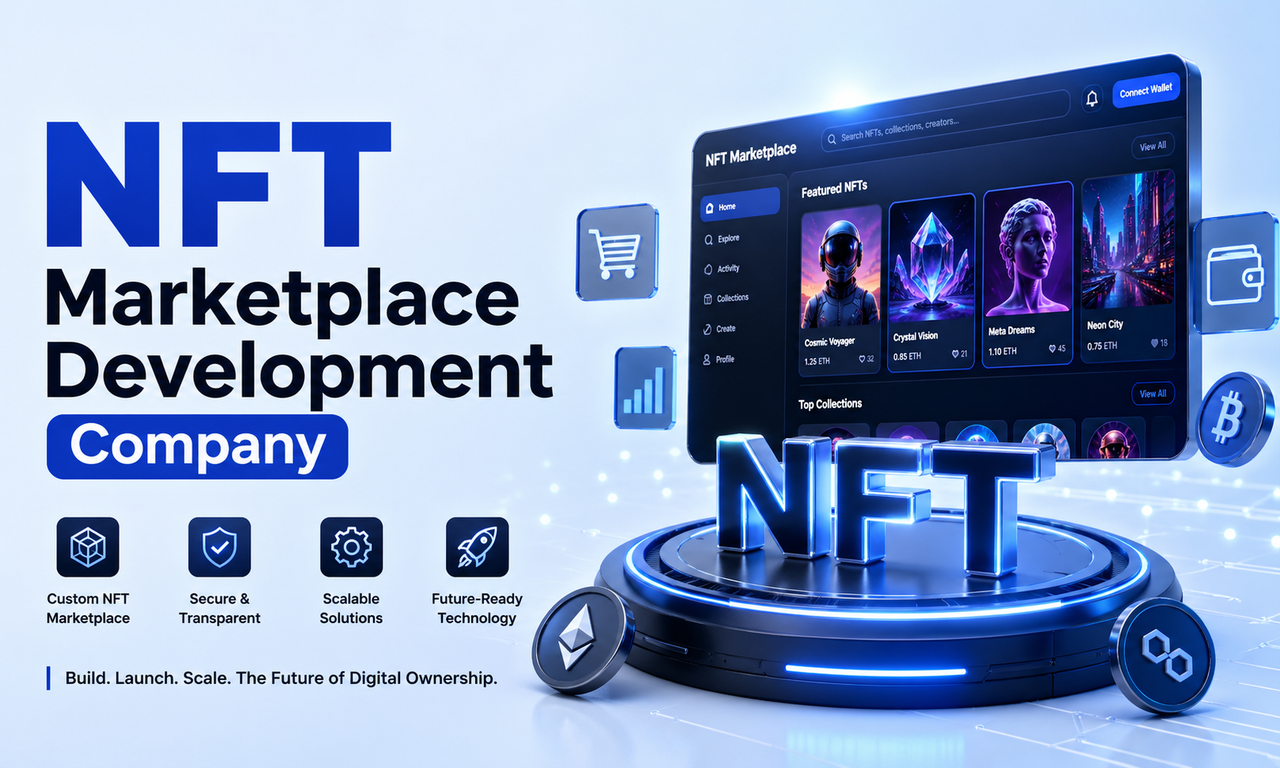 The digital economy is shifting fast — and NFTs (Non-Fungible Tokens) are no longer just a buzzword. From artists and musicians to real estate investors and game developers, everyone is racing to build their own NFT platform. But here's the truth most people miss: the success of your NFT venture depends heavily on the NFT Marketplace Development Company you choose.
In this post, I'll walk you through what an NFT marketplace truly is, why development quality matters more than you think, and how to identify the right development partner for your vision.
What Is an NFT Marketplace — And Why Does It Matter in 2026?
An NFT marketplace is a blockchain-powered digital platform where users can mint, buy, sell, and trade non-fungible tokens. Think of it as eBay or Amazon — but for unique digital assets that live on the blockchain.
These digital assets can be anything:
- Digital art and collectibles
- Music tracks and albums
- In-game weapons, skins, and characters
- Virtual real estate in the metaverse
- Fashion items and luxury goods
- Tokenized real-world assets (DeFi)
The global NFT market generated roughly USD 26,982.4 million in 2023 and is forecasted to grow to USD 211,719.9 million by 2030. That's an explosive trajectory — and businesses that get in early with a solid platform stand to gain the most.
But here's where many entrepreneurs go wrong: they underestimate how technically complex it is to build a reliable, secure, and scalable NFT marketplace.
The Core Challenges of NFT Marketplace Development
Building an NFT marketplace isn't like building a regular website. You're dealing with:
Smart Contract Security — Every transaction on your platform runs through smart contracts. A single vulnerability can drain your entire platform. Auditing and writing gas-efficient contracts requires deep blockchain expertise.
Multi-Blockchain Compatibility — Users aren't all on Ethereum. They want Solana, Polygon, BNB Chain, Cardano, and more. Supporting multiple chains means complex backend architecture.
Scalability — When your platform goes viral (and you want it to), can it handle 10,000 simultaneous users? Poor infrastructure choices early on can cause catastrophic downtime later.
UX/UI for Non-Crypto Users — Mainstream adoption requires that even someone who has never used a crypto wallet can navigate your platform effortlessly.
Regulatory Compliance (KYC/AML) — As governments worldwide tighten regulations around digital assets, your platform needs built-in KYC (Know Your Customer) and anti-fraud mechanisms.
This is exactly why partnering with an experienced NFT Marketplace Development Company isn't a luxury — it's a necessity.
What Makes a Great NFT Marketplace Development Partner?
When evaluating development companies, look beyond the pitch deck. Here's what truly matters:
1. End-to-End Service Capability
The best companies handle everything — from initial ideation and UI/UX design to smart contract development, testing, deployment, and post-launch maintenance. You don't want to stitch together five different vendors for one product.
2. Proven Experience With Blockchain Tech Stacks
A capable team should be fluent in Ethereum, Binance Smart Chain, Polygon, Solana, Tezos, and Polkadot, along with NFT standards like ERC-721, ERC-1155, TRC-721, and more.
3. White-Label Solutions for Faster Launch
If time-to-market matters (it always does), white-label NFT platforms let you launch a branded, feature-rich marketplace in a fraction of the time it would take to build from scratch.
4. Smart Contract Auditing
Every smart contract should be fully audited before deployment. This is non-negotiable. Ask potential partners directly: "Do you audit your smart contracts? By whom?"
5. Post-Launch Support
Your marketplace will need constant updates, security patches, and feature additions. A partner who disappears after deployment is a liability, not an asset.
Key Features Your NFT Marketplace Must Have
Whether you're building from scratch or using a white-label solution, here are the features that separate world-class platforms from mediocre ones:
- User Registration & KYC Verification — Trust starts with identity.
- Wallet Integration — Support MetaMask, WalletConnect, and other major wallets.
- NFT Minting (Single & Collections) — Let creators mint with ease.
- Auction & Fixed-Price Listings — Flexibility drives engagement.
- Creator Royalties — Automated royalty splits on every resale.
- Advanced Search & Filter — Price, category, rarity, blockchain, and more.
- Multi-Chain Support — Don't limit your users to one blockchain.
- Push Notifications — Keep users informed about bids, sales, and drops.
- Analytics Dashboard — Give creators and traders real data to work with.
- Cross-Platform Responsiveness — Desktop, tablet, and mobile — all seamless.
Real-World Use Cases: NFTs Are Solving Real Problems
It's easy to dismiss NFTs as speculative or niche. But they're being adopted across serious industries:
Gaming: Players truly own in-game assets. Skins, weapons, and characters can be traded on open markets — creating real economies within games.
Music: Musicians release albums or exclusive tracks as NFTs, giving fans direct ownership and bypassing traditional middlemen.
Real Estate: Tokenized property ownership is making real estate investment more liquid and accessible globally.
Fashion & Luxury: Brands use NFTs to verify authenticity and prevent counterfeiting of high-value products.
DeFi: NFTs represent collateralized loans, governance rights, and fractional asset ownership in decentralized finance protocols.
If your business operates in any of these industries, there's a real, actionable NFT strategy waiting to be built.
A Trusted Name: Technoloader as an NFT Marketplace Development Company
One development partner worth knowing about is Technoloader, a blockchain development company based in Jaipur, India, with over 8 years of experience in the space.
What sets them apart from generic development agencies:
- 450+ completed blockchain projects across NFT, DeFi, crypto exchange, and gaming
- Multi-chain expertise — Ethereum, Polygon, Solana, BNB Chain, Cardano, Polkadot, Tezos
- Full-stack NFT services — from white-label platforms to custom smart contracts, wallet development, UI/UX, and mobile apps
- Dedicated development teams — your project gets focused attention, not a rotating roster of freelancers
- Post-launch maintenance — they stay with you long after deployment
Their development process follows a structured 7-step approach: Project Ideation → Prototyping → UI/UX Development → Smart Contract Development → Testing → Deployment → Updates & Maintenance. This systematic approach minimizes risk and keeps timelines predictable.
Pricing varies based on complexity — a basic white-label solution can start around $20,000, while custom enterprise platforms with advanced features range significantly higher. But compared to the market opportunity, the ROI potential is substantial.
They've earned recognition from platforms like Clutch (Top Blockchain Company 2026), GoodFirms, and SelectedFirms — all credible third-party validators in the B2B tech space.
Final Thoughts
The NFT space is still young enough that getting in with a quality platform can establish you as a market leader. But the technical complexity means shortcuts will cost you — in security breaches, poor user experience, or platforms that simply can't scale.
The right NFT Marketplace Development Company isn't just a vendor. They're a strategic partner who understands blockchain deeply, builds with long-term scalability in mind, and supports you beyond launch day.
Whether you're a startup, an artist collective, a gaming studio, or an enterprise exploring Web3, the message is clear: your NFT marketplace is only as strong as the team that builds it.
Do your research, ask the hard questions, and invest in quality from day one. The market is growing fast — and it rewards those who build well.