Update: Fundry - "The simplest way to move a complex project forward"
I'm excited to share an update about Fundry on Open for Product!
The simplest way to move a complex project forward
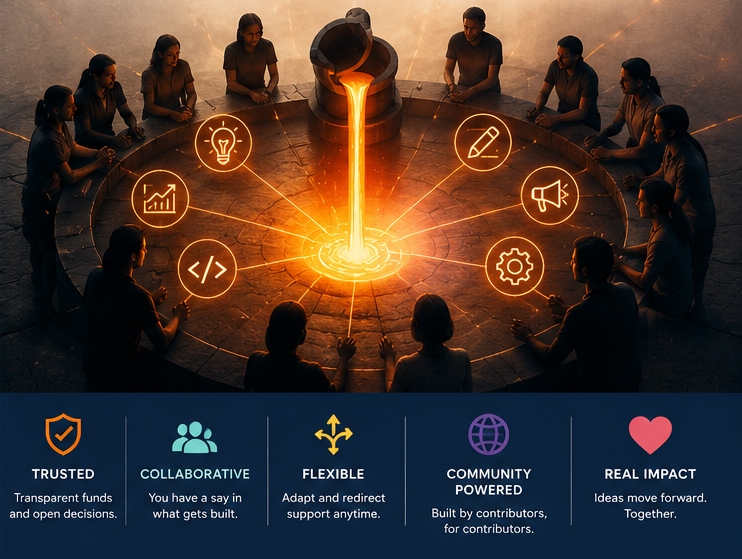
Fundry is a project funding approach that I thought might be a nice collective way to contribute to the direction a given project takes.
Briefly, here's the idea:
People can contribute directly to Open for Product, or to a project on Open for Product in one of two ways:
- to a pool of project funds
- to a specific project goal
Points
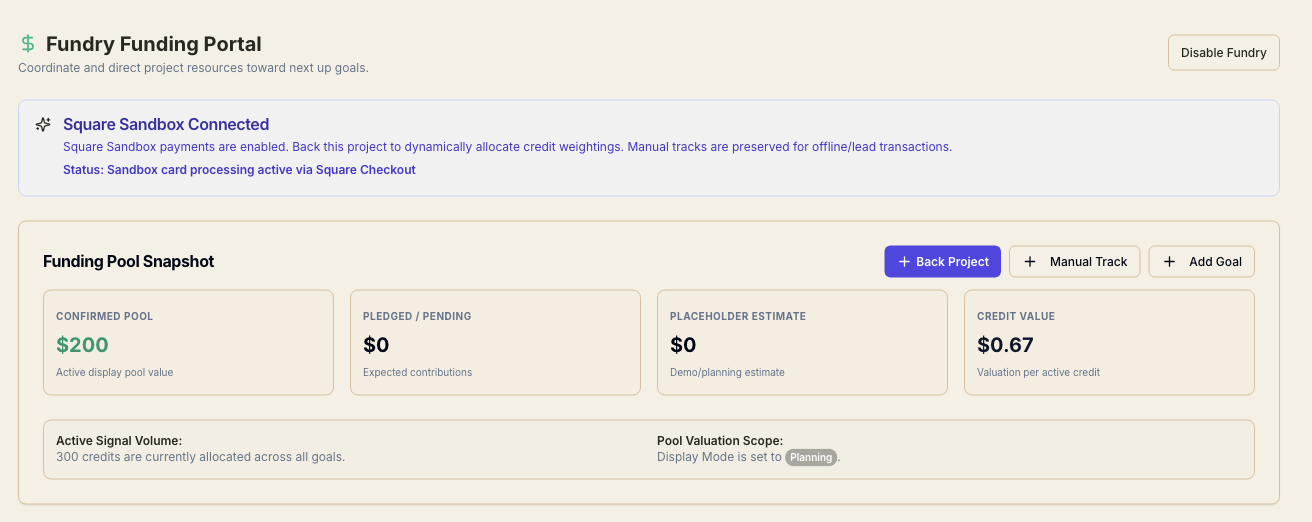
But there's an interesting twist! Every contributor receives 100 Fundry points to use as a signal for the strategic direction of the project, which enables even project pool contributors to help dictate the direction of the project. Even if you don't contribute funds directly to a specific goal, you can weight the general pool of available project funds toward a goal of your choice using your points!
Points are a nice way to influence direction because it provides some amount of additional influence to contributors of smaller amounts, while not punishing contributors of larger amounts— but perhaps temering their sway a little bit. Contributors can signal support for 1 or more goals by distributing their 100 points as they see fit. After 7 days, signals are locked in, but additional contributions award you more points.
I haven't really done the math in a bunch of different scenarios to see where this can go wrong yet, but there's another layer that helps to create balanced decision making: governance.
Governance
Ultimately, every project has its own form of governance (how decisions get made within the project). The default governance type right now is a project lead advisory model; project leads ultimately decide what goals to move forward, but the signals from contributors— using points, and not weighted as much by pure dollar amount of contribution! —help leads check the direction of the wind, so to speak.
Payment processor
The site is integrated with a payment processor now, but it's in testing mode. Feel free to pop over, find a project you like, and run through a contribution on its Fundry tab! There are no formal mechanisms for in-kind benefits for your help in place yet, but I'd be happy to offer something from the platform at some point to anybody who provides some positive or negative— and either way constructive —feedback to help get this built properly!
Contributions to the platform itself can be made through its own project, Open for Product (Core Platform)— but again... it's in test mode right now! If you contribute through a test contribution, you can signal a direction you like with your points, though!
I don't have many goals set up yet; feel free to join a project and add some.
The development process
I've been experimenting quite heavily with vibe coding (for anybody who does not know: this is the process of prompting an artificial intelligence model with text guidance to get it two write code for you). Implementing Fundry has been, by far, my most exciting vibe coding experience yet.
Two reasons:
- the models have all been getting consistently better:
whereas I used to need to check nearly every line of code, and correct the work of the model even when it did a reasonably good job, I barely look at the code now.
In other words, I can trust much more that the model will produce something viable. That said, I do regularly have one model check the work of another model, which does unearth some issues that need to be addressed. - Unrelated to vibecoding specifically—
The implementation of a funding mechanism, especially a creative and exploratory one like Fundry, feels like the moment this whole platform moved from proof of concept side project to MVP-ish real-world platform.- Now, I realize I've done the thing you're "not supposed to do": I built a thing before validating a market.
And that's okay!
Let me explain. I'm supposed to be "building in public", but I'm horrible at keeping a social interaction and posting schedule. So, I've just gotten ahead of myself a bit, but there's still room for massive pivots if this gains momentum, and a market emerges that needs a different kind of thing.
And, this has been a creative process for me. I've used being immersed in the building of the platform of Open for Product to understand more fully my own motivations, and where Open for Product fits in a broader cultural perspective.
- Now, I realize I've done the thing you're "not supposed to do": I built a thing before validating a market.
Proof of Concept for what?
That's the thing; I have never been entirely sure!
Here's why that's not a problem:
Open for Product was meant to be built in public, not only for a community, but by a community. I don't know exactly what that should look like, but I think Fundry is one step in the right direction.
It's all about collective effort, cooperativism, and collaboration. Maybe as an MVP of something, Open for Product is more likely to attract a community of like minded people who will be interested in taking it somewhere.
I know for me, it gives me a more concrete way to talk about it— and related ideas that go beyond the platform cooperative. (So, maybe I'll hit a groove with those social posts.) And the community is the actual thing I've been striving toward here. So it doesn't really matter if Open for Product doesn't take off as a project management or group to group governance exchange or a way to skill up while contributing to something you care about or whatever (like a way to run projects like Open Book.
Together, we'll make something right for us. That's the concept.
More to come in a future post... but I've also added a landing page, and an About page to the platform *, so if you want to really find out what this is a proof of concept (maybe an MVP?) for, you can go check those out!
*NOTE: the copy is AI slop placeholder text, but it gets the point across well, I hope.
If you do visit, let me know what strikes you the most about the ideas, or about the implementation of Open for Product as a collective project platform. Where are you inclined to collaborate with a collective of other people?
@remlaps you are among the people who've looked at this before, and said, "I'm not really sure what it is." Hopefully my recent developments will shed some light.
Thanks! I still need to set up my account and explore the site, too. I didn't forget, but I need to remember to do it when I'm at the computer. Maybe tomorrow. We lost most of last weekend due to an unanticipated situation.