Why OutageScope Exists: Solving the Multiplayer Server Guesswork
Multiplayer games fail in a very specific way: not always loudly, not always completely, and almost never with helpful explanations. One minute you are queueing into a match, the next you are stuck on “Connecting…”, kicked back to the menu, or staring at an error code that could mean anything from a bad Wi-Fi moment to a full-blown server incident.
That uncertainty is the real problem. And it is the reason OutageScope exists.
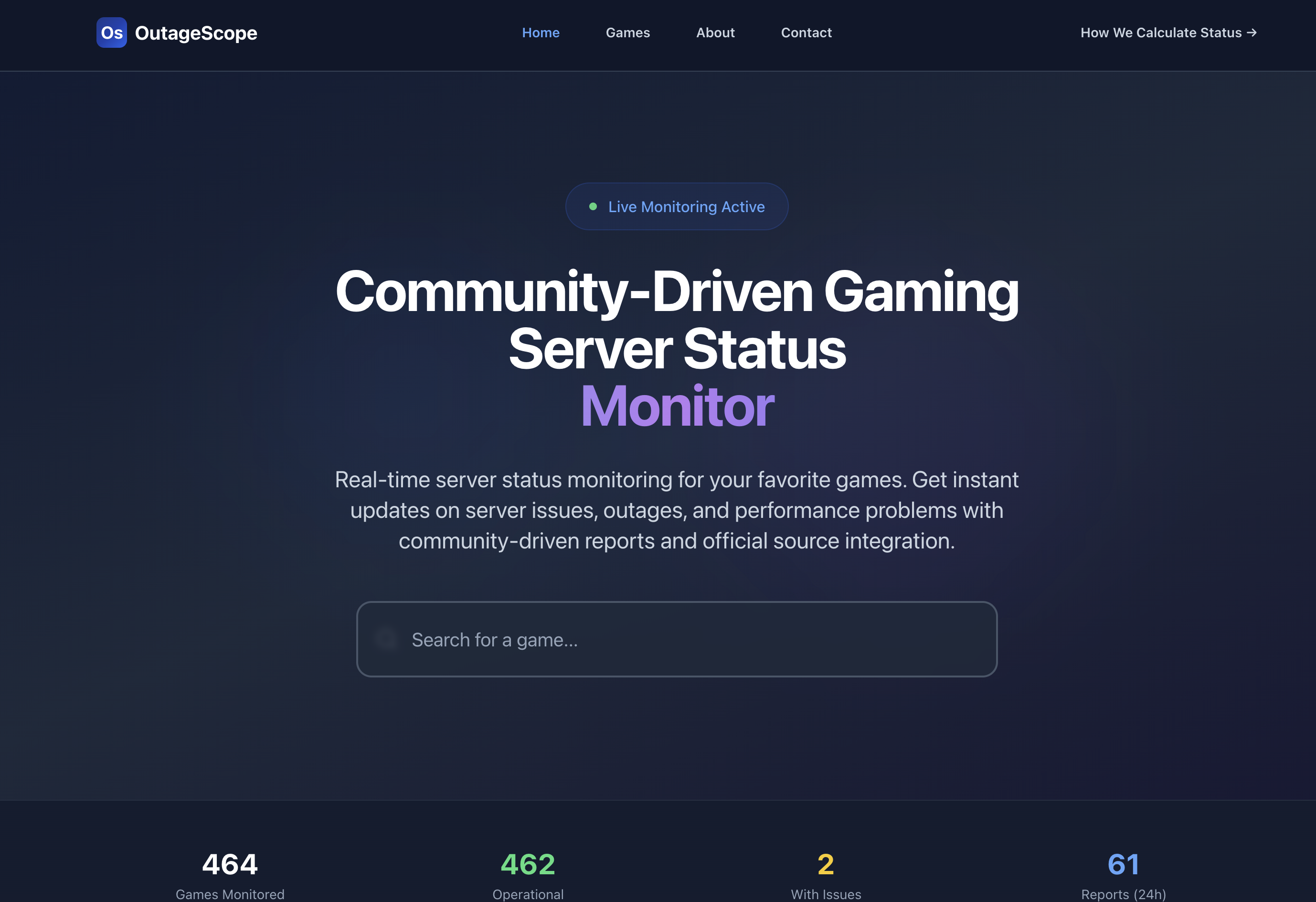
OutageScope positions itself as a gaming server status monitoring platform built to deliver reliable, up-to-date server status information using community reports and time-based detection algorithms.
The core frustration: “Is it me, or is it the game?”
When something breaks in an online game, most players run the same loop:
Restart the game
Restart the router
Check social media
Search Reddit
Look for an official status page (if it exists)
The problem is that this loop wastes time when the issue is widespread—and it still doesn’t produce confidence when the issue is partial. In its mission statement, OutageScope calls out the exact gap it is trying to fill: traditional monitoring can miss issues or provide outdated information, and the community often becomes the best real-time indicator of what’s happening.
OutageScope exists to compress that messy guessing into a single, readable answer: likely operational, maybe unstable, or likely down—right now.
Why “traditional” status signals can feel unreliable
A major reason multiplayer stability is hard to judge is that outages are rarely binary. A game can be “up” while:
matchmaking is broken for one mode,
logins fail in one region,
a particular platform (console/PC) can’t authenticate,
the backend is slow enough that players time out.
OutageScope’s solution is not to rely on a single signal. Instead, it’s built on the premise that player experience at scale is the strongest indicator of real-world stability.
The OutageScope approach: community signal, structured analysis
OutageScope’s system starts where the problem starts: with players. It relies on user reports from gamers worldwide to identify issues quickly.
But the platform’s value is not simply “collect reports.” It’s what happens next.
OutageScope publishes a methodology explaining that it uses a calculation system built on time-based patterns to detect spikes and sustained issues while maintaining transparency about decision-making.
In practice, that means:
Reports are submitted with relevant details and organized into issue categories.
The system analyzes activity using multiple windows—5 minutes, 1 hour, 24 hours—to distinguish sudden spikes from background noise.
It applies report-volume analysis, pattern recognition for mass outages, and breakdowns by category/geo/platform (when available).
This is how OutageScope aims to solve the guesswork: it turns scattered player complaints into a meaningful pattern.
Clear status labels that reflect how outages actually behave
OutageScope also exists because gamers do not want dashboards full of raw metrics when they are trying to play. They want an answer they can act on.
So the platform maps report patterns into defined status levels:
Likely Operational when reports are minimal and no spike patterns appear.
Possible Issues when moderate user-reported issues are detected.
Potential Problems when report volume is low but elevated enough to watch.
Likely Down when there’s strong evidence of a widespread outage (mass reports in a short timeframe).
Monitoring Reports when reports exist but patterns suggest isolated/localized problems.
This isn’t just labeling for the sake of labeling. It acknowledges the reality that many “server issues” are unstable, partial, or region/platform-specific before they become universal.
Confidence levels: honesty about uncertainty
A monitoring platform becomes trustworthy when it doesn’t pretend to be certain all the time.
OutageScope includes confidence levels (High, Medium, Low) and explains what they mean—strong consistent patterns vs. mixed signals vs. insufficient/conflicting data.
That feature exists for a very practical reason: during early incidents, data is often incomplete. Confidence helps players interpret the status as an informed read, not a guarantee.
Real-time visibility across many games
OutageScope also exists to give gamers a “bigger picture” view. The All Games dashboard aggregates server health across hundreds of titles and highlights Trending Issues based on recent report activity.
This matters because gaming outages are sometimes ecosystem-wide: platform services, network disruptions, or shared providers can create waves of instability across multiple games. A single-game status page can’t show that context; an aggregate view can.
Built by someone who felt the pain
Finally, OutageScope exists because its creator did. The About page states it’s built by a solo developer who understands the frustration of server downtime and decided to build a tool to help the community.
And because community-driven platforms can be abused, OutageScope’s legal documentation outlines safeguards like hashed IPs for rate limiting, plus storage/caching components and retention rules for reports and IP hashes.
The takeaway
OutageScope exists to remove the most annoying part of multiplayer problems: not knowing. It turns community experience into structured signals, analyzes those signals across time windows, and surfaces a clear status with confidence—so players can stop guessing, stop wasting time troubleshooting the wrong thing, and decide faster whether to wait or act.