DFW.
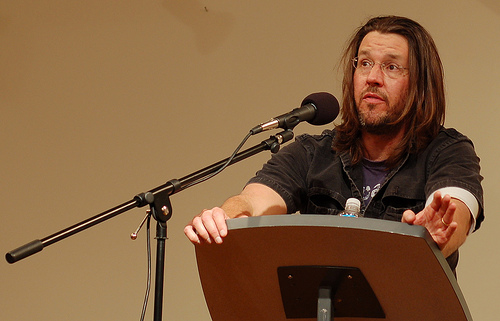
I met David Foster Wallace some six years ago when he was in town promoting Oblivion, a collection of short stories. There was a reading at the First Church in Harvard Square, and the room was packed, humid, and the acoustics were terrible. The thought of church pews melting in a non-Apocalyptic scenario hadn’t occurred to me until that night.
He read “Incarnations of Burned Children” as well as a small portion of “Mr. Squishy,” then answered some questions, only a few of which I remember. He offered an elaboration on irony as he’d defined it in “E Unibus Pluram” (something he was questioned about often), raising an eyebrow and mentioning something about the impossibility of lists when someone asked him to name his ten favorite movies, and offered a hilarious leveling stare to someone who asked if he worked out. (“Well? Do you?”) Another person prefaced his question by thanking Wallace for writing about Boston the way he did. Someone asked him if he was single, and he said he was getting married to that woman—he pointed—over there. There was applause, and that marked the end of the reading. Time to sign books.
I ran out to meet a date. She complained about our lateness. We cited Wallace. She didn’t care. “You don’t know David Foster Wallace,” we countered. We walked down to the Charles, sat on a bench, and talked. A few hours later, we made our way back to the church, and Wallace was still there, signing books, chatting. The line had almost petered out, and I slipped in at the back.
I asked him if he’d be up for an interview. He said maybe, and that I should write him at Pomona. We shared a brief bit of very funny mutual sarcasms. He signed my version of a coffee-stained volume of Chekhov short stories with the note “David Foster Wallace has read most of this.” Then he drew an arrow, curving from the top of the page to the title below.
In any swing of a writer’s work, chances are there will be passages that will make you leap out of your seat, make you want to play with them, jam with them, whatever the verb is. Passages that make you want to be there, too, and you could ape their language a little bit, get at their rotating, multi-tentacled why-this-is-why-it-is a little bit, your inner wall of light bulbs going on the fritz. That’s the nugget necessaire. Wallace had—and fought for—that quality in spades.