Just Doing Your Job? Well, Just Don't!
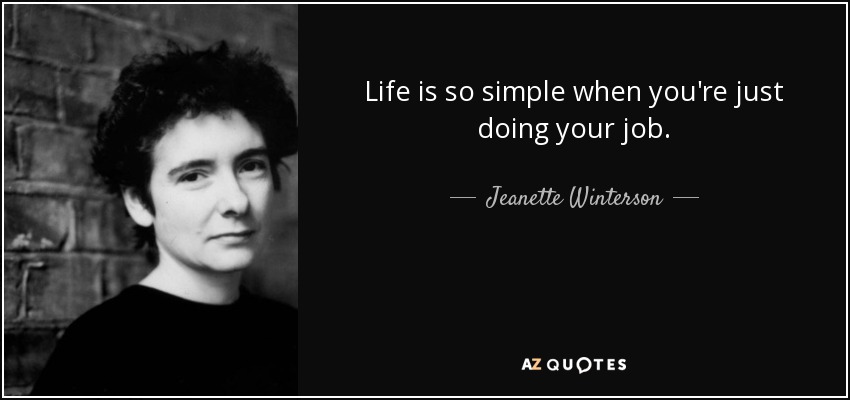
Police brutality is bad, so is corruption. It's terrible that police commit crimes with impunity: they plant evidence, they conspire with other officers to ensure that justice doesn't cross that “thin blue line” and put a cop in jail, they police for profit, etc. Nevertheless, I'm not opposed to police because of brutality or corruption. I don't dislike cops because they often use excessive force or do shady things. I dislike police because of their function. I dislike the whole institution not because certain cops abuse their power, but because the duty itself is unethical. Even if no cop ever “did anything wrong” and corruption and “brutality” were non-existent, I would still oppose policing. Also, I don't have any problem with cops per se. It's not individual officers that I hate, but the institution itself. The problem is that it is impossible to do your job as a cop without doing things that are terribly unethical.
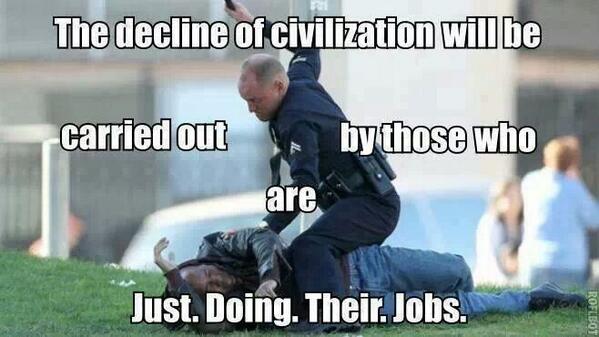
Part of what police do is good, which is why people get so upset when you talk bad about cops or when one says that they are anti-police. Cops respond to accidents and help people, they help protect children from abuse, and try to catch robbers. (Policing is not the best way to go about doing these things, but these are things that cops do.) At the same time, the bulk of what cops do is totally unethical. Cops routinely intimidate peaceful protestors, rob and harass the homeless, break up homeless encampments, “arrest” (a euphemism for “kidnap” in this instance) people for committing victimless crimes like smoking pot, and even “arrest” prostitutes (in spite of the fact that the prostitutes are usually victims being exploited). All these things are just part of the police officers’ duties. The cops aren't being corrupt when they do these things: they are just doing their jobs.

“Just doing my job” is an excuse to behave unethically. It's not politicians that take innocent people at gunpoint for the "crime" of possessing weed. It's cops that do that! It's not legislators that arrest people for feeding the homeless. It's cops that do that too! "Just doing their job" is the mother-fucking problem! When a cop enforces an unjust law, he is morally culpable. It's the cop that has the gun. It's the cop that kidnaps people and enslaves them for marijuana possession. A crime is an act that hurts other people. Smoking pot isn't a crime. Legislators have banned things that are not naturally criminal. By banning vices, they have manufactured crimes. If you arrest someone for doing something that does not in any way harm anyone else, then you are guilty of kidnapping. It isn't the congressmen that throw innocent people in jail. No, that crime is committed by cops who are “just doing their jobs!” If you lock someone in a cage for years because of some victimless “crime,” you are turning that person into a slave. The people that are most morally culpable for the crime of enslaving innocent human beings are the cops who enforce these unjust laws. Hitler may have given the order to kill the Jews, but every Nazi soldier who murdered Jews while “just following orders” is guilty of genocide!
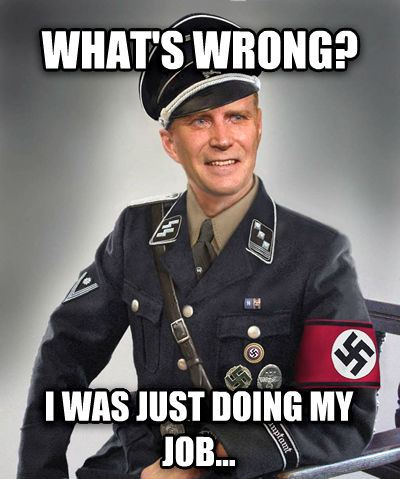
Fuck corrupt cops too, but corruption isn't the problem! I'm ethically opposed to policing because of the cops that are "just doing their job." It's their job to tear up homeless encampments, arrest people for feeding the homeless, arrest pot-smokers, etc. The problem, however, isn't police corruption or excessive force per se, but the whole institution of the police.

The reality is that policing has a terrible history. The roots of modern policing are in runaway slave patrols and private thugs-for-hire organizations like the Pinkertons. The job of slave patrols was to kidnap and enslave people, something that modern police still do. Cops kidnap people to put in prison, where they perform involuntary labor. For-profit prisons and prison guard unions have lobbied against marijuana legalization. People busted for possession spend years as slaves within the prison-industrial complex. Private thugs-for-hire police forces like the Pinkertons used to beat and gun-down striking workers and protestors. Slave patrols expanded in the North into private security forces to shut down strikes. Back in the day, these private police worked for corporations. They used force to shut down protestors. When workers at Carnegie Steel went on strike in 1892, Carnegie Steel hired the Pinkertons to break up the strike. Henry Clay Frick, chairman of Carnegie Steel, ordered the Pinkertons to open fire on the protestors. Fast forward to 2016 and we see the Standing Rock protests against the Dakota Access Pipeline. The police shot protesters with fire hoses in sub-zero weather, blew off a woman's arm, sicked attack dogs on a pregnant woman, etc. Why? Because police are government-run Pinkertons that do the bidding of large corporations! (By the way, in 2017 the Dakota Access Pipeline leaked 210,000 gallons of crude oil on the Native American reservation, proving that the people protesting the pipeline were right to worry that the pipeline would pollute the drinking water of the Native American community that lives there.) When Robert Peel created the first Metropolitan Police Force in London, part of its task was to shut down protests and strikes. Peel’s police were called “Bobbies.”
In America, the Bobbie model of policing was eventually adopted as well, which helped to control civil unrest from protests and strikes. However, even long before that occurred, former-members of runaway slave patrols had taken up jobs in law-enforcement in the South and formed “vigilante justice” groups. The Thirteenth Amendment had abolished slavery, but had a loophole: “Neither slavery nor involuntary servitude, except as a punishment for crime whereof the party shall have been duly convicted, shall exist within the United States…” The United States had had private prisons since the time of the American Revolution. During the Reconstruction Period, after the American Civil War, runaway slave patrols morphed into the KKK and other such groups and infiltrated law-enforcement: they would help capture freed Africans and get them convicted (usually wrongfully convicted) so that they could be re-enslaved. The former slave-owners would then acquire legal slaves through “convict leasing.” In America, Bobbie-style policing fused with runaway slave patrols, and the for-profit prison system created incentives for legislators to ban harmless things like hemp and marijuana in order to justify enslaving people. Convict leasing from private prisons as a form of legal slavery lasted until almost 1930, and wasn’t officially banned until 1941. Although convict leasing is no longer legal, slavery as punishment for crimes is still practiced in America. Inmates are currently being used to fight the fires in California. Private for-profit prisons have contracts with the government that require the government to keep them full, which makes government go out of its way looking for excuses to lock people up. Some police departments have arrest quotas, requiring officers to make a certain number of arrests. And modern policing is still closely linked to its historical roots.
Law-enforcement did not begin with modern policing. Prior to professional police forces, there were constables, watchmen, marshals, and sheriffs. They weren't doing policing-for-profit and the system of law-enforcement was more democratic. They had elected officials and jury nullification as the norm rather than the exception. When groups like Black Lives Matter call for the abolition of police, they aren't calling for chaos, but rather for a change in the fundamental nature of law-enforcement. You can call alternative methods of law-enforcement “policing” if you like, but they are fundamentally different in the estimation of social justice advocates. Most people who oppose modern policing don't want to return to the pre-policing way of doing things. We think that we can do better than that. And we aren't envisioning some nonsensical utopia: we're looking to real world examples of systems that have been tested and proven to work, systems that we think are better than the ones that currently exist in America.
If you are interested in the particular alternative that I propose, check this out:

mate, I am the beginning of joining steemit. I have followed you, when there is time to see my blog community steemit 2018 @dorsuwa
thank you for your kindness, in receiving friendship in steemit
corruption and money speaks the rest of it you made an excellent post many don't dare to write on such topics but you stand out from the league and making a bold statement
you just shared the other perspective of it which we usually don't see often
i was just doing my job that's the lamest excuse of them all
If there is a guilty that the police behave as they do, they are the same people in society. People support police behavior, they are all potential dictators, when they have the opportunity, they decide to impose themselves on others by force. When the police repress, there are many people who do not support it, but there is another group that does. As happened in Catalonia, there was repression, and some citizens agreed, and others did not. When the police do what they do, they may or may not be following orders, but from their point of view, they believe they do the right thing.
From their point of view, yes...but their point of view is objectively wrong, from the perspective of science-based ethics.
@ekklesiagora yes I agree with you. However, I do think there is an aspect of idealism too, in terms of convincing others of how you think things should be. The police uphold and enforce the principles of statuses quo- of big capital, of laws based on outdated morals and a passion for retributive justice instead of restorative justice (think the difference between treating someone with a cocaine addiction instead of throwing them in jail for years) @Vieira there is often a fundamental disconnect between the "laws on the books," enforced by police and the people, the citizens, that figuratively put them in power. Often police can exploit a loophole in their own rules of conduct to act violent toward the people they are sworn to protect and serve, when they could have used little to no force at all. The reason that they often believe that they are "just doing their job" is because they know they have governments to protect their job security and even have juries that meet in private BEFORE deciding to charge police of assault or murder. The committing of evil is often done not by people with malicious intentions to do harm, but by people that have no sense of individual arbitration over the rules they have to follow in order to earn a living or even survive. I feel this video is appropriate
where is the moral conduct of behavior ??
too much of harassment is not sensible at all
its more like forcing are we in a dictatorship regime
started on a great note but your post showed the reality very sad to see this
@ekklesiagora sir
I'm new comer to in this platform...actualy I'm always try learn something with every posts...I think u have wonderful and uncommon idea about our life...smart work sir...
I think police departement is always try control and protect our law....
Cheers~~~~