Programmable DC Power Supply for EV Charging & Battery Testing | 2026 Guide
Introduction
The global electric vehicle (EV) industry has experienced unprecedented growth, with worldwide EV sales exceeding 20 million units in 2025. By 2030, this number is projected to exceed 40 million units. As the core component of electric vehicles, battery systems and charging infrastructure require rigorous quality testing, making programmable DC power supplies indispensable in this field.
A programmable DC power supply is an advanced power source that allows precise digital control of output voltage and current. Unlike traditional fixed-output power supplies, programmable DC power supplies enable engineers to set any voltage and current values within an extremely wide range, while providing real-time monitoring and data recording capabilities.
This article explores the innovative applications of programmable DC power supplies in EV charging and battery testing, analyzing their technical advantages and future development trends.
Part 1: Technical Principles and Core Advantages
1.1 How Programmable DC Power Supplies Work
The core technology of programmable DC power supplies is based on power electronics conversion. AC input is first converted to pulsating DC through a rectifier circuit, then processed through Power Factor Correction (PFC) and DC-DC converters to produce stable DC output.
A typical programmable DC power supply consists of:
Power Conversion Unit: Converts input electrical energy to adjustable DC output, typically using switching power supply technology for high efficiency.
Digital Control Unit: Includes microprocessor, ADC (analog-to-digital converter), and DAC (digital-to-analog converter) for precise parameter control.
Human-Machine Interface: Touch screens, knobs, buttons, or remote control interfaces for parameter setting and data viewing.
Communication Interfaces: RS-232, RS-485, USB, GPIB, or Ethernet interfaces supporting automated test system integration.
1.2 Key Performance Specifications
For EV and battery testing applications, critical specifications include:
|
Parameter |
Entry-Level |
Professional |
|
Voltage Range |
0-750V |
0-1000V |
|
Current Range |
0-100A |
0-500A |
|
Power Range |
30kW |
100kW+ |
|
Voltage Resolution |
10mV |
1mV |
Interfaces |
USB, RS-232 |
Ethernet, CAN |
1.3 Why Choose Programmable DC Power Supplies?
Precision Control: Digital closed-loop control systems ensure output accuracy and stability within ±0.05%.
High Flexibility: Users can freely set any voltage/current curves without hardware changes.
Data Recording: Built-in data acquisition records complete test processes for analysis.
Automation Integration: Standardized interfaces enable seamless integration with test systems.
Energy Recovery: Some models support energy feedback to the grid, significantly reducing test costs.
Part 2: EV Charging Station Testing Applications
2.1 Challenges in Charging Station Testing
Wide Voltage Range: Vehicle battery platforms vary from 200V to 800V, requiring test equipment to cover this range.
High Power Requirements: Fast charging stations can reach 350kW or higher.
Complex Communication Protocols: Stations must comply with CHAdeMO, CCS, GB/T, and other standards.
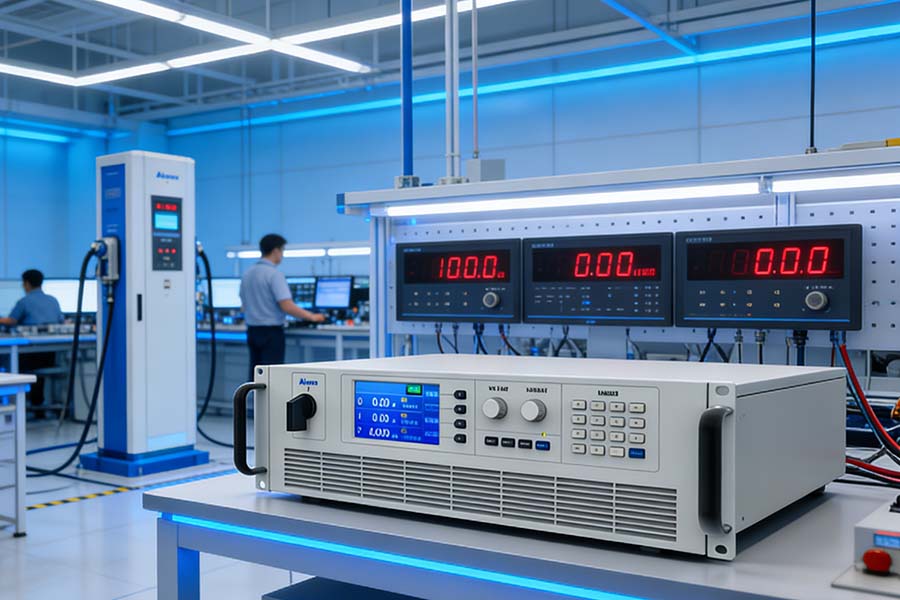
2.2 Programmable DC Power Supply Applications in Charging Station Testing
Core Function Testing
Output Characteristic Testing: Verifies output voltage stability, current limiting, and protection functions under various loads.
Efficiency Testing: Measures conversion efficiency at different power levels.
Standby Power Testing: Evaluates energy consumption during standby mode.
Start/Stop Testing: Simulates various battery conditions to verify station logic.
Protocol Compliance Testing
Modern testing requires verifying communication protocol compliance. Combined with simulation software, programmable DC power supplies can simulate EV battery responses, testing charging station handling of various requests.
Part 3: Battery Pack Testing Applications
3.1 Importance of Battery Testing
Power batteries are the most critical and expensive EV component. Testing is essential for ensuring quality.
Cell Testing: Verifying individual cell capacity, internal resistance, and self-discharge rate.
Module Testing: Testing performance of modules with multiple cells.
Battery Pack Testing: Complete validation including BMS functions and safety protections.
3.2 Role in Battery Testing
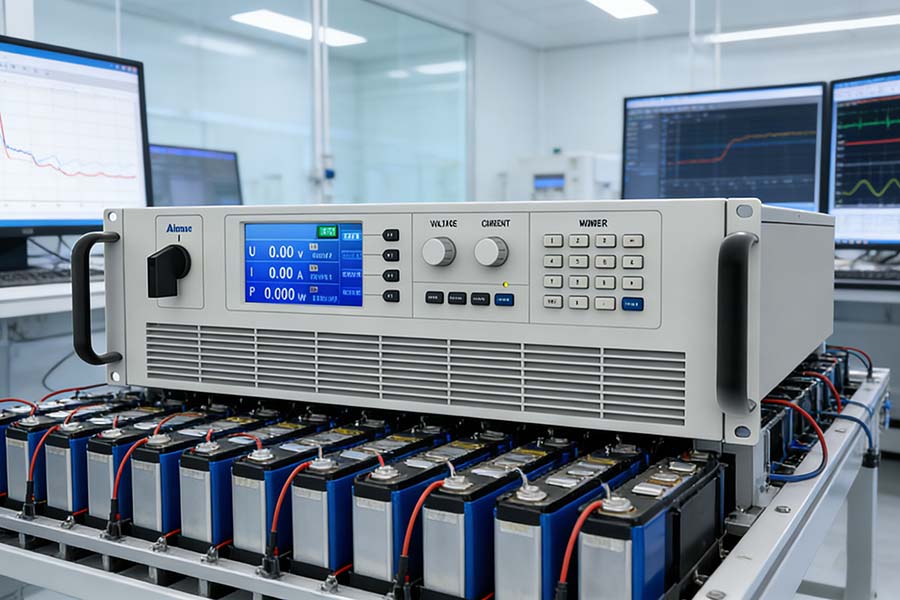
Programmable DC power supplies serve as both "source" and "load" in battery testing.
Charging Tests
Standard Charging: Testing according to standard curves (0.3C, 0.5C, 1C).
Fast Charging: Simulating fast charging scenarios with high voltage/current.
Pulse Charging: Evaluating battery response to different charging strategies.
Discharge Tests
Capacity Testing: Measuring actual usable capacity under standard conditions.
Rate Discharge Testing: Evaluating capacity retention at different discharge rates.
Pulse Discharge Testing: Simulating acceleration and climbing conditions.
Cycle Life Testing: Repeated charge/discharge cycles to evaluate degradation.
3.3 BMS Function Verification
Battery Management Systems (BMS) are the "brain" of power batteries. Programmable DC power supplies play a crucial role in BMS verification:
SOC Estimation Verification: Standardized testing verifies BMS state-of-charge accuracy.
Balancing Function Testing: Evaluates passive and active balancing performance.
Protection Testing: Verifies over-voltage, under-voltage, over-current, over-temperature, and short-circuit protections.
Communication Testing: Simulates BMS-vehicle controller communication.
Part 4: Case Studies
Case Study 1: Battery Pack End-of-Line Testing
A major Chinese EV manufacturer deployed an automated testing system based on programmable DC power supplies.
System Configuration:
• 4 units × 80kW programmable DC power supplies
• Integrated battery pack EOL testing software
• Automatic barcode and fixture recognition
• Data management and traceability system
Results:
• Testing time reduced from 45 minutes to 15 minutes
• 100% test coverage achieved
• Annual labor cost savings of approximately 2 million yuan
Case Study 2: Third-Party Charging Station Testing Platform
A national-level EV testing center established a comprehensive charging station testing platform.
Capabilities:
• Supports GB/T 20234, CHAdeMO, CCS standards
• OBC (On-board Charger) testing capability
• Charging interoperability testing
• Safety and EMC testing environments
Part 5: Selection Guide and Best Practices
5.1 Key Selection Criteria
Voltage and Current Range: Ensure maximum output meets device requirements with 20% margin.
Power Capacity: Consider parallel operation for high-power testing.
Dynamic Response: Verify ability to accurately simulate rapid load changes.
Programming Features: Check support for list programming, sequence programming, and triggering.
Brand and Service: Choose brands with good reputation and comprehensive support.
5.2 Usage Best Practices
Safety First: High voltage and current require strict safety protocols and protective equipment.
Environmental Control: Maintain stable temperature and humidity for reproducible results.
Regular Calibration: Ensure measurement accuracy through periodic calibration.
Data Management: Establish proper test data management for completeness and traceability.
5.3 Industry Trends
Higher Voltage Platforms: With 800V architectures, test equipment must support 1000V or higher.
Greater Power Density: Equipment will continue to shrink in size while increasing power.
Smart Integration: Test equipment will become more intelligent with auto-recognition and auto-reporting.
Energy Recovery: Energy recovery power supplies will become the standard.
Conclusion
Programmable DC power supplies play an increasingly important role in electric vehicle and new energy applications. Whether for charging station validation or comprehensive battery testing, their precise control, flexible programming, and reliable performance make them essential tools for engineers.
As the EV industry continues to grow, testing needs will expand and testing technology will advance. As testing engineers and procurement professionals, we must stay informed about industry trends and select the most suitable testing equipment for high-quality EV development.