Beyond the promoted feed: How steemometer turns visibility into a reusable service
TL;DR: To bring value to the Steem ecosystem, developers and investors should focus ruthlessly on giving creators the ability to exchange visibility for token burning.
In my recent post, Steem promotion as a decentralized competitor to Google AdSense - revisiting Visibility as a Service (VAAS), I wrote about boosting the value of the Steem blockchain (and the STEEM token, hopefully) by giving promoted posts visibility inside and outside of the Steem ecosystem. As discussed there, this was demonstrated by showing a small table of Steem /promoted posts on my Blogger blog.
This concept, which I've been calling "visibility as a service" (VAAS) is something that I played with quite a bit a few years ago. After revisiting the topic for my blogger gadget, I decided to take a second look at that work.
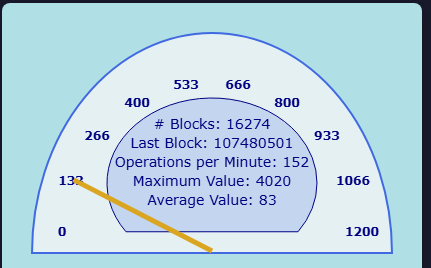
This week, I used free tier accounts with Cline and Antigravity after work to port the code that I had done in Java some years ago over to Javascript and post it as open source code on github with a repo and a demo. I even managed to make a couple small improvements, too.
What I want to highlight in today's post is that the /promoted feed is only the tip of the iceberg. Many other techniques are also possible.
The idea behind the recently ported Steemometer program is simple. Give people real-time information about the blockchain at the same time as displaying links to boosted posts and messages. There's nothing original there. But, what I realized is that things outside the promoted feed can also be boosted.
So, the web based version is the same as the original. It shows information about Steem's transaction activity in the top half of the dashboard, and it displays posts or messages in the bottom half (along with a few simple controls). Let's take a look, however, at all the different ways that things can be boosted to appear in the Steemometer dashboard.
In my opinion, exchanging visibility for burning is a principle that should be front and center for Steem developers and investors.
The /promoted feed
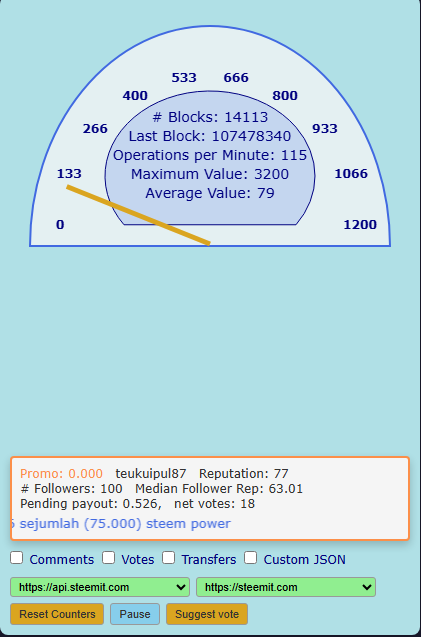
This is the boosting method that's designed into the blockchain, itself, so of course it needs to be included. To get a post in the promoted feed, you just send a transfer to the @null account with this exact format for the post to be boosted: '@author_account/permlink' (no quotes). Unfortunately, the blockchain is very finicky, so it must match that format exactly.
Where the Steemometer program is concerned, posts in the promoted feed will be displayed using a likelihood that's proportionate to promotions that were made any time 24-hours before the program was launched until the present time.
Beneficiary reward burning
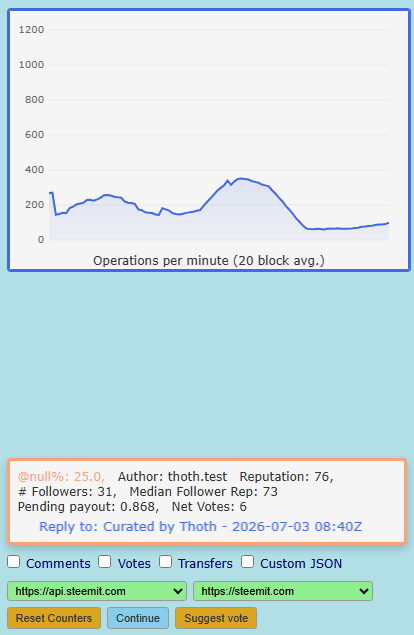
Many Steemizens are already familiar with beneficiary reward burning as a result of using the #burnsteem25 tag. As with the promoted feed, people can use beneficiary reward burning and the burnsteem25 tag in hopes of getting curator visibility.
The Steemometer program takes it beyond just using the #burnsteem25 tag, however. It finds posts and replies with a @null beneficiary and shuffles them into the VAAS section of the dashboard with a likelihood that's based on the beneficiary percentage. A post that burns 50% of rewards should appear twice as often as a post that burns 25%. It even digs up posts that didn't use burnsteem25 and leaves out posts that used the tag but forgot to set a beneficiary.
This can be seen in the image to the left.
Using STEEM or SBD to boost posts before and after payout
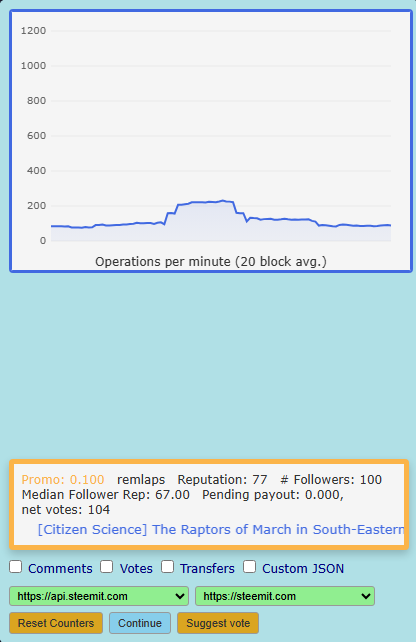
One limitation of the /promoted feed is that it's not possible to use it to increase visibility of posts that already paid out. A second limitation is that posts can only be promoted using SBDs. The requirement for SBDs adds friction to the promotion process at times (like now and probably most of the blockchain's lifetime) when the STEEM price is below the haircut price and SBDs are not being issued.
The Steemometer VAAS routine works around both of these limitations. Regarding the age of a post, it looks for transfers that happen while the program is running (or during the previous 24 hours). Even if the post is older than 7 days, the Steemometer will still display it. Similarly, it works around the second limitation by converting STEEM and SBD into a common unit and shuffling the posts with a frequency that is proportionate to the standard amount.
The image to the right shows a post that paid out in April and was boosted today using STEEM (not SBD).
Broadcast messages / vanity messages
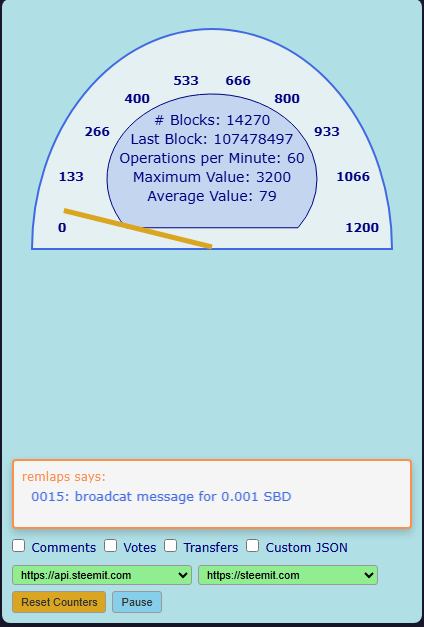 | 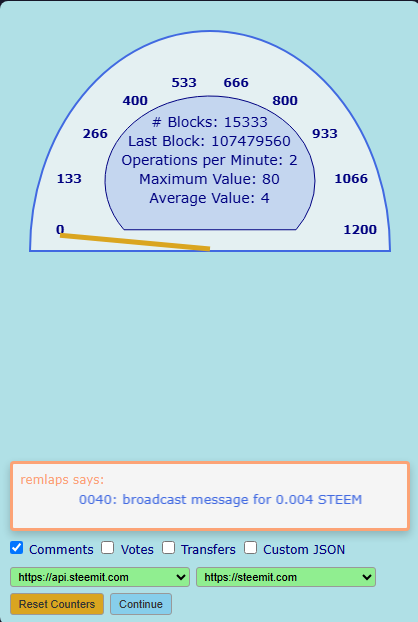 |
It is also possible to use the memo of the @null transaction to send a message to everyone using the program.
As with boosting a post, this message can be sent using SBDs or STEEM, and they will appear in proportion to the burned amount in a standardized unit. STEEM and SBD boosted messages are both shown here.
Additional information
As an aside, here are some other points about the Steemometer app:
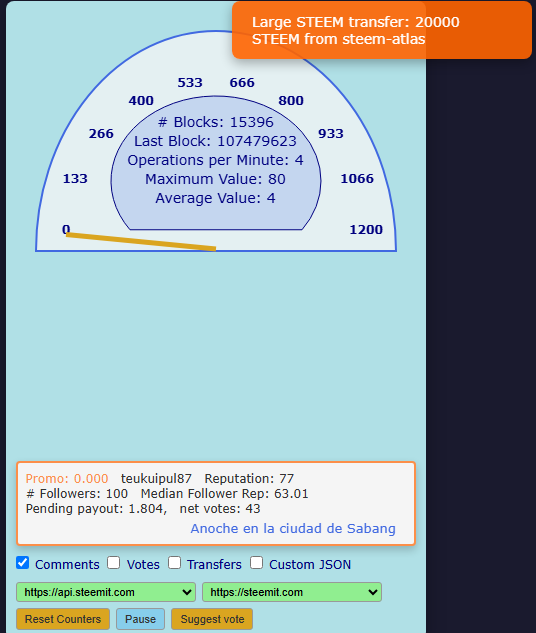
- The tool also gives clickable notifications when a large transfer/power-up/power-down happens (shown to the right). A click on that red box while land on the transaction in SteemWorld.
- The VAAS box is clickable. In the case of boosted posts, it takes you to the post (using the front-end specified in the right-hand dropdown list). In the case of broadcast/vanity messages, it takes you to the sender's account profile.
- Some accounts are filtered out based on low reputations or an absence of a proven follower network.
- The information in the Steemometer is intentionally ephemeral. The point is to gain attention for people's posts, so it operates in a way that aims to maximize user attention for the information that it provides.
- Finally, the likelihood of display for boosted posts and messages decays as time passes. A post that's boosted today has better odds than one that was boosted three days ago with the same amount.
Conclusion
Of course, the Steemometer was always a toy program, and it still is, but this demonstrates some of the possibilities that are available for developers and investors to encourage the exchange of visibility for token burning. By giving content creators new ways to deploy their tokens through techniques like this, Steem's developers can enhance the value of Steem as a social ecosystem.
If Steemit had positioned itself as social-first, instead of blockchain-first way back when, things might have been very different, but we can still take that approach now by making visibility into a top-tier priority.
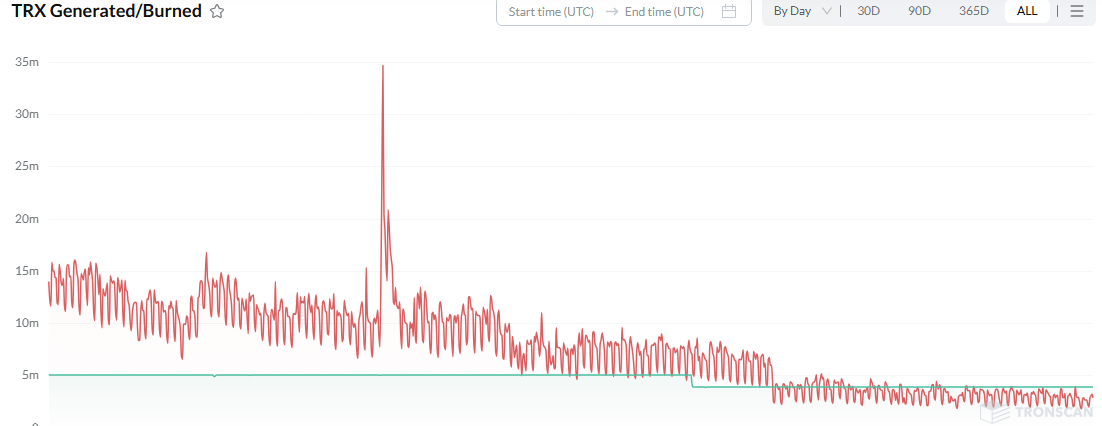
I'm old enough to remember when the price of STEEM was in the $0.30 range and the price of TRX was in the $0.03 range. Today, those magnitudes are reversed. TRX has also outperformed many other cryptocurrencies in the recent years. In retrospect, it seems to me that the TRX growth started, in earnest, when they began burning enough to offset most/all of the token production. Of course, there's no easy way to know if one caused the other, but it's hard to ignore a 10X value gain when the rest of the market has been treading water or sinking.
Every new application that lets users exchange visibility for burning creates another mechanism for demand growth and supply reduction. The important idea isn't the Steemometer itself. It's that visibility can become a reusable service that any application can offer - inside and outside the Steem ecosystem. This is a near green-field opportunity that Steem developers and investors should be working hard to plow and harvest.