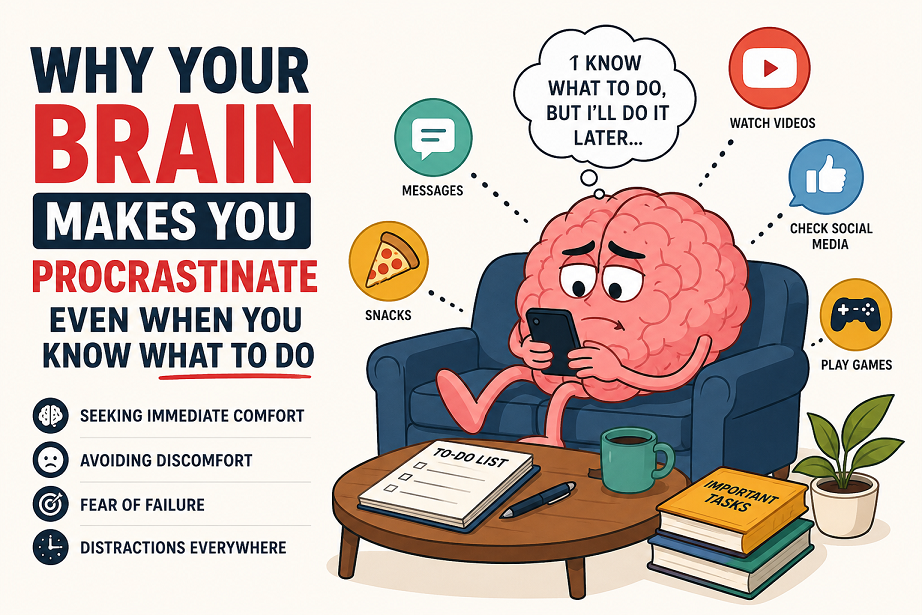
Why Your Brain Makes You Procrastinate Even When You Know What To Do
Why Your Brain Makes You Procrastinate Even When You Know What To Do
Have you ever had an important task in front of you, knowing exactly what needs to be done, but somehow you find yourself watching videos, checking social media, cleaning your room, or doing anything except the thing that actually matters?
You are not alone.
Millions of people experience procrastination every day. The strange thing is that procrastination is rarely caused by laziness.
Your brain is often trying to protect you.
But sometimes that protection becomes the very thing stopping you from achieving your goals.
The Brain Prefers Immediate Comfort
The human brain evolved to focus on immediate rewards.
Thousands of years ago, survival depended on dealing with problems that existed right now:
finding food
avoiding danger
protecting yourself
Modern problems are different.
Your brain must now think about:
studying for an exam next month
saving money for the future
exercising for long-term health
building a career
The problem is that the brain naturally prefers:
“Feel good now”
over:
“Benefit later.”
This is why scrolling through your phone feels easier than starting a difficult project.
Difficult Tasks Create Mental Resistance
When a task feels complicated, boring, uncertain, or overwhelming, the brain interprets it as discomfort.
Your brain then searches for an escape.
Examples:
You need to write an article.
Your brain says:
“Maybe check your messages first.”
You need to exercise.
Your brain says:
“Start tomorrow.”
You need to learn a new skill.
Your brain says:
“You are too busy today.”
The brain is not always looking for success.
Sometimes it is looking for comfort.
The Fear Behind Procrastination
Many people procrastinate because of hidden fears:
Fear of failure
“If I don't start, I cannot fail.”
Fear of criticism
“What if people don't like my work?”
Fear of not being perfect
“If it cannot be perfect, why begin?”
This creates a cycle:
Fear → Delay → Stress → More fear → More delay
How To Trick Your Brain Back
The solution is not simply “work harder.”
The solution is to make the brain feel safe.
- Start extremely small
Instead of:
“I must write a 2,000-word article.”
Tell yourself:
“I will write one paragraph.”
The hardest part is usually starting.
- Remove distractions
Your environment controls your behavior.
If your phone is beside you, your brain knows an easy reward is available.
Create distance between yourself and distractions.
- Use the 5-minute rule
Tell yourself:
“I only need to work for five minutes.”
Often, once you begin, your brain enters a state of momentum.
- Reward progress
The brain learns through rewards.
Celebrate completing small steps.
Small victories create motivation.
The Truth About Procrastination
Procrastination is not simply a time-management problem.
It is often an emotional-management problem.
People delay tasks because they want to avoid uncomfortable feelings.
Understanding your brain gives you power over your habits.
The goal is not to fight your brain.
The goal is to train it.
Question For Discussion
What is the biggest reason you procrastinate?
Lack of motivation?
Fear of failure?
Too many distractions?
Feeling overwhelmed?
Share your experience below. Your answer may help someone else.