Cryptocurrency Market Cycles and Their Relationship With Global Economic Trends
Cryptocurrency is among the most rapidly expanding technologies in the financial market. The future price of cryptocurrencies like Bitcoin and Ethereum is a primary reason why many people purchase them. But the cryptocurrency market is not always trending in one direction. Often the prices increase significantly in a short period of time and sometimes they decline abruptly. These cycles are known as cryptocurrency market cycles. It is crucial to understand these market cycles, as it aids investors in making sound choices and steering clear of needless losses. Simultaneously, these cycles are linked closely with the global economic trends and thus the cryptocurrency market is a component of the wider financial system.
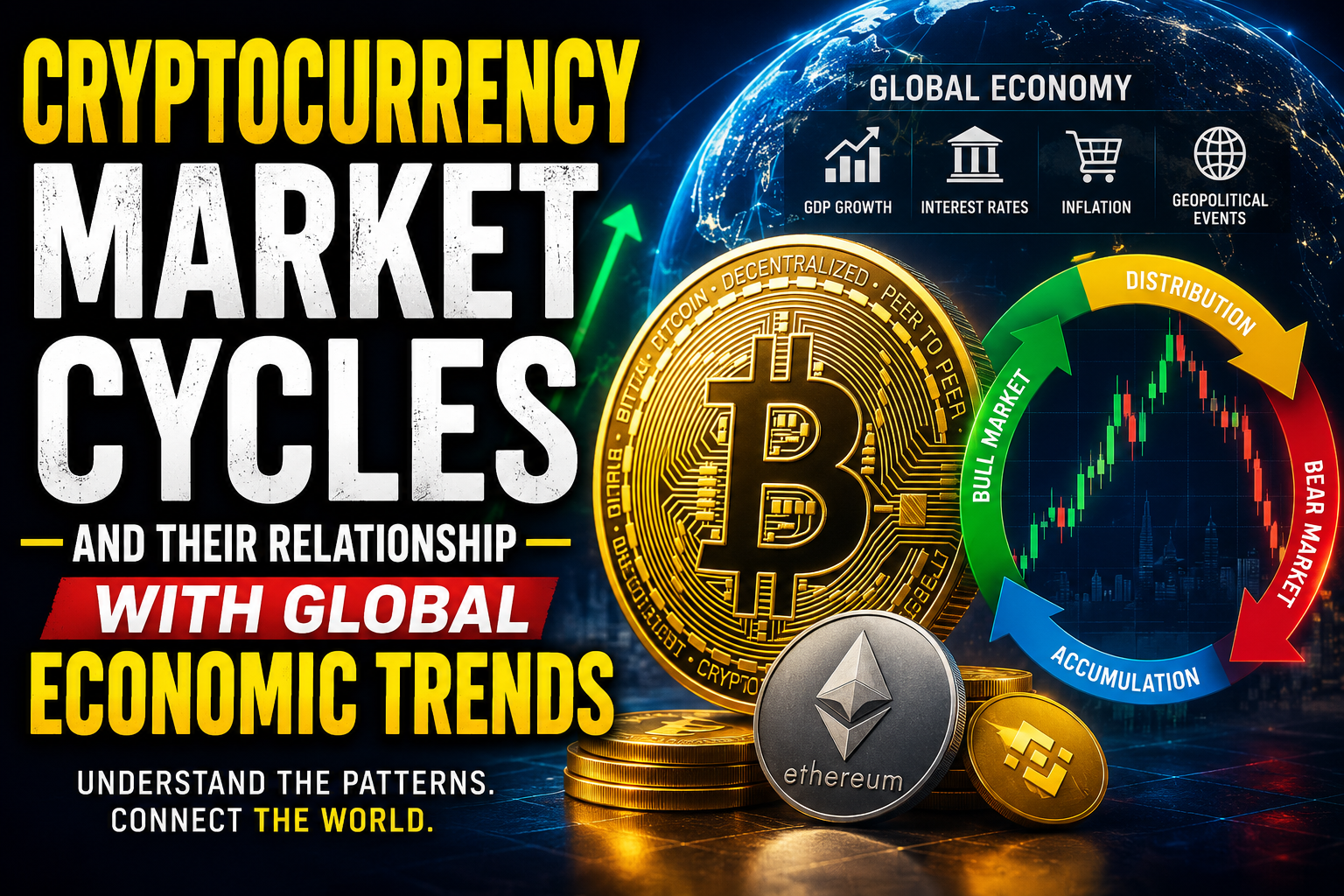
A cryptocurrency market cycle refers to the fluctuation in price levels from a low to a high level and then back to a low level. There are typically 4 stages in a complete cycle. Low prices and expert traders start buying make the first stage of accumulation. The second phase is the uptrend or bull market, during which prices keep climbing as people start to take an interest in cryptocurrencies. The third step is distribution; many investors begin to sell their assets once they have made profits. The final part of the cycle is the downtrend, or bear market, where prices dip due to more sellers than buyers. Once more, another cycle begins after a while and the process repeats.
Investors' actions are one of the primary drivers of these market cycles. The human factor is an important component in the cryptocurrency market. When prices are going up, then many people get excited and think that prices are going up forever. This results in an increase in cryptocurrency trading and further rising prices. However, when prices start to drop, there's a lot more fear. A lot of investors sell their investments to prevent further losses. The fear creates further falls in prices. I have come to know that it is important for an investor to have control over their emotions; when he is making investment decisions, it is the emotions that are likely to cause him to make wrong decisions.
Another factor that affects cryptocurrency market cycles is the global economy. The world economy involves the financial transactions of various countries in the world. When the global economy is strong, people have typically more money to invest. Firms do better, jobs are created, and investors are more inclined to take risks. Such times are when cryptocurrencies tend to attract more investments and therefore have higher prices. However, when the world economy slows down due to inflation, recession or uncertainty about the economy, many investors will shift their funds to safer investments rather than cryptocurrencies. This results in a drop in the price of cryptocurrencies.
Inflation also plays a crucial role in the relationship between cryptocurrency market cycles. Inflation occurs when prices of goods and services increase over time, thereby decreasing the value of money. These people think that Bitcoin can help people preserve their wealth in times of high inflation rates, since Bitcoin is limited in supply. But not consistently does this belief lead to higher prices. Central banks typically raise interest rates in order to curb spending when inflation gets too high. Higher interest rates increase the cost of borrowing and can lead to a reduction in the desire to take risks on expensive assets and save. Consequently, during these times, cryptocurrency prices can drop.
The government policies also impact the cycles of cryptocurrencies. Numerous governments have established laws for both the regulation of cryptocurrency trading and taxation.There are laws put in place by many governments regarding cryptocurrency control and taxation, as well as the security of financial transactions. Favorable regulation that fosters innovation can raise investor confidence and attract more investors. However, if there are strict regulations or government bans, it can lead to uncertainty and diminish investments. When the government decides on something, it is not always a slow process and investors respond to the news in a significant way, thereby leading to sudden price fluctuations. Governments should develop a balance between regulation and protection of investors, not to the detriment of technological innovation.
Cryptocurrency market cycles also include technology and innovation. The cryptocurrency sector is still in the process of developing new technologies, including decentralized finance (DeFi), smart contracts, blockchain enhancements, and digital payment systems. These advancements are the attraction of fresh players to the blockchain space and boost the demand for cryptocurrencies. Investors tend to value up when they think that new technology will enhance the future of cryptocurrency. However, security-related issues like hacking, fraud, or technical issues can make investors unsure about the investment and its value, leading to a drop in price. So the development of technology can have a positive or negative impact on a market cycle.
The international events also affect the cryptocurrency markets significantly. Major events like pandemics, wars, political disputes, banking crises, and international trade issues can alter investor behavior. In times of uncertainty, some investors might choose to invest in cryptocurrencies instead of more traditional investment vehicles such as government bonds or gold. The nature of these reactions could lead to sharp price fluctuations in the crypto market. I think that people who want to invest should be following the news not only in the crypto industry but also big events happening around the world as they can affect the market.
To summarise, the cryptocurrency market cycles are repeatable and normal due to the investment actions of investors, economic situations, government policies, technological advancements, and world events. These cycles are closely linked with the international economic trends and indicate that cryptocurrency is no longer an isolated entity from the world economy. Investors who can grasp these relationships are better able to make decisions on rational and not emotional grounds. With the rising surge of cryptocurrency, I think it is vital that students, researchers, investors or financial professionals become knowledgeable about the market cycles, and global economics trends. With a proper knowledge, investment risks can be minimized and long-term investment success can be enhanced.
https://x.com/i/status/2076307331885731979
https://coinmarketcap.com/currencies/pussfi/
https://x.com/i/status/2074764888006709589
Note:-
Regards, @adeljose