The Relationship Between Cryptocurrency Regulation and Financial Innovation
In recent years, the cryptocurrency has been one of the most significant financial breakthroughs. It has revolutionized people's thinking about money, banking, and digital transactions. Bitcoin and Ethereum are cryptocurrencies that let people transfer and exchange cash without full reliance upon standard banks. With the advancement of cryptocurrency, many governments and financial institutions are now focusing on it. This has opened up a significant debate on the interplay between crypto regulation and financial innovation.
Cryptocurrency regulation is the set of rules, laws, and policies established by the government to regulate the use of cryptocurrency. Financial innovation, in contrast, is the development of new financial products, services, technologies and systems that enhance how money is managed. These concepts are quite closely related since the way they are designed can either foster innovation or hinder it.
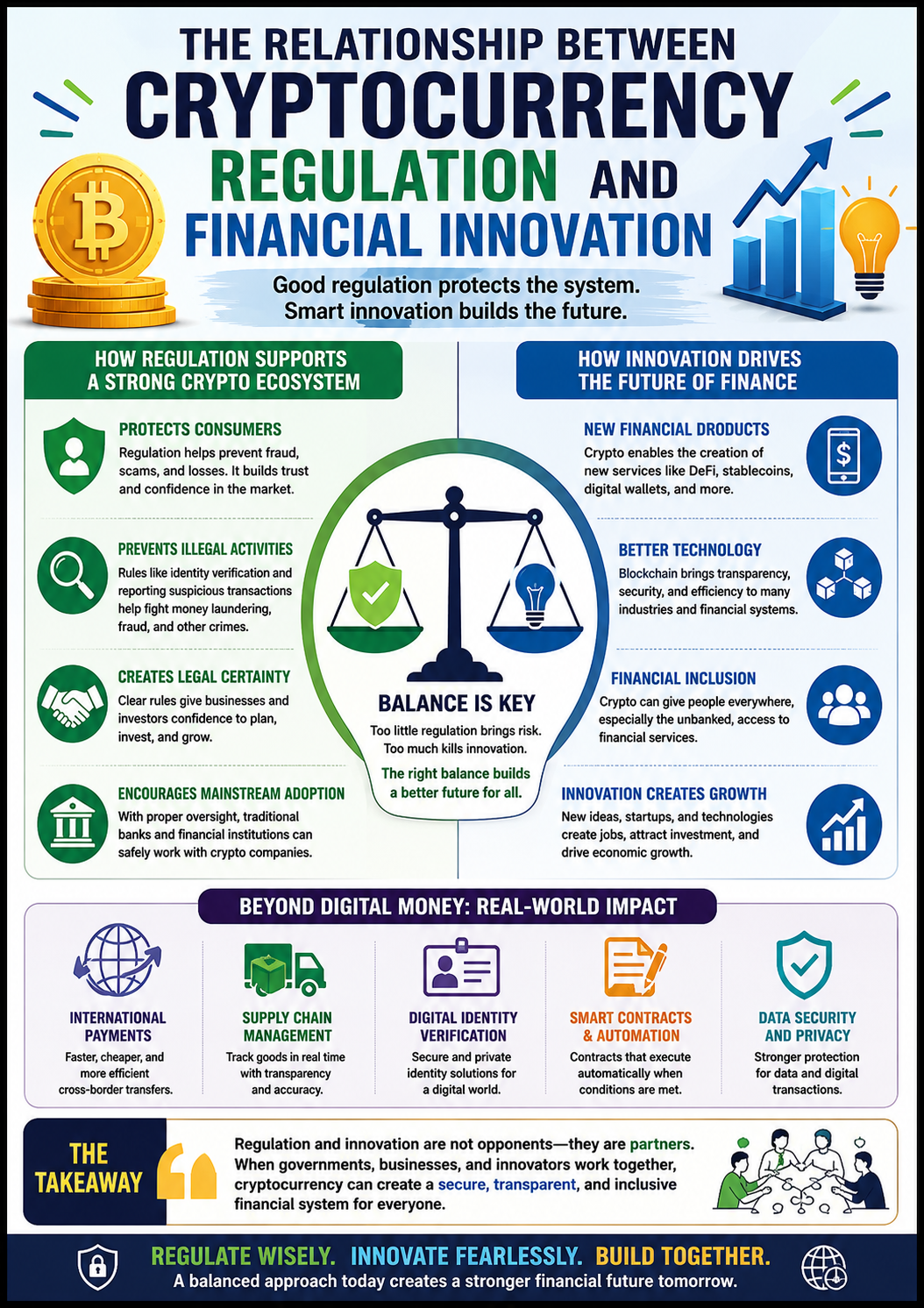
I think regulation is needed since it helps to build trust in the cryptocurrency sector. While plenty of people are fascinated with the digital currencies, they do not like the idea of facing fraud, hacking, scams, and financial losses. If not well regulated, criminals may exploit investors and users. Clear rules by the governments make investors feel safer investing in cryptocurrency projects. This greater confidence can lead to greater involvement in the digital economy by both people and organisations.
One upside to cryptocurrency regulation is consumer protection. A multitude of cryptocurrency exchanges and investment sites have failed, leaving investors with significant losses.Over the years, numerous crypto exchanges and investment platforms have gone under, resulting in substantial losses for investors. Other projects have been established and then after the investors have given them money, the project owner simply moves the money out of the account. These situations can be averted by establishing a set of regulations that sets standards for companies before they can be allowed to operate. This safeguards users and contributes to strengthening the financial system.
The regulation can also deter illegal activities. Cryptocurrencies can be used anywhere in the world and some criminals have tried to use digital currencies for money laundering, fraud, and other illegal purposes. Many governments have passed and enforced laws that mandate that cryptocurrency business must verify the identity of their clients and report any suspicious activity. These efforts will help minimize criminal operations, while at the same time giving legitimate users the advantages of cryptocurrency technology.
But too much regulation can sometimes pose a problem for innovation. When entrepreneurs and developers are free to try something new, they are more likely to develop new financial innovations. Regulations that are too onerous will cause startups to have difficulties getting on the market. Nonetheless, small businesses may not be able to comply with complex legal needs. This means that innovative ideas might not be brought to the public.
I believe a balance is very key. Governments must be able to shield consumers but not to prohibit new solutions from being developed. Cryptocurrency is still an emerging market and stringent regulations may stifle technological advances. A lot of innovations that were accepted started as experiments. Some of these innovations may never have happened if starting from day one there had been stricter regulations.
The other important role of regulation in fostering innovation is to deliver legal certainty. Unpredictable legal climates may deter investors and businesses from investing in certain industries. Regulations that clearly define what is permitted and what is not will allow businesses to plan long-term with increased confidence. This stability creates investment opportunities, spurs research and fosters new financial technologies.
Regulations for cryptocurrencies could, as well, foster a partnership among the conventional monetary institutions and the digital asset businesses. Regulatory issues are one of the reasons why banks, payment providers and investment companies are reluctant to engage in business with cryptocurrency enterprises. Regulations that are clear can defer uncertainty and provide opportunity for partnerships. Such collaborations can result in innovative financial solutions, such as blockchain-based banking services.
Financial innovation in cryptocurrency isn't limited to digital currency. The blockchain technology used by numerous cryptocurrencies can have various applications, including international payments, supply chain management, digital identity verification, and smart contracts. A smart contract is a digital contract that automatically runs based on certain conditions being met. These technologies can be developed safely with proper regulation and be adopted in various industries.
Various nations have taken a different stance on regulating cryptocurrencies. In some countries, it has been possible to develop enabling environments for innovations keeping track of them. Others have placed tight limits because of worries over monetary security and client safety. The effectiveness of these approaches frequently relies on the knowledge and understanding of the market and technology on the part of regulators.
The interplay of financial innovation and regulation of cryptocurrencies will remain dynamic. Governments will have to adapt their policies to the new challenges and opportunities that are emerging due to technological developments. To effect the development of secure, transparent, and innovative systems, the regulatory framework, business, and investors, and technology developers must collaborate.
To sum up, there is a linkage between cryptocurrency regulation and financial innovation. Regulation serves to safeguard consumers, limit unlawful behavior and enhance consumer confidence in digital financial systems. Meanwhile, innovation fuels the creation of new technologies and financial services which potentially have the capacity to enhance people's lives. I think the best way is balanced regulation that safeguards users, and lets creativity and technological developments thrive. Achieving this equilibrium allows cryptocurrencies to play a more significant role in the evolution of a more modern, efficient, and inclusive financial system.
Note:-
You have been sharing the same promotional links in all your recent posts.
Regards, @adeljose
0.00 SBD,
0.14 STEEM,
0.14 SP
https://x.com/i/status/2038990196453126632
https://coinmarketcap.com/currencies/pussfi
https://x.com/i/status/2036134193260802100